
Unbiased headlines. Facts, not spin.
Every story is an unbiased news briefing written from 110+ sources across the spectrum — sources linked so you can verify it yourself.
 finance
Notable (6/10)
Event date: September 2, 2026
finance
Notable (6/10)
Event date: September 2, 2026
Nokia Rejoins Euro Stoxx 50 Today as Volkswagen Is Dropped After 27% Stock Slide
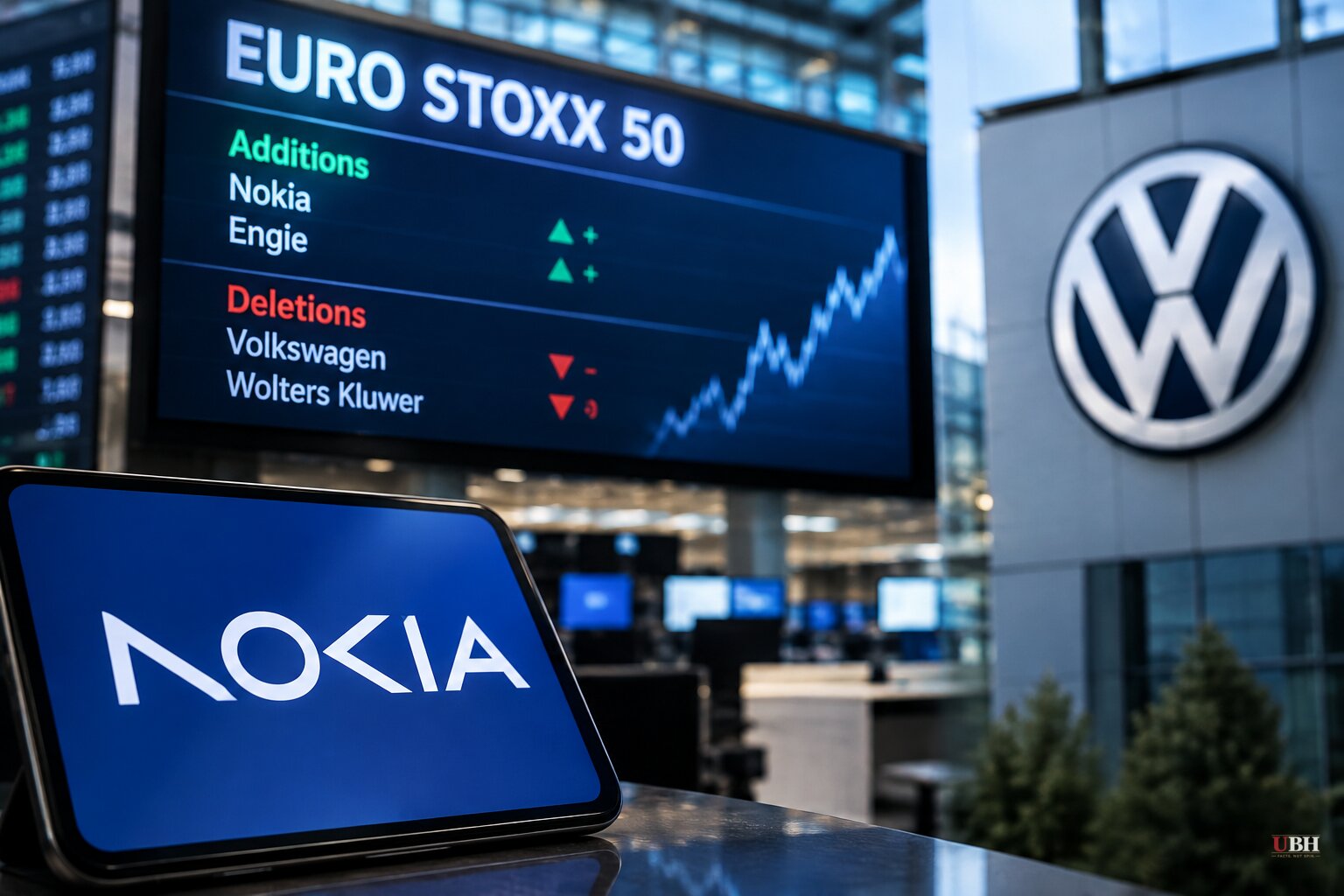
Since Stoxx Ltd. announced its annual Euro Stoxx 50 review on September 1, the changes take effect before today's market open, September 21. Nokia Oyj and Engie SA are in. Volkswagen AG and Wolters Kluwer NV are out.
A Finnish network equipment maker riding the AI infrastructure boom replaces Europe's largest automaker, which is bleeding market share to China and shutting down factories.
Nokia's Comeback
Nokia is walking back into the benchmark exactly one year after Stoxx dropped it. The stock has more than doubled over the past 12 months and is up roughly 53% to 55% year-to-date, according to BigGo Finance and Oninvest. Shares hit a near-18-year high in June before pulling back some, per Global Banking and Finance.
The driver is Nokia's pivot toward fiber-optic gear for AI data centers. In the second quarter, the company reported revenue of €4.815 billion, up 8% year over year, with earnings per share of €0.07, according to BigGo Finance. Its Network Infrastructure division grew 12%, and sales to cloud and AI customers more than doubled from a year earlier.
Nokia is also stacking partnerships: Google Cloud on AI agents for autonomous network management, and Vodafone on AI-driven network slicing that dynamically allocates bandwidth, according to Zacks reporting cited by Oninvest.
JPMorgan kept an Overweight rating on Nokia in August with a $21 price target, implying more than 100% upside from the stock's last close, BigGo Finance reported. Of 23 analysts tracked by Koyfin, 12 rate it a buy, four say hold, and seven recommend selling. Retail sentiment on Stocktwits stayed bearish even as message volume about the stock jumped 150% in a single session and 642% over the past month.
Volkswagen's Exit
Volkswagen's shares have fallen nearly 27% so far this year, according to Reuters reporting carried by Global Banking and Finance. The company is mid-restructuring, and the damage isn't cosmetic.
German business publication WirtschaftsWoche reported supervisory board documents proposing to end production at four plants between 2031 and 2034: Emden and Zwickau in 2031, Hanover in 2032, and Neckarsulm in 2034, according to Traders Union. Volkswagen has declined to comment on the contents of those documents.
Being dropped from an index doesn't change a company's balance sheet, but it does matter for capital flows. Funds that track the Euro Stoxx 50 have to sell VW shares and buy Nokia and Engie shares to stay aligned with the benchmark, a mechanical effect Oninvest and Stocktwits both flagged. With BMW, Mercedes-Benz, and Ferrari the only automakers left in the index, Volkswagen's removal leaves Europe's biggest carmaker outside the room where passive money automatically flows.
The Bigger Fight: China
This isn't just one company's stock chart. The European Union's auto sector supports about 13 million jobs and roughly 7% of EU GDP, according to the European Commission, cited by The Epoch Times. The Commission's March 2025 Automotive Action Plan called the industry's situation a "critical turning point," warning of high costs, supply-chain exposure, and the risk of falling behind in batteries, software, and autonomous driving.
Renault Group said in July that the industry faces "a significant competitiveness gap" against China in both development speed and production costs, pointing to lower Asian labor costs and China's aggressive vertical integration of battery supply chains. BMW's 2025 annual report struck a similar note, saying growing Chinese competition is making long-term planning harder.
Pierre-Olivier Essig, founder of independent research firm AIR Ltd, told The Epoch Times that Europe should double down on segments where it still has an edge, like luxury and performance vehicles, while governments consider tax relief on labor and profits to keep manufacturing at home. Essig warned that without that support, Europe risks becoming "a service-only country" that has effectively surrendered its industrial base.
Subsidies keep jobs and capacity onshore in the short run, but that cuts against the basic market discipline this index shuffle is enforcing. Volkswagen isn't losing ground because Brussels under-subsidized it. It's losing ground because it bet heavily on an expensive EV transition, got squeezed by Chinese manufacturers on cost, and is now paying for it with plant closures and a falling stock price. Propping that up with taxpayer money doesn't fix the underlying cost problem; it just delays the reckoning at public expense.
What's Next
The European Commission's own analysis found China has overtaken the EU as the world's largest car exporter, a shift Brussels has been sounding alarms about since last year. Whether Volkswagen's four planned plant closures actually happen as WirtschaftsWoche's leaked documents describe, starting with Emden and Zwickau in 2031, remains something the company has not confirmed on the record. The Euro Stoxx 50's broader sibling, the Stoxx 600, also picks up Greek banks Piraeus Bank and Alpha Bank today, after Greek equities were reclassified to developed-market status in April, while JD Sports Fashion, Thule Group, and Fraport AG drop out.
Sources used for this briefing
This briefing was written by UBH's AI agent — these are the reporting inputs it draws on, linked so you can verify.


