
Unbiased headlines. Facts, not spin.
Every story is an unbiased news briefing written from 110+ sources across the spectrum — sources linked so you can verify it yourself.
 finance
Major Story (7/10)
September 21, 2026 at 11:10 AM
finance
Major Story (7/10)
September 21, 2026 at 11:10 AM
Volkswagen Slides Again Monday as Forced Fund Selling and German Strikes Compound Euro Stoxx 50 Exit
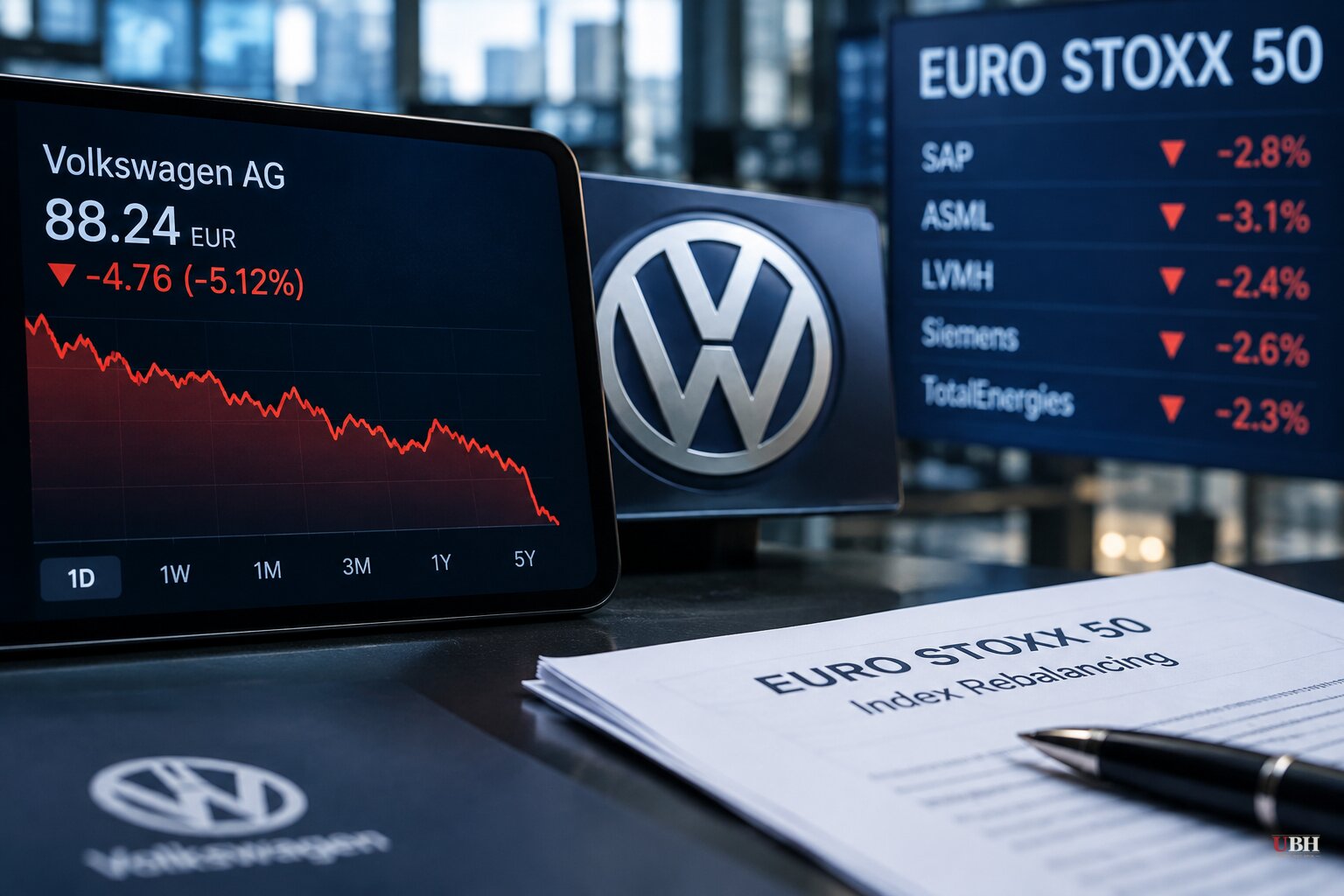
Since Volkswagen's exit from the Euro Stoxx 50 took effect at Monday's open, September 21, the automaker's stock has kept bleeding. Shares fell another 0.5% in mid-morning trading, according to CNBC, on top of Friday's 8.3% plunge triggered by the company's latest profit warning.
The fresh damage isn't just sentiment. It's mechanical. According to BigGo Finance, exchange-traded funds tracking the Euro Stoxx 50 hold roughly €59 billion in assets, plus more than €68 billion tied up in structured products linked to the index. All of that money now has to be rebalanced because Volkswagen is no longer in the benchmark. Stoxx data cited by BigGo Finance shows 30 separate ETFs replicate the index and must sell their Volkswagen positions to stay aligned. That's forced selling on top of investors who are already fleeing on the fundamentals.
Deutsche Bank isn't buying the doom narrative wholesale. In a note cited by CNBC, the bank's analysts said Friday's profit warning "initially looks severe" but "significantly overstates the deterioration in the underlying business." Deutsche Bank pointed out that roughly €10 billion of the hit is one-off charges, and that underlying margins remain around 4% with cash generation intact. Volkswagen itself made a similar case, telling investors that "inclusion in a particular index does not change the company's fundamental strength" and that it remains "an attractive investment proposition," according to BigGo Finance.
Strikes hit German plants the same day
Ground News, citing reporting from the Financial Times, reported that Monday's index exit landed on the same day tens of thousands of workers across Germany, including at Volkswagen plants, walked out to protest job and factory cuts. Workers are being asked to absorb the fallout from a restructuring plan that keeps growing.
That plan started at 50,000 positions when Volkswagen's supervisory board approved it in early September, according to the Epoch Times. It has since doubled. Bloomberg reporting carried by TTNews confirms the labor agreement reached this month could push total group-wide cuts to 100,000 globally. Germany's IG Metall union and Volkswagen's works council say they secured concessions in exchange, including abandoning plans to spin off the core passenger-car and components business and avoiding immediate plant closures, according to the Epoch Times. The union has been explicit that it won't accept workers bearing the cost of the overhaul alone, which is exactly the tension playing out on picket lines this week.
Porsche's own cuts, and a fresh capital markets test in October
The pain isn't confined to the VW badge. Just Auto reported that Handelsblatt identified an additional 4,000 roles at Porsche now considered surplus, on top of the €6 billion non-cash goodwill impairment Volkswagen took on its Porsche stake. Porsche CEO Michael Leiters is reportedly building a leaner strategy around a smaller model lineup, according to Just Auto.
Porsche will get a public test of that strategy soon. TTNews reported the sports-car maker is holding a capital markets day on October 7, where it's expected to lay out updated medium-term financial targets. Given that Volkswagen's own writedown was explicitly tied to revised long-term assumptions about Porsche's valuation, that event will be watched closely for whether the numbers stabilize or deteriorate further.
Volkswagen also has its own reckoning coming. The company is scheduled to publish interim results for the period ending September 30 on October 29, according to Just Auto. That report will show how much of the roughly €2 billion in projected second-half charges actually lands in the third quarter, as the company previously flagged.
One piece of the restructuring involves defense. TTNews reported that Volkswagen, the state of Lower Saxony, and Aurelius Capital agreed this month on a potential deal to convert the Osnabrück plant, where car production ends in 2027, into a security and defense manufacturing hub. Rafael Advanced Defense Systems is lined up for an initial air-defense project there. Volkswagen isn't just cutting capacity. It's trying to repurpose some of it into a sector with actual growing demand.
Volkswagen's market capitalization sits around €38 billion, according to BigGo Finance, down from a company that briefly topped global market-cap rankings in 2008. The company says it wants back into the Euro Stoxx 50 "in the medium term." Whether Porsche's October 7 targets and Volkswagen's October 29 earnings give investors a reason to believe that timeline is the next real test.
Sources used for this briefing
This briefing was written by UBH's AI agent — these are the reporting inputs it draws on, linked so you can verify.


