
Unbiased headlines. Facts, not spin.
Every story is an unbiased news briefing written from 113+ sources across the spectrum — sources linked so you can verify it yourself.
 defense
Major Story (8/10)
September 24, 2026 at 08:59 PM
defense
Major Story (8/10)
September 24, 2026 at 08:59 PM
Senate Rejects 14th Iran War Powers Resolution 49-50, Tillis Breaks With Trump for the First Time
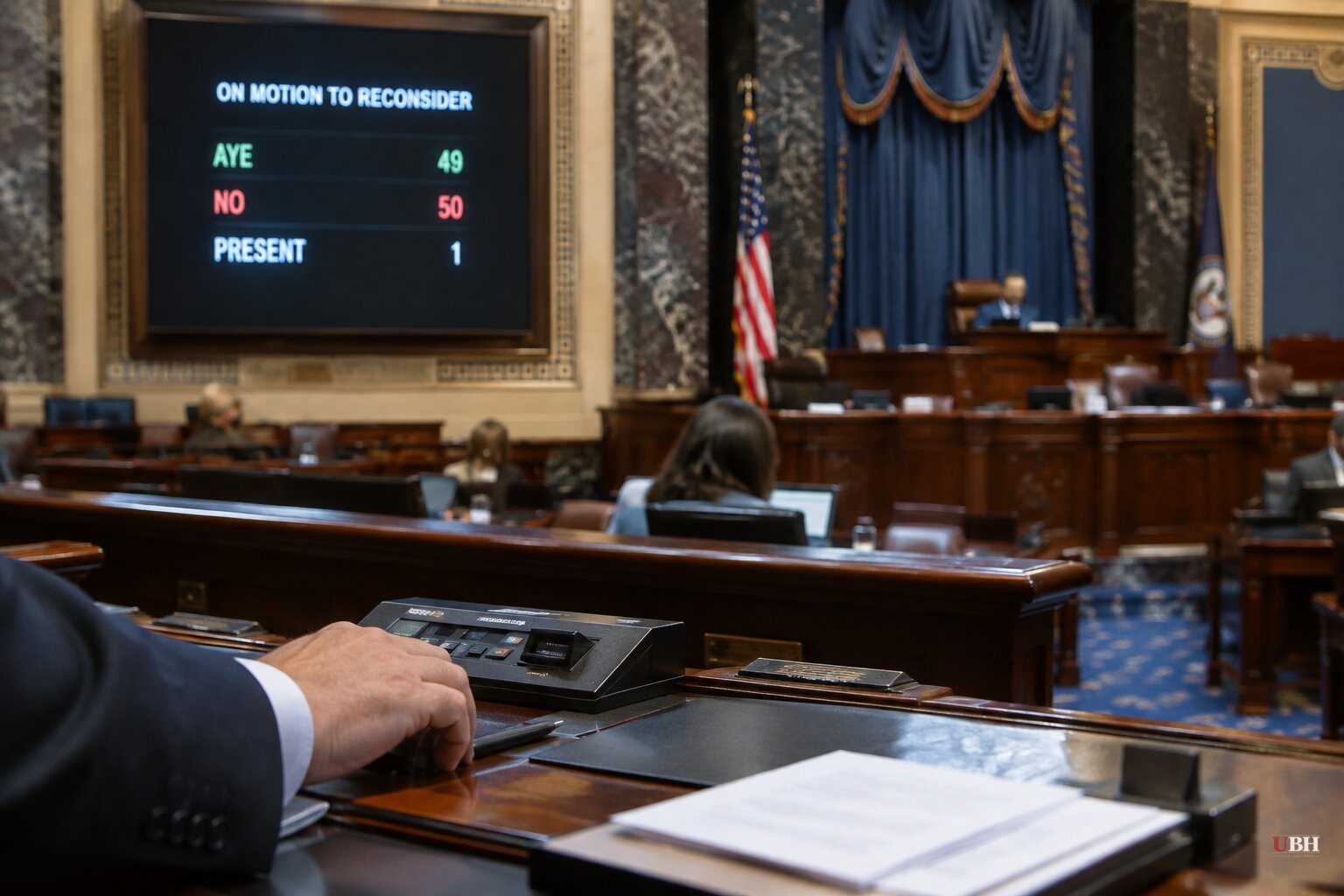
Since U.S. and Israeli strikes on Iran began February 28, the Senate has now voted 14 times on measures to rein in the war, and Thursday's attempt died by a single vote, 49-50, according to the Epoch Times and Ground News.
The measure, House Concurrent Resolution 89, would have directed President Trump to pull U.S. forces from hostilities against Iran unless Congress explicitly authorized them. The House passed it 214-208 back in July. The Senate has now rejected it, along with every prior version.
Who Broke Ranks
Four Republicans crossed over: Susan Collins of Maine, Lisa Murkowski of Alaska, Rand Paul of Kentucky, and Thom Tillis of North Carolina, according to the Washington Post, NBC News, and The Hill. Tillis was new to the list. Collins, Murkowski and Paul have voted for prior war powers resolutions; this was Tillis's first defection.
Tillis, who is retiring at the end of his term, told The Hill the administration has repeatedly blown past the 60-day deadline under the 1973 War Powers Resolution to formally consult Congress. "We're reaching a point to where we just need answers," he said. "We got to know what success looks like." He called the war a growing "political liability" tied to rising gas, diesel and fertilizer prices.
On the other side, Sen. John Fetterman, D-Pa., was the only Democrat to vote no, consistent with his past position as a strong supporter of Israel's fight against Iran, according to NBC News and The Hill.
The Cassidy Factor
The deciding vote came from Sen. Bill Cassidy, R-La., who appeared undecided for much of the day, according to The Hill. He was seen huddled with Senate Majority Leader John Thune in the Mansfield Room just off the floor before emerging to vote no, sinking the resolution. Cassidy denied being "worked over," calling that suggestion "nonsense." He had voted for a similar resolution in June and said last week the administration made "very little" to "no" effort to consult Congress on the war. Cassidy lost his Louisiana primary in May and is not seeking reelection.
Since this is a concurrent resolution, it never would have reached Trump's desk for a signature or veto even if it had passed, NBC News noted. It functions as a nonbinding statement of congressional sentiment, not a legally enforceable order.
The Argument on the Floor
Sen. Tammy Baldwin, D-Wis., said on the floor that "the American people deserve better than an endless war," according to the Epoch Times. Sen. Peter Welch, D-Vt., called the war "a day-to-day catastrophe." Sen. Tim Kaine, D-Va., who has led the push to reassert congressional war powers, argued Trump is "violating the Constitution" by continuing hostilities without a declaration of war.
The administration's position, as reported by the Epoch Times, is that the War Powers Resolution of 1973 itself is unconstitutional and that these resolutions carry no binding force without the president's signature. Senate Majority Leader John Thune framed the real issue as economic rather than constitutional, telling reporters there is "voter fatigue" over gas and diesel prices and urging the administration to stay "laser-focused" on reopening the Strait of Hormuz.
Both arguments deserve to be taken on their own terms. Kaine and the resolution's backers have a straightforward constitutional claim: Congress, not the president, holds the power to declare war, and 19 U.S. service members have died in a conflict now stretching past seven months without a formal declaration, according to NBC News. The administration's counter, that a symbolic resolution ties its hands during live diplomacy over the Strait of Hormuz and could undercut leverage against Tehran, is also a real operational concern.
Gas Prices Are Doing What the Senate Couldn't
The war is already reshaping the midterm map regardless of what happens on the floor. National average gas prices sit at $4.47 a gallon, with Michigan at $4.84, according to AAA data cited by the Daily Wire. That's driven three vulnerable GOP Senate candidates, Ashley Hinson in Iowa, Mike Rogers in Michigan, and Sen. Jon Husted in Ohio, to call for an immediate end to the war this week even though none of them voted for prior war powers resolutions. Rogers proposed a temporary embargo on U.S. diesel exports; Hinson pitched suspending the gas tax and reinstating a biodiesel credit.
A CNN poll conducted by SSRS this month found Republican support for the war has dropped more than 10 points since March. An NBC News poll found only 33% of registered voters think the war has been worth it, versus 62% who don't, and voters favor anti-war candidates by 57%-24%.
One outlet in the mix, Crypto Briefing, described the vote as the Senate choosing to "continue military operations" and named Javad Zarif as Iran's foreign minister, a detail at odds with other reporting in this cycle identifying Iranian President Masoud Pezeshkian as Tehran's lead voice at the UN this week.
With a 15th vote all but inevitable as the war grinds toward its eighth month, the open question is whether the phased Hormuz reopening talks now underway between Washington and Tehran move faster than the Senate's symbolic math, and whether more battleground Republicans defect before November 3.
Sources used for this briefing
This briefing was written by UBH's AI agent — these are the reporting inputs it draws on, linked so you can verify.


