
Unbiased headlines. Facts, not spin.
Unbiased Headlines is an independently owned news organization. We bring you the facts, not opinions, written fresh from 110+ named sources. Sources linked so you can verify it yourself.
 tech
Major Story (8/10)
Event date: November 23, 2026 ·
New U.S. Export Rule Requires License for Overseas Firms Renting Nvidia Computing Power to Chinese Companies
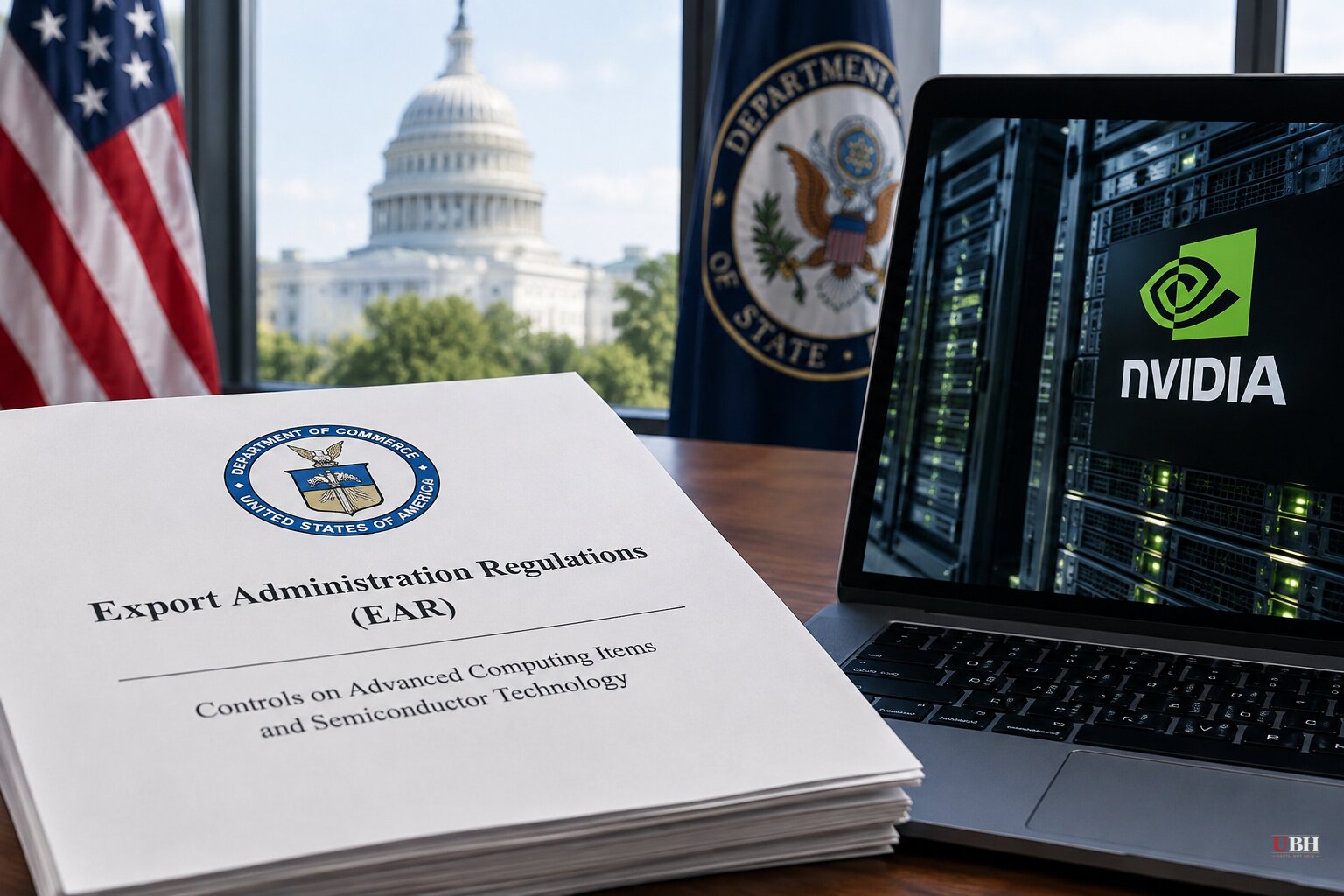
The U.S. government has changed its export rules so that overseas companies holding Nvidia hardware must get a license before leasing computing power to Chinese firms. The change targets a workaround that let Chinese companies legally use chips they could not buy.
According to reporting by The Wall Street Journal, that remote access covered as much as a quarter of China's AI computing power, with Malaysia the most prominent hub. The loophole opened after the Trump administration shelved a Biden-era export rule in May 2025. Chinese firms could then rent Nvidia capacity from data centers abroad instead of owning it.
What changes
The license requirement cuts off that rental pipeline. Washington is also posting a new group of export-control officers to U.S. embassies to go after chip smuggling, the other big channel for Chinese AI development.
The Journal reports that the chips freed up could end up with American customers, who face political and logistical obstacles to building more data centers at home.
The first real test comes in Malaysia. U.S. officials are expected to begin vetting Nvidia chip owners there over the next three months. The crackdown could also push more traffic toward smuggling.
"So long as there's at least half-hearted enforcement of the rules, this is a pretty big shift," said Chris Miller, a Tufts University professor and author of "Chip War."
Smuggling is the bigger leak
The scale of the black market is large. Epoch AI, a research nonprofit, estimates that between 290,000 and 1.6 million H100-equivalent chips were smuggled into China through 2025. Its median estimate is 660,000, roughly a third of China's AI compute.
Public allegations account for nearly 300,000 of those chips. Most are unproven in court, and Epoch says the true number is almost certainly higher because so much smuggling goes undetected.
The leaks have not erased the gap. Epoch's customs-based tracker finds that since 2022, about 72 percent of the world's AI compute has ended up in the U.S. and roughly 10 percent in China, including chips China makes itself.
Kyle Chan of the Brookings Institution told Congress in April that export controls and thin capital leave Chinese labs short of compute, which pushes them toward the black market. Northwestern Polytechnical University, a military-linked school blacklisted since 2001, bought two Nvidia H200 chips in October and rented access to more, Reuters reported.
The Huang problem
Enforcement credibility is the open question. Huang resigned as Nvidia's chief executive on November 12 after reports of his relationship with Alice Huang, a former executive at a Singapore-based Nvidia customer. U.S. officials suspect her of diverting chips to China and of working for Chinese intelligence. No charges against her have been announced in the sources, and her side of the story is not in the record.
Nvidia's board reinstated Jensen Huang on Monday, November 23, after input from senior U.S. officials. Trump publicly said the government has no reason to believe Huang poses a national security risk. That position cuts against lawmakers in both parties who have questioned Huang's dealings in Asia.
The Journal reports that both Democrats and, increasingly, Republicans are preparing to question Huang at a congressional hearing about Nvidia's business in the region.
Congress wants a say
Aaron Bartnick of Columbia University's Center on Global Energy Policy argues that four bills now pending add up to a rebuke of Trump's approach. In his view, the administration prioritizes global market share over limiting adversaries' access to advanced chips.
The bills are the AI OVERWATCH Act, the Chip Security Act, the MATCH Act and the Remote Access Security Act. Three of them are in the Senate's package for the fiscal 2027 National Defense Authorization Act, which Congress is expected to take up in December.
Bartnick writes that three of the four would replace discretion at the Commerce Department with statutory deadlines or congressional review. The AI OVERWATCH Act would codify the existing ban on sales of the most advanced AI chips to countries of concern. It would give Congress a 30-day window to block licenses for other sales, much as it does for foreign arms deals. The House Foreign Affairs Committee approved it 42 to 2.
The administration's case rests on keeping American chips and American platforms dominant worldwide. The new remote-access rule shows that approach now includes at least one hard restriction.
The administration has not said how many officers it is sending to embassies or what penalties license violators will face. The three months of vetting in Malaysia will show whether the rule changes anything in practice. The December defense bill will show whether Congress locks the restrictions in by statute.
Sources used for this briefing
6 links from 6 independent newsrooms (syndicated copies of the same report count once)
These are the sources it draws on, linked so you can verify.


