
Unbiased headlines. Facts, not spin.
Unbiased Headlines is an independently owned news organization. We bring you the facts, not opinions, written fresh from 110+ named sources. Sources linked so you can verify it yourself.
 tech
Major Story (8/10)
Microsoft Links Six Hacking Groups to ARTEX AI Tool, Including China's Salt Typhoon; Spy-Agency Breach Not Attributed
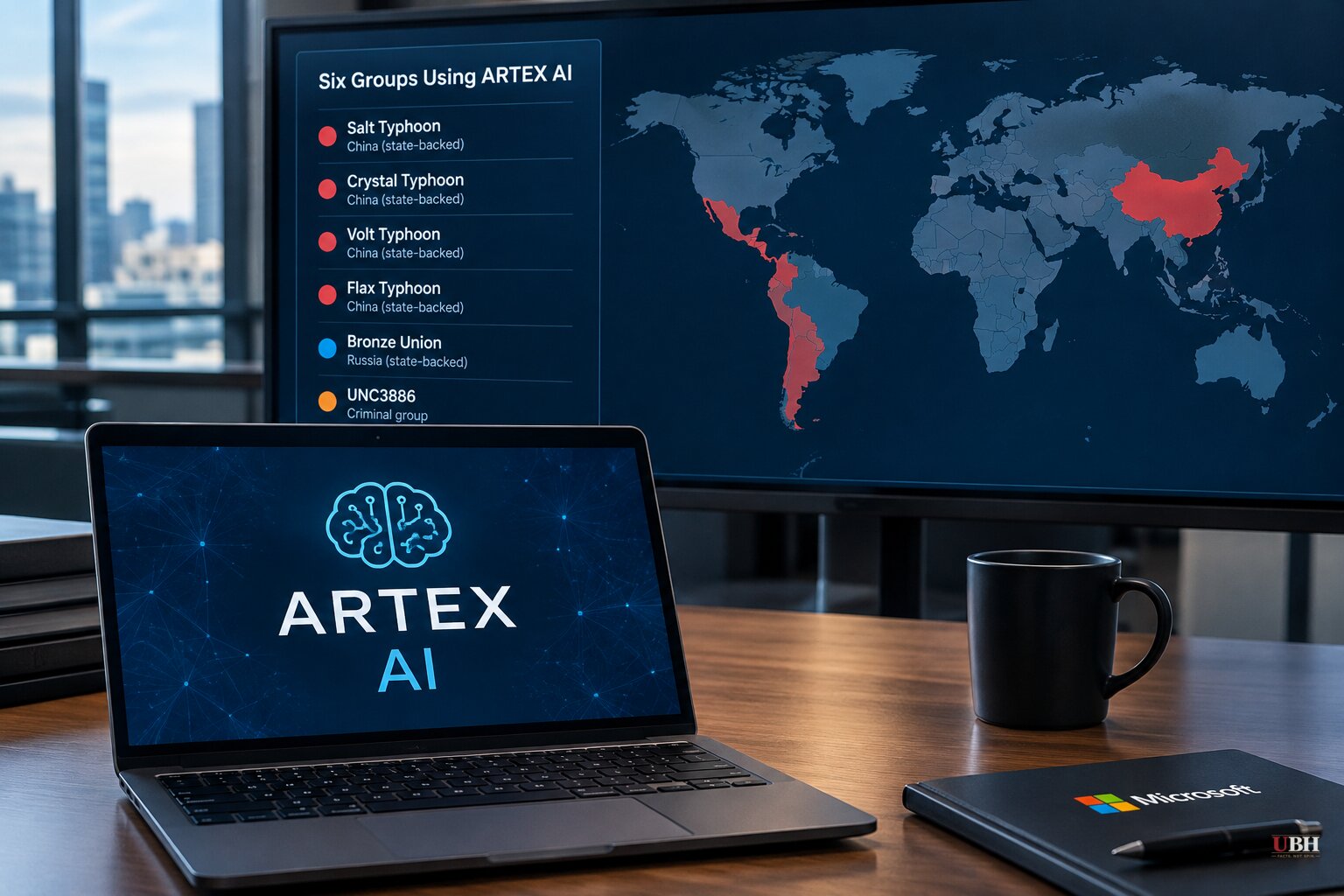
Twelve days after the FBI's Nov. 13 FLASH advisory on the ARTEX AI hacking framework, Microsoft said today, Nov. 25, that at least six state-backed and financially motivated groups now use it, including China's Salt Typhoon and Crystal Typhoon.
The other four are Storm-0940, Storm-3358, Onyx Sleet and Pearl Sleet. Microsoft Threat Intelligence said the groups use ARTEX for network reconnaissance, credential attacks and web application exploitation. The company said it has observed this as of November.
What Microsoft says ARTEX does
Microsoft says an operator sets the scope and targets. ARTEX then uses AI agents to set goals, plan each stage, run attack tools, map discovered systems and report back. Depending on the target's defenses, it can go from reconnaissance to persistent, privileged access "in a matter of minutes," Microsoft said.
The company was blunt about what the tool is not. "ARTEX does not introduce new attack techniques; it uses common, pre-existing penetration testing tools and techniques," Microsoft wrote.
The giveaway is behavior, not fingerprints. Attackers can and do change IP addresses and user-agent strings to dodge simple signature blocking, Microsoft said. The durable signal is a burst of varied requests in a short window, with retries and next-stage moves at machine speed. By default, ARTEX does not try to hide its activity.
Microsoft said recent campaigns abused ARTEX to search public repositories for exposed secrets, enable supply chain compromise and scan internet-facing systems. It named the ConnectWise supply-chain attack and attacks on South Korean and Japanese financial institutions. The FBI had earlier put the South Korean theft at personal data on roughly 67,000 people and the ConnectWise compromise at access to more than 2,250 downstream tenants.
The intelligence-agency intrusion
The Microsoft report landed one day after the disclosure, on Tuesday, Nov. 24, of an intrusion into a shared analysis system used by the CIA, the Office of the Director of National Intelligence and the National Geospatial-Intelligence Agency. The New York Times and Nextgov/FCW reported that ARTEX was allegedly used.
The Associated Press reported that the system analyzes publicly available information. Nextgov/FCW reported that it draws on social media, commercial satellite imagery and data brokers. A source told Nextgov/FCW the breach has been resolved and classified systems were unaffected.
Microsoft did not attribute that breach to any of the six groups. The identity of the intruders and the AI model they used remain unconfirmed. What, if anything, was taken is also unclear.
The New York Times separately reported that the NSA suffered a similar breach exposing unclassified information. That is the Times' own reporting, and the agency has not been quoted confirming it in these accounts.
The administration's position
The White House has taken a different line on the wave of recent outages. The NSA's classified internal network was restored Nov. 20 after several days of disruption. Director of National Intelligence Jay Clayton attributed that outage to software patching, not a cyberattack. The Trump administration has denied the outages were part of a coordinated attack.
Those statements concern the outages. The reported ARTEX intrusions involve unclassified or open-source systems, and no source here connects the two.
The FBI is also investigating an apparent breach of the National Crime Information Center, the nationwide database of criminal histories, missing persons, fugitives and stolen property. Investigators have not publicly said how far the intrusion went or whether records were stolen.
Where the tool came from
A developer going by Autumn-27 published ARTEX on GitHub in July. It is written in Go and was built for authorized penetration testing. The developer pulled the repository in October after reports of malicious use, but community forks, archived copies and localized versions persist. At least one Chinese company now sells commercial access to a version.
The FBI advisory said ARTEX ships with no model of its own. It connects to outside models, including Claude and GPT, along with DeepSeek, GLM, Grok and Kimi. The FBI said attacker-controlled instances mostly use Chinese models, led by the DeepSeek Flash family. It said those models show no observable guardrails when a request is framed as penetration testing. Researchers counted more than 1,600 publicly exposed ARTEX consoles in early November.
Salt Typhoon is the group U.S. agencies believe was behind the 2024 breach of at least nine telecommunications companies. Microsoft's naming of Salt Typhoon and Crystal Typhoon is its own attribution, based on its telemetry.
What defenders are told
Microsoft's advice is to cut internet-facing exposure, lock down credentials and secrets, and limit lateral movement. It also recommends customers turn on automatic attack disruption in Microsoft Defender XDR, one of its own products. The FBI's advisory urged similar steps, plus monitoring application activity and preserving evidence of suspected intrusions.
The open questions are concrete. Neither Microsoft nor any named U.S. official has said who was behind the intelligence-system intrusion, which model drove it, or what data left the network. The FBI has not said how far the NCIC intrusion reached.
Sources used for this briefing
7 links from 7 independent newsrooms (syndicated copies of the same report count once)
These are the sources it draws on, linked so you can verify.


