
Unbiased headlines. Facts, not spin.
Unbiased Headlines is an independently owned news organization. We bring you the facts, not opinions, written fresh from 110+ named sources. Sources linked so you can verify it yourself.
 tech
Breaking / Critical (9/10)
FCC Authorizes SpaceX to Deploy Up to 1 Million Starmind Data Center Satellites
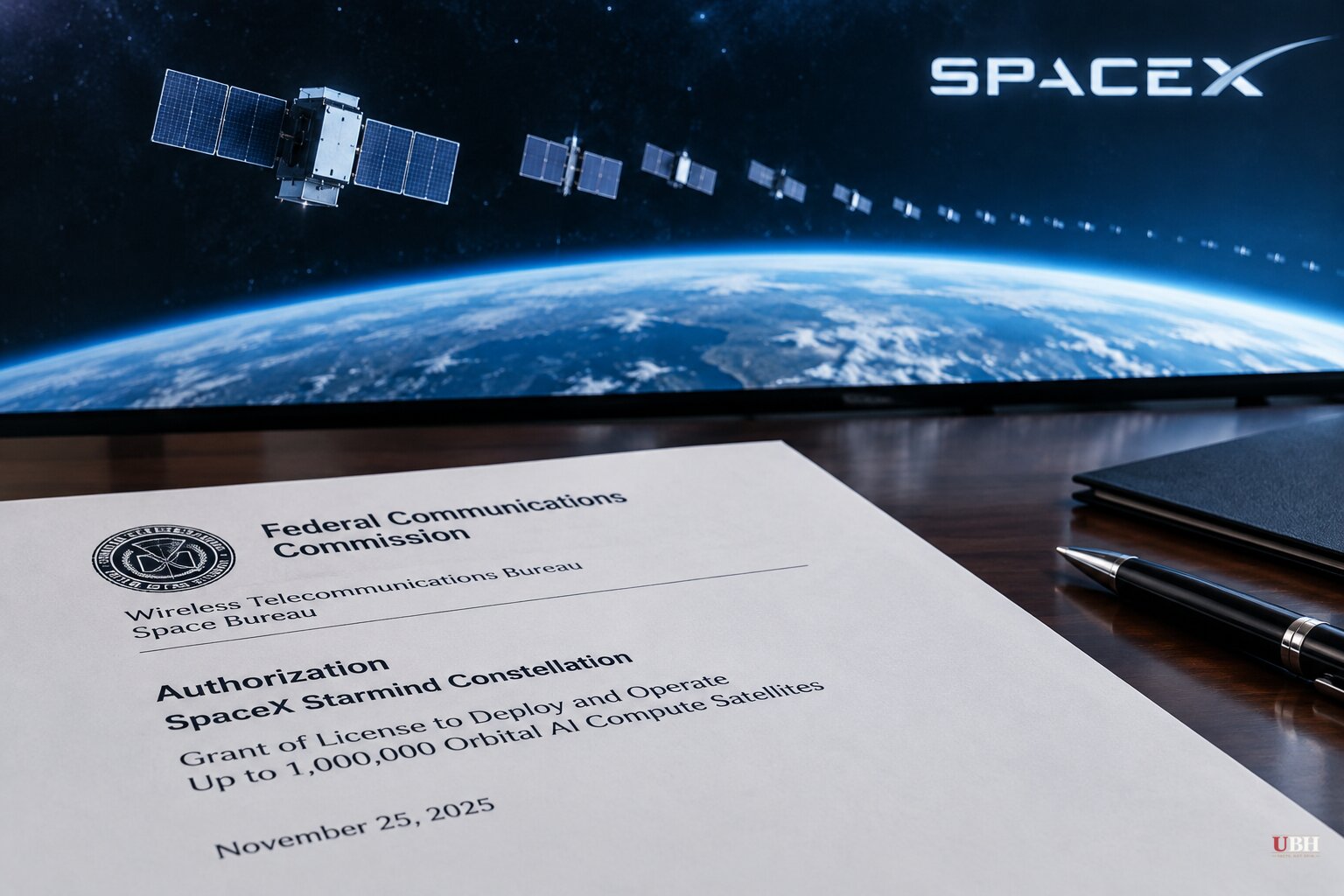
The Federal Communications Commission authorized SpaceX on Wednesday, Nov. 25, to deploy up to 1 million satellites as orbital data centers. The system is called Starmind. The agency says it is the first U.S. authorization for a constellation of data centers in space.
FCC Chairman Brendan Carr announced the grant on X. "Today, in a historic first, the FCC approved SpaceX's request for 1 million satellites (orbital compute modules) to create data centers in space," he wrote. In a statement he added: "By moving compute capacity beyond Earth, SpaceX and the many competitors working on their own orbital data centers are meeting the moment."
The order, DA 26-1273, came from the FCC's Space Bureau. SpaceX filed the application on Jan. 30, 2026.
What the license requires
A license for a million satellites is not a million satellites. The FCC attached a schedule, and the authorization becomes void if SpaceX misses it.
- Deployment must begin no later than November 2033.
- 10% of the maximum, or 100,000 satellites, must be up by November 2035.
- 50% must be up by November 2038.
- The full 1 million is due by 2040.
Politico reported the authorization runs 15 years. SpaceX must also file reports twice a year covering close approaches with other objects, satellites taken out of service, re-entries and the total deployed.
For scale, roughly 17,000 satellites exist in orbit today. Starlink, SpaceX's existing network, has just over 11,000. Before it started deploying Starlink, SpaceX sought approval for 42,000 satellites. Reuters noted that operators sometimes request more satellites than they plan to launch, to buy design flexibility.
The disposal question is still open
The FCC did not give SpaceX everything it asked for. SpaceX wanted to move satellites above 600 kilometers into "graveyard" disposal orbits, or even solar orbits, instead of letting them burn up on re-entry.
The agency deferred that request. It said SpaceX had not provided "sufficient information" about its disposal plans. Before launching any Starmind satellite that won't re-enter the atmosphere, SpaceX has to apply for a license modification and justify it.
The FCC said the system "operates consistent with the FCC's orbital debris rules."
Spectrum and hardware
The license is mostly about radio spectrum. Starmind satellites are designed to talk to each other and to Starlink over lasers. The FCC approved radio links only as backup, including for telemetry, tracking and command in emergencies. Those use the 18.8–19.3 GHz downlink and 28.6–29.1 GHz uplink bands.
That backup use is on an unprotected, non-interference basis. SpaceX cannot claim protection from other operators and must shut down any transmission that causes harmful interference.
SpaceX has said the satellites will "capture solar energy in space to power" AI work on Earth. In its filing to the FCC, the company argued that harnessing near-constant solar power "will achieve transformative cost and energy efficiency while significantly reducing the environmental impact associated with terrestrial data centers." It plans to build the chips at its Terafab facility. SpaceX and Tesla confirmed in August that Terafab will go up in Grimes County, Texas, with an initial $16.8 billion investment.
The skeptics
Amazon's satellite unit, Leo, and others criticized the plan. Their argument was that SpaceX was unlikely to deploy every satellite and that doing so could take centuries. Amazon is a direct competitor in satellite broadband.
Carr rejected that criticism in March. "Amazon should focus on getting Amazon's house in order with their own launches and their own satellite constellation, rather than worrying about other people that are actually out there launching satellites at the pace and cadence that SpaceX is," he said.
The plan also leans heavily on Starship, SpaceX's next-generation reusable rocket, which is still in development. The economics depend on that rocket cutting launch costs.
Rivals are lining up
SpaceX is not alone. Google launched a "Project Suncatcher" AI server satellite in October. Blue Origin will fly the first dedicated heavy-lift launch for Suncatcher in 2029.
The FCC said it is reviewing other orbital data center proposals and will decide each one. This order is the first template. Starmind also featured heavily in the pitch Elon Musk made to investors before SpaceX went public in June.
At the Baron Investment Conference this month, Musk estimated the first Starmind computers could launch in the third quarter of 2027. The first hard test comes later. SpaceX must have a satellite in service by November 2033 or lose the license, and it still has to convince the FCC that its high-altitude disposal plan meets the debris rules.
Sources used for this briefing
8 links from 8 independent newsrooms (syndicated copies of the same report count once)
These are the sources it draws on, linked so you can verify.
More coverage: Elon Musk


