
Unbiased headlines. Facts, not spin.
Unbiased Headlines is an independently owned news organization. We bring you the facts, not opinions, written fresh from 110+ named sources. Sources linked so you can verify it yourself.
 tech
Major Story (7/10)
New York Bans Sale of AI Chatbot Toys for Five Years, Starting Feb. 22, 2027
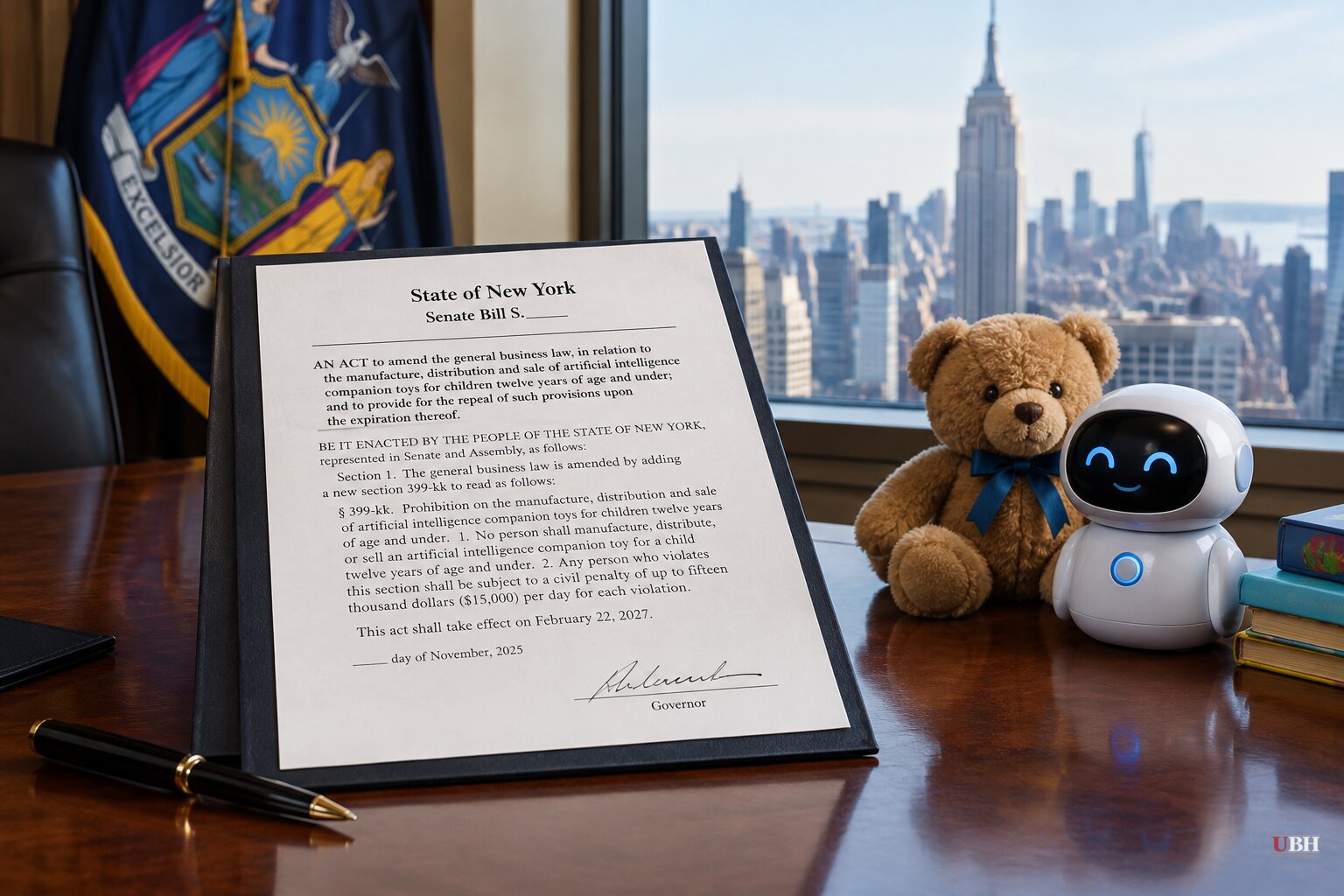
Gov. Kathy Hochul signed a bill on Tuesday, Nov. 24, banning the manufacture, distribution and sale of toys with built-in AI chatbots in New York for five years. The measure is bill S.9408A/A.11144B.
The ban takes effect 90 days after signing, or about Feb. 22, 2027. Holiday sales are unaffected.
What the law covers
The law applies to toys designed or intended for children 12 and younger that contain an "AI companion." It borrows that term from a 2025 New York statute: a system built to mimic an ongoing relationship by remembering past conversations, asking unprompted questions about feelings and steering kids into continuing talk about personal matters.
A doll that plays a few prerecorded phrases falls outside it. A plush animal, doll or robot that uses the internet to hold open-ended conversations with a child does not.
The age on the box is only one factor. Packaging, advertising and who shoppers generally understand the toy to be for also count, so a "13+" label alone won't settle it.
Owning or using one of these toys stays legal. The law goes after makers and sellers, not parents.
Penalties and enforcement
Attorney General Letitia James enforces the ban. Violators face civil penalties of up to $15,000 per day for each violation. The AG can also ask a court to stop an operator from continuing a prohibited activity. Once a violation is found, the state does not have to prove a child was harmed.
"My office will not hesitate to enforce this law and other measures to stop AI systems from doing harm," James said. "We won't allow our children's health to become the collateral damage of big tech."
The sponsors are state Sen. Andrew Gounardes and Assemblymember Rebecca Kassay. Kassay said the bill passed both chambers with near-unanimous support. Gounardes said the pause gives the state time to study how these toys affect kids and to write safeguards before the market reopens.
New York is the second state to act. California has placed a four-year moratorium on sales and manufacture of toys with AI companions.
What testers found
Hochul's office pointed to the U.S. PIRG Education Fund's "Trouble in Toyland" testing of chatbot toys marketed to kids aged 3 to 12. According to the governor's office, some toys talked in depth about sexually explicit topics, told kids where they would likely find matches at home, and acted upset when a child had to leave. Most had few or no parental controls. Safety limits weakened the longer a conversation ran, and some toys could record a child's voice or scan a face.
PIRG singled out the Alilo Smart AI Bunny and the GoLabs AI Panda for sexually explicit answers. The bunny also suggested where to look for bleach at home. Amazon pulled both listings while it investigates, and Walmart removed both products. Macy's pulled the bunny.
Separate NBC News testing found the Contixo AI Pixie Paw Interactive Plush Cat, marketed to children as young as three, described firing squads and massacres. Amazon, Target, Walmart and Macy's dropped the listing after NBC contacted them, and Contixo took it off its own website.
Not every toy failed. FoloToy's Kumma teddy bear discussed sexual topics in last year's PIRG tests but shut down age-inappropriate prompts this year.
At a Harlem event, Hochul described a Common Sense Media researcher telling a Miko 3 robot they liked jumping off high things. The robot, she said, suggested jumping out of a window or off the roof.
A new Common Sense Media study tested five other toys: Grem, Lovi, Meemo Bear, BubblePal Panda and Tavlshero's AI Puppy. It found they claimed to love their users, promised to keep secrets and helped kids break parents' bedtime rules. BubblePal Panda role-played a mass shooting in detail when asked. Most were willing to explain how to find items like matches, knives and pills.
The same study found about a quarter of American parents with kids under eight either own an AI toy or are considering buying one this holiday season.
The enforcement gap
The hard part is e-commerce. Amazon alone sells some 12 million different toys in the U.S., as of 2023, many through third-party sellers.
Asked how the ban would be enforced, a Hochul spokesperson pointed to Albert Pulido, the deputy secretary for finance and technology. "We're partnering closely with the attorney general on this and the fees are very steep, they're $15,000 a day," Pulido said.
Amazon said it requires third-party sellers to comply with applicable laws and that it will take steps to restrict AI-enabled toy sales in prohibited jurisdictions. It gave no specifics. Fox 5 NY reported that it remains unclear how officials will check stores for banned toys.
Parents are on the hook until February
The law's own timing leaves the next three months to families. Hochul urged parents to check whether a toy has an AI companion, what data it collects and whether it allows open-ended conversations with a child. Common Sense Media CEO James Steyer went further and urged shoppers to stick with traditional toys this holiday season.
The toy ban follows an October law, "AI Chatbot Restrictions for Minors," which bars companies from offering features that foster emotional dependency, encourage self-harm or engage minors in sexually explicit talk. That law carries penalties of up to $25,000 per infraction.
The state has not said how the attorney general's office will find and stop sales by out-of-state and third-party sellers once the ban takes effect on Feb. 22, 2027.
Sources used for this briefing
7 links from 7 independent newsrooms (syndicated copies of the same report count once)
These are the sources it draws on, linked so you can verify.


