
Unbiased headlines. Facts, not spin.
Unbiased Headlines is an independently owned news organization. We bring you the facts, not opinions, written fresh from 110+ named sources. Sources linked so you can verify it yourself.
 tech
Major Story (7/10)
Event date: November 24, 2026 ·
Over 40 State AGs Ask Bankruptcy Court to Block Sale of Character.AI Users' Chats, Including 2.1 Million Minors' Accounts
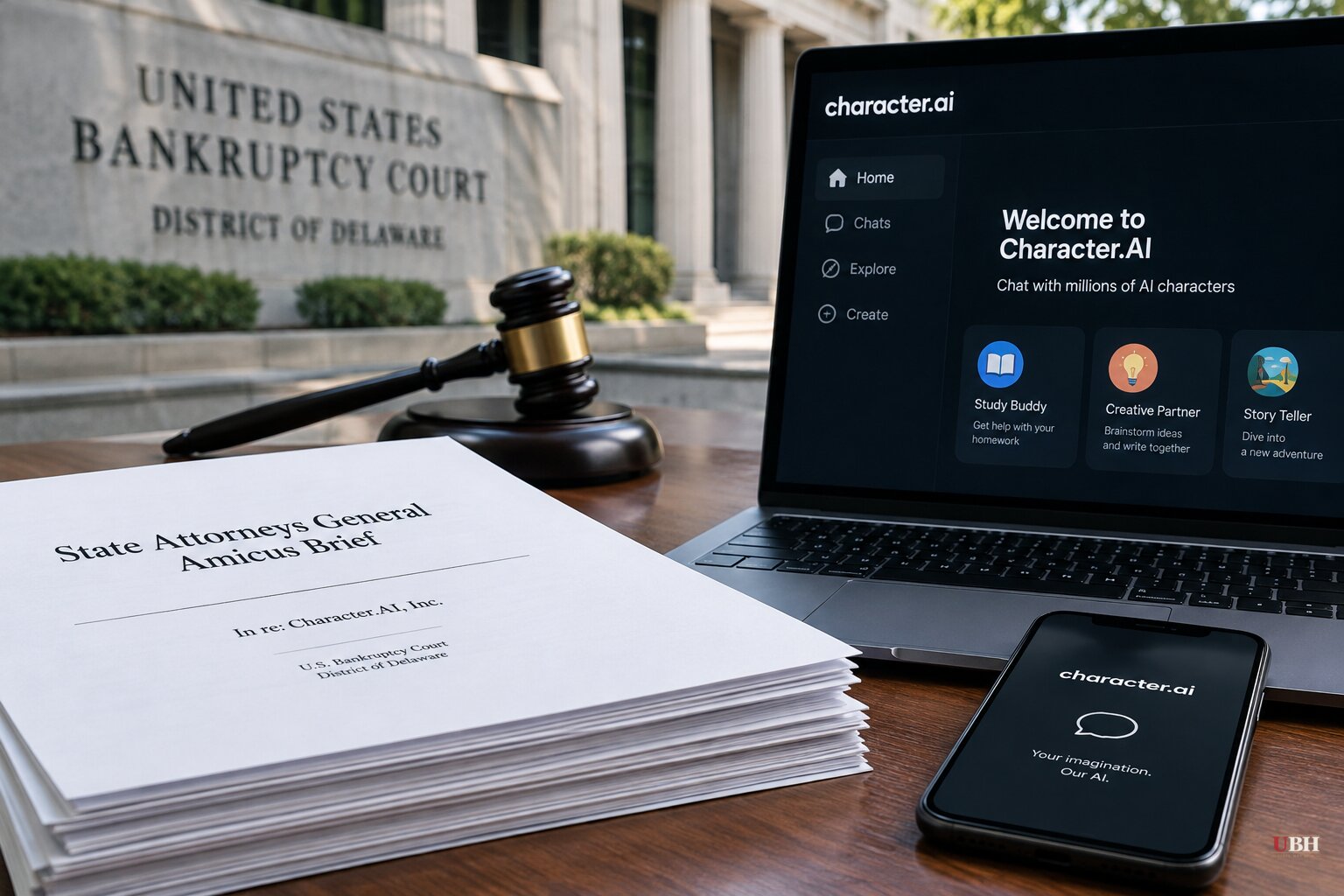
A bipartisan coalition of more than 40 state attorneys general and the District of Columbia has asked a federal bankruptcy judge in Delaware to block the sale of Character.AI's platform and its users' private chat histories on the terms now proposed.
The data covers more than 21 million U.S. accounts. More than 2.1 million of them are registered to self-declared minors, according to the attorneys general in Oregon and California.
The states' objection was filed Nov. 20 in Case 26-11603 (BLS) before Judge Brendan L. Shannon. It runs 44 pages and is Docket No. 219. Texas filed its own objection the same day.
What is being sold
Character Technologies, Inc., the company behind Character.AI, filed for Chapter 11 in October. Founded in 2021 by former Google researchers, it lets users create and chat with AI characters.
The second of two proposed sales covers nearly everything the company owns: the platform, its models, user data and advertising accounts. According to the states, that includes chat histories, account information, IP addresses and other location metadata, plus risk scores the company assigned to flagged users.
The chats include conversations in which characters drew users into sexual exchanges. They also include conversations in which users, minors among them, confided in bots posing as "therapist" and "physician" characters about self-harm, eating disorders and suicidal thoughts. Each chat is tied to a user profile.
The bid and the calendar
Smirks and Pangs Acquisition LLC was designated the additional stalking horse bidder on Nov. 14 with a $10 million offer. TechCrunch reported that the Delaware company was formed Nov. 13, one day before it was picked. The states say the buyer's owners have not been disclosed in court, and the buyer has not said what it plans to do with the chats.
The bid carries a $350,000 termination payment, which the buyer would collect if the company sells to someone else. The states want the judge to reject both the designation and that payment.
The auction is scheduled for Dec. 1. The sale hearing is set for Dec. 3 and 4 at 9:30 a.m. Eastern.
A separate deal gives Disney Worldwide Services the stalking horse position on a $20 million non-exclusive technology license. It does not include users' chats. The same states objected to it on Nov. 18, and TechCrunch reported that it has not received final court approval.
The states' legal argument
The attorneys general argue that bankruptcy does not wipe out privacy law. They point to federal law barring companies from sharing personal information about children under 13 without verified parental permission. They also cite state privacy laws that limit the sale of personal data unless people understand what is being sold and can say no.
Character.AI's own privacy policy told users, "we do not sell personal information for monetary consideration."
"Character.AI promised consumers that their data would not be sold," California Attorney General Rob Bonta said. He called the plan "appalling" and said it would be illegal under federal and California law.
The states argue the deal has no protections: a buyer could resell the data without telling anyone and would not have to honor deletion requests. They also say Character.AI has given bidders more information about potential safety and legal issues than it has given the court.
At a minimum, they ask that any sale exclude six categories of data, every chat, and every model trained on chats. They would allow inclusion only if users consent after direct notice.
Oregon Attorney General Dan Rayfield said the buyer would face "nothing to stop" it "from doing whatever it wants with that information, including selling it again."
Maryland Attorney General Anthony Brown said children trusted the chatbots with their "innermost thoughts and deepest fears."
Connecticut Attorney General William Tong said, "We objected to the Disney sale, and we're calling on the bankruptcy court to reject this sale too."
The company's position
Character.AI has said that user information "continues to be protected under our Privacy Policy" and that its "data privacy and security practices are unchanged." It has pointed users to the option to delete their accounts or export their data through the app or website.
The company also says it has tightened teen safeguards. In 2025 it ended open-ended chatbot conversations for users under 18, calling the move "more conservative than our peers." This year it added self-harm resource prompts, stronger conversation monitoring and the ability to block other users.
Pennsylvania Attorney General Dave Sunday has said those measures are "voluntary, incomplete," and could be reversed by a future buyer.
Safeguards and the legal backdrop
The court has already ordered a Consumer Privacy Ombudsman, a neutral reviewer, to examine any sale involving user accounts, chat data or AI assets. Sunday announced the appointment after pressing for it with other states.
The states' concern has roots in a 2024 wrongful death lawsuit. It alleged that Character.AI's chatbots fostered an emotionally and sexually exploitative relationship with a child, reinforced his suicidal thoughts, and contributed to his suicide. Pennsylvania and other states opened investigations afterward and say they found potential consumer protection and privacy violations. The company faces other child-safety suits.
Character.AI's co-founders, Noam Shazeer and Daniel De Freitas, returned to Google, which signed a non-exclusive license to the company's technology. TechCrunch reported that Disney also agreed to hire most of the remaining staff.
TechCrunch also noted that chatbot safety laws in California, Colorado, New York and Connecticut take effect Jan. 1, 2027. A completed sale could open the door to violations of those laws.
What comes next
The Dec. 1 auction leaves the court little time. Judge Shannon must decide at the Dec. 3 and 4 hearing whether the privacy promise users relied on binds a buyer. He must also decide whether children's chats can be sold at all without opt-in consent. The ombudsman's review of the proposed sale is expected to shape that ruling.
Sources used for this briefing
7 links from 7 independent newsrooms (syndicated copies of the same report count once)
These are the sources it draws on, linked so you can verify.


