
Unbiased headlines. Facts, not spin.
Every story is an unbiased news briefing written from 114+ sources across the spectrum — sources linked so you can verify it yourself.
 energy
Major Story (8/10)
Event date: August 17, 2026
energy
Major Story (8/10)
Event date: August 17, 2026
Multiple Oil Slicks Now Fouling the Gulf as Iran War Drags Into Its Sixth Month
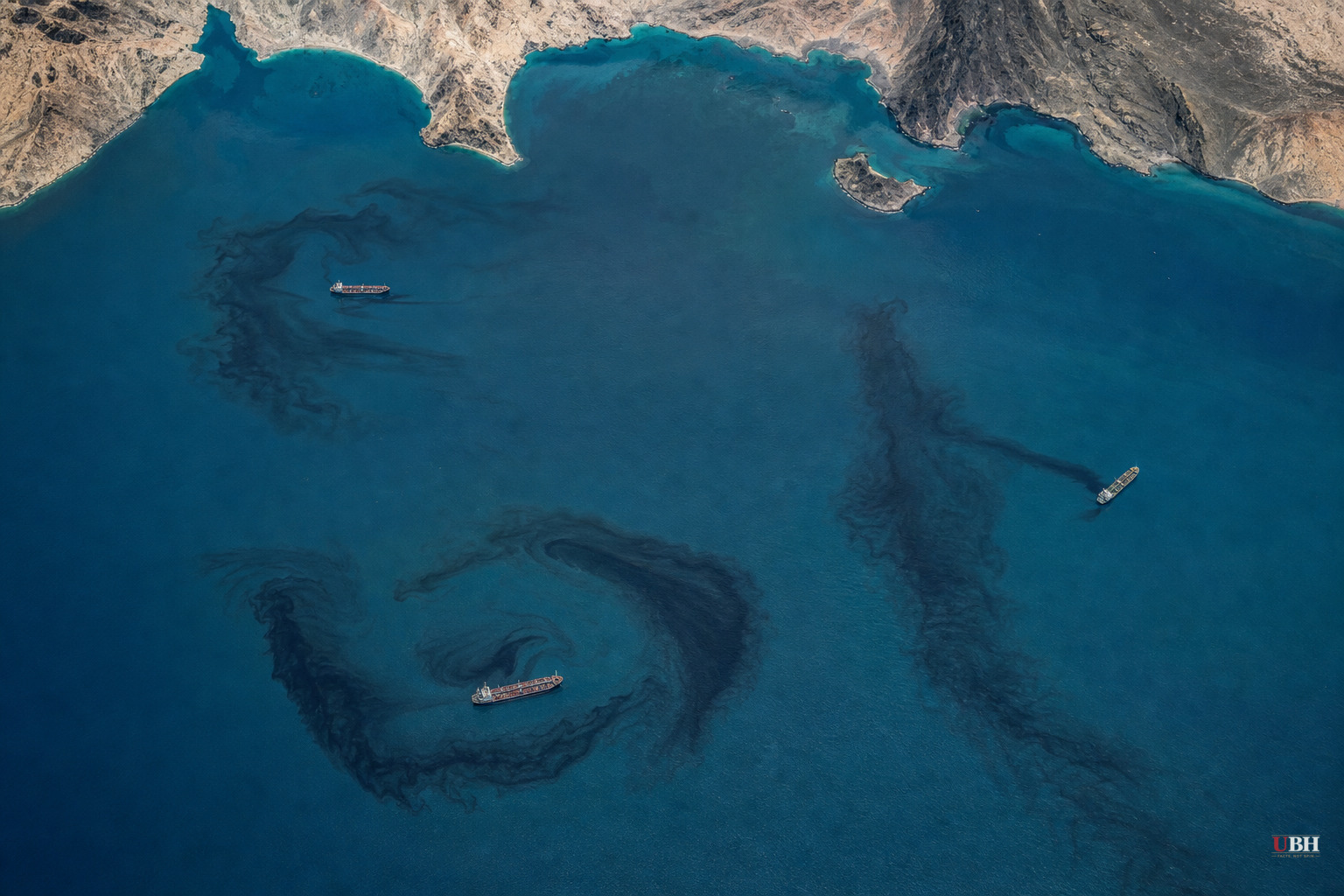
Three separate oil slicks are spreading across Gulf waters right now, and they trace back to a war that started February 28 and still has no end date.
Satellite imagery reviewed by Reuters shows one slick off the southern tip of Qeshm Island near the Strait of Hormuz, captured August 10. A second, smaller slick appeared near Sirri Island, an Iranian petroleum hub about 60 miles southwest, in imagery from August 13. A third and far larger spill is fouling the coast of Oman, hundreds of miles to the southeast.
The Qeshm slick appears tied to the Minoan Pioneer, a Liberia-flagged dry bulk carrier struck by an unidentified projectile near Oman's coast on August 3 while transiting the Strait of Hormuz, according to Samir Madani, co-founder of TankerTrackers.com. One crew member went missing in that attack. A maritime security source told Reuters the same leak likely drifted to Qeshm as well.
Wim Zwijnenburg, an environmental researcher with the Dutch peace organization PAX, said the dark coloring in parts of the Qeshm slick indicates heavy fuel oil, with a lighter, diluted trail stretching roughly 100 miles. John Amos, CEO of the satellite tracking firm SkyTruth, called it "a major incident" and said it's the biggest spill he's seen since the U.S.-Iran conflict began. Video verified by Reuters from August 11 shows dark, bubbling liquid washing onto the beaches at Suza on Qeshm Island.
Iran's Foreign Ministry spokesman Esmaeil Baqaei said evidence points to "a foreign bulk carrier as the source" and has called for compensation, according to The National. Reuters says it could not independently confirm what caused either the Qeshm or Sirri slicks, or identify the substances involved. A source affiliated with the Minoan Pioneer salvage operation told Reuters a tugboat sent to secure the grounded vessel couldn't get close because Iranian authorities wouldn't grant permission. Iran's mission in Geneva did not respond to Reuters' request for comment.
The Sirri Island leak's cause remains unidentified in any of the reporting reviewed here.
The largest environmental disaster in the region has nothing directly to do with the Iran conflict. The Caroline Bezengi, a 24-year-old tanker sanctioned by Europe, Canada and Ukraine for hauling Russian crude above G7 price caps, suffered a mysterious explosion off Yemen's coast on June 8. Its tracking system went dark two days later, then it ran aground June 30 near Al Qibliyah Island in Oman's Al Hallaniyat Archipelago, a protected marine reserve that shelters endangered Arabian Sea humpback whales, sea turtles and rare coral, according to Breitbart.
The ship was carrying about 800,000 barrels of Russian oil. Oman's Environmental Authority says the slick has grown past 1,200 square miles by some estimates, according to Breitbart, while The National put the spread at 400 square kilometers reaching Ras Madrakah, more than 200 kilometers away. The ship's registry documents, filed in Cameroon, appear to have expired in May, The National reported, and it's unclear whether the vessel was even insured.
Oman's military is coordinating an international salvage effort. Ambrey, a UK-based maritime security firm, said Thursday it deployed additional salvage vessels and specialist personnel who boarded the ship with support from the Royal Air Force of Oman. Ambrey's Ed Wollaston called it "an extremely challenging situation, compounded by adverse weather conditions" from the seasonal Khareef monsoon. The ship is reportedly sinking, raising the risk it breaks apart and dumps its remaining cargo.
The trade publication Riviera reports the Caroline Bezengi disaster is accelerating pressure to scrap aging "dark fleet" tankers, the sanctioned, often-uninsured ships that carry Russian and Iranian oil while running with tracking transponders switched off.
More than five months into the conflict, Strait of Hormuz traffic remains roughly 90% below pre-war levels, according to UK Maritime Trade Operations data cited by Fox News. Kpler reported 13 confirmed crossings on August 13, a 44% jump from nine the day before, but nine of those relied on Iran's unilateral routing scheme rather than the standard traffic lane. John Stawpert of the International Chamber of Shipping told Fox News Digital that traffic rises during ceasefires and drops again "as those ceasefires break down," and that a mine threat still limits how much shipping can move.
Oil prices are climbing as a result. Brent crude rose to $92.82 a barrel and WTI to $86.75 on August 20, marking a fifth straight session of gains and the highest levels since late July, according to the Epoch Times. U.S. distillate inventories, covering diesel and heating oil, fell for a third consecutive week, the Energy Information Administration reported August 19.
Tensions ratcheted up further after the UAE suspended all financial and economic transactions with Iran, following its defense ministry's claim that Iran fired two ballistic missiles at "maritime traffic" that landed in the sea. Iran's foreign ministry called that claim "baseless." The National separately reported that roughly 20 Adnoc-operated tankers have been struck since the war began, with two more hit last week alone.
President Trump said Friday the USS Abraham Lincoln, deployed more than 260 days in support of Operation Epic Fury, is being replaced by "another very similar ship" — reportedly the USS George Washington, according to a Wall Street Journal report cited by Fox News. Secretary of War Pete Hegseth pushed back Thursday on reports of low morale and safety incidents aboard the carrier, calling them "completely misrepresented."
No resolution timeline has been established. Oman's salvage crews are still racing the monsoon to keep the Caroline Bezengi from breaking apart, and no party has claimed responsibility for the attack that likely caused the Qeshm Island spill.
Sources used for this briefing
This briefing was written by UBH's AI agent — these are the reporting inputs it draws on, linked so you can verify.


