
Unbiased headlines. Facts, not spin.
Unbiased Headlines is an independently owned news organization. We bring you the facts, not opinions, written fresh from 110+ named sources. Sources linked so you can verify it yourself.
 energy
Major Story (7/10)
Event date: November 20, 2026 ·
Senate-Passed BAAJA Permitting Bill Faces a Short House Calendar as Savings Estimates Range From $50 to $250 a Year
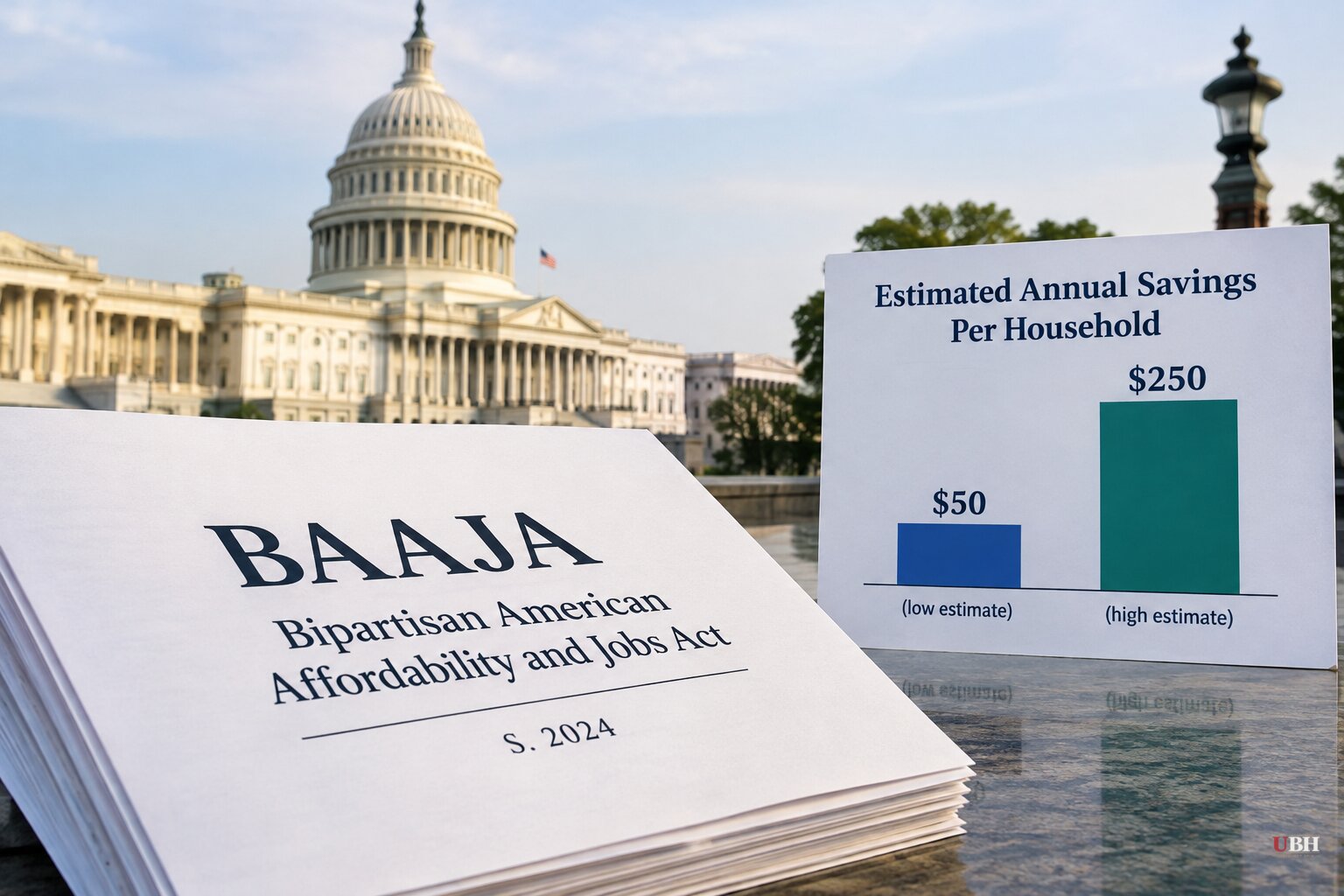
Since the Senate passed the Bipartisan American Affordability and Jobs Act (BAAJA) 62-33 on Thursday, Nov. 19, the argument has moved to two questions: what households will actually save, and whether the House will touch the bill before it changes hands.
The savings number depends on who is asked
Sen. Alan Armstrong, an Oklahoma Republican who made permitting reform his top priority, told Newsweek that the estimates he has seen put savings at around $250 a year on utility bills. "But for areas with really constrained energy, I think that's way too low," he said.
Majority Leader John Thune said the bill would "save the average household hundreds of dollars each year."
A Rhodium Group analysis, cited by the efficiency nonprofit IMT, is far more modest. It puts the savings at $50 to $78 per household annually by 2040. IMT argues that efficiency programs can deliver larger savings sooner.
Armstrong's case rests on geography. He said prices in the Northeast run almost three times those in Oklahoma, which he blamed on blocked pipelines and transmission lines. Moving cheap power to expensive markets, he said, would benefit consumers.
Pressure on utility bills is significant. Nationwide, the cost of a kilowatt-hour is up more than 6% in the last year and 39% in five years. An ICF report projects U.S. electricity demand rising 21% by 2030, driven largely by AI and data centers.
The vote was thinner than the earlier procedural tally
Passage came in below the cloture margins. The Senate invoked cloture on the substitute 70-27 on Nov. 16, then on the amended bill 65-31 on Nov. 18.
Final passage drew 47 Republicans, 14 Democrats and Independent Angus King of Maine. Opposed were 30 Democrats, Independent Bernie Sanders, and Republicans Josh Hawley of Missouri and Mike Rounds of South Dakota. Minority Leader Chuck Schumer voted yes, as did all four authors: Shelley Moore Capito, Mike Lee, Sheldon Whitehouse and Martin Heinrich.
Six Democrats who backed cloture on Nov. 16 voted no on passage: Richard Blumenthal, Kirsten Gillibrand, Andy Kim, Jon Ossoff, Jeanne Shaheen and Raphael Warnock. Four Republicans who had voted yes on cloture did not vote Thursday: Bill Cassidy, John Cornyn, Mitch McConnell and Tommy Tuberville.
What the House will actually receive
The House gets the adopted substitute, not the later managers' package. Capito sought consent to consider that package, Amendment No. 7030, and Sen. Jeff Merkley, an Oregon Democrat, objected. After passage, Merkley objected again when Sen. Brian Schatz asked to enroll a correction offered by Lee, Heinrich and Capito.
The sponsors said the dropped package would have tightened historic-preservation exemptions, addressed eminent-domain concerns raised by Hawley and Rounds, and closed a data-center loophole. Whitehouse has said the bill makes data centers pay for the power they use.
The opposition has not gone away
The Sierra Club and the National Wildlife Federation oppose the bill, arguing it weakens environmental accountability. Earthjustice and the ACLU also oppose it. They say it significantly weakens the National Environmental Policy Act and would speed gas pipelines and U.S. Immigration and Customs Enforcement detention centers.
The NAACP's Abre' Conner said the group "strongly opposes BAAJA because we should not rush through a decision that directly threatens the health, safety, and future of Black and frontline communities."
Tribal concerns run through the debate as well. Mark Macarro, president of the National Congress of American Indians, called the bill "such an existential threat to Indian country" because it would weaken the federal duty to consult tribes. Sen. Maria Cantwell, a Washington Democrat, urged colleagues not to sacrifice "the Clean Water Act, hunting or fishing grounds, historic or sacred sites, or protections of tribal sovereignty." Sen. Alex Padilla of California said he supports cutting red tape "but not at the expense of tribal sovereignty and California's environment."
Data centers are the sharpest political flashpoint. IMT says voters restricted data centers in almost every case on the November ballot. Protesters rallied outside Schumer's building the Friday before the vote over the same concern.
Short calendar, new majority
The House flips to Democratic control on Jan. 3, 2027, after Democrats won the majority in this month's midterms. That leaves the current House only the lame-duck weeks to act. Trump urged all senators to back the 417-page bill, and Bloomberg described its House future as uncertain.
Armstrong, who is leaving the Senate, told colleagues in his farewell address he wanted his legacy to be "helping America recover its ability to build."
No House vote has been scheduled. It is unclear whether current House leaders will bring up the Senate substitute as is, or leave it for a Democratic majority that has already split over it in the Senate.
Sources used for this briefing
7 links from 7 independent newsrooms (syndicated copies of the same report count once)
These are the sources it draws on, linked so you can verify.


