
Unbiased headlines. Facts, not spin.
Unbiased Headlines is an independently owned news organization. We bring you the facts, not opinions, written fresh from 110+ named sources. Sources linked so you can verify it yourself.
 energy
Notable (5/10)
Centrus Shares Fall 21.5% in the Week Cantor Started Coverage at Overweight With a $130 Target
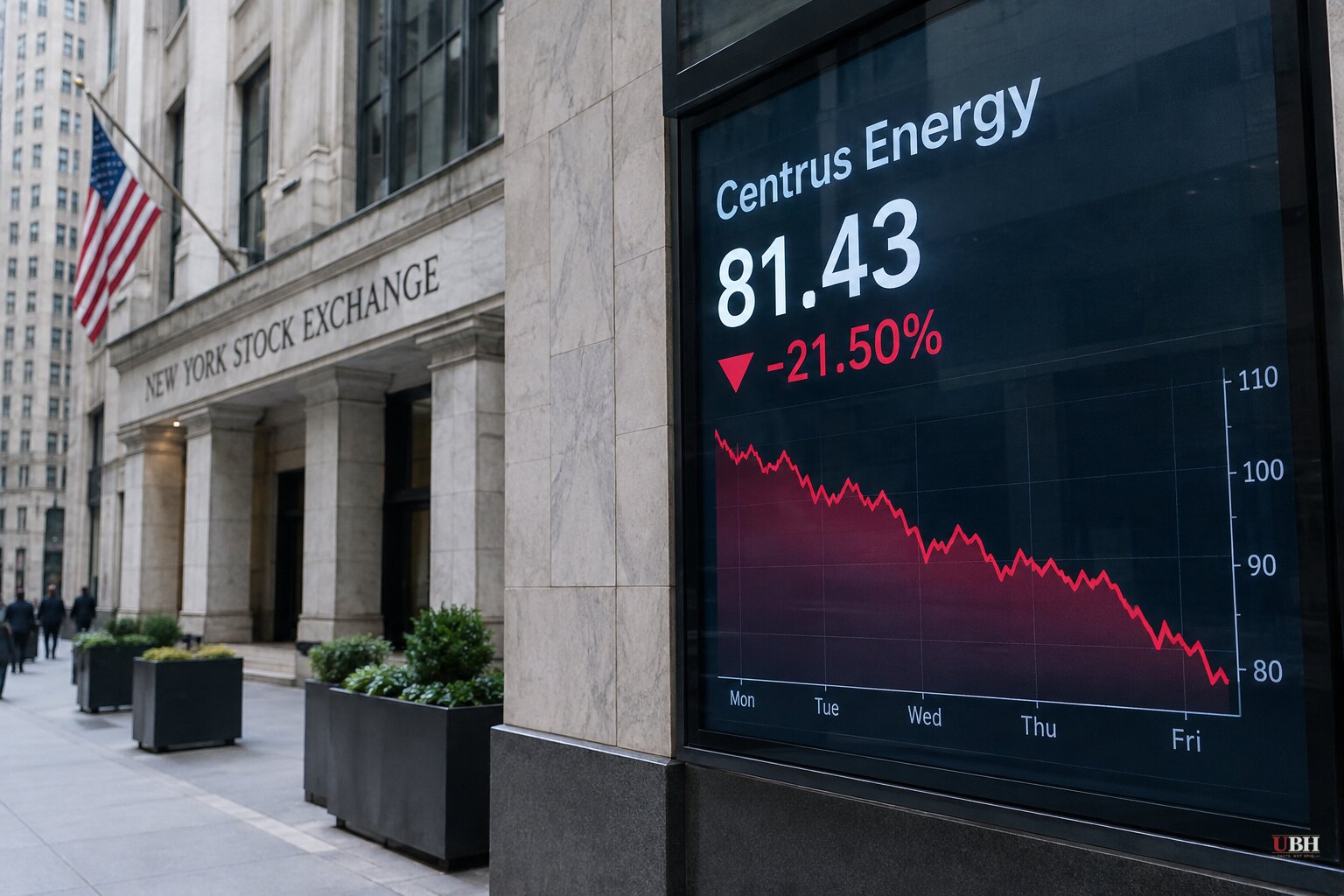
Cantor Fitzgerald picked a rough week to turn bullish on Centrus Energy (LEU). On Monday, Nov. 16, the firm initiated coverage of the only U.S. producer of high-assay low-enriched uranium (HALEU) with an Overweight rating and a $130 price target, about 25% above the prior Friday's close.
By Friday, Nov. 20, LEU had dropped 21.5% on the week to $81.43. That is a new 52-week low and roughly 76% below the stock's 52-week high. Cantor's target now implies about 60% upside.
It is a long fall. When Needham published a Buy case in July, the stock traded around $171. It has lost more than half its value since.
Nuclear names are sliding together
Centrus is not alone. At midday Friday, Oklo (OKLO) traded at $19.81, down $1.03 on the day, against a 12-month high of $115.72 and a 12-month low of $18.53. Its 50-day moving average is $30.20 and its 200-day is $49.29. Oklo's market cap stands at $3.87 billion.
BWX Technologies (BWXT) fell $8.49 to $108.56 at midday Friday. Its 52-week low is $108.17 and its high is $241.82.
Terrestrial Energy (IMSR), which listed through a SPAC merger, was near $3.00 earlier this month with a market cap of about $318 million. Its 52-week high is about $14.28. The company is pre-revenue and reports roughly $274 million in cash and no debt.
Cantor's argument: a Russia-sized hole
Cantor's thesis starts with demand. It projects U.S. electricity consumption rising from about 4,100 TWh in 2024 to roughly 5,180 TWh in 2030, a 4% annual pace, before settling near 2.5% a year through 2040. Citing BloombergNEF, it sees data center demand growing from about 25 GW in 2024 to more than 80 GW by 2030.
The Edison Electric Institute puts coal retirements at roughly 150 GW by 2035. Cantor calls nuclear "the most logical baseload technology" to fill that gap.
The supply side is where Centrus comes in. Four companies control about 95% of global enrichment capacity, and Cantor says state-owned enterprises in Russia and China held about 62% of it in 2024. The EIA puts Russia's share of U.S. enrichment service supply at 26% for 2025.
The 2024 import ban removes that supply once waivers run out on Jan. 1, 2028. Cantor expects "a structural shortfall through 2028 in which demand will exceed total non-Russian supply."
Prices for SWU, the unit of enrichment work, fell from about $160 in 2010 to about $60 in 2016. They climbed above $190 by the end of 2025. Cantor expects pricing to stay supported because new capacity from Centrus, Urenco and Orano lags the demand ramp.
The HALEU gap
HALEU is uranium enriched to between 5% and 19.75% U-235. Nine of the ten advanced reactor designs funded under the Department of Energy's Advanced Reactor Demonstration Program need it. Historically, the only commercial source was Russia's Tenex.
DOE projects U.S. HALEU demand above 40 metric tons a year by 2030 and above 60 tons by 2035. Domestic production in 2024 was about 900 kilograms, all from Centrus's 16-machine demonstration cascade in Piketon, Ohio. That is a gap of more than 40 times.
DOE's stockpile of down-blended material, about 21 tons by mid-2026, is what Cantor calls an interim supply for early demonstrations, not a commercial-scale source.
Politics and the doubters
The One Big Beautiful Bill cut credits for new wind and solar while keeping nuclear's. Democrats won both chambers of Congress this month. Cantor does not expect nuclear to lose its credits, because "nuclear power has bipartisan support."
The firm also flags a risk. A Congress that extends wind and solar credits "could soften investor sentiment on nuclear."
Analysts are split on the smaller names. Wedbush rates Terrestrial Energy Neutral with a $4 target, set in October. Lake Street Capital Markets rates it Buy at $15, also in October. Cantor itself had an Overweight and $12 target on the company dating to December 2025. One firm trimmed its IMSR target from $15 to $8 in September. The spread between $4 and $15 reflects how little revenue the sector has to anchor a valuation.
Cantor's report does not offer an explanation for the week's selloff, and the MarketBeat price data attributes none either.
What comes next
The timeline is fixed. The Russian import waivers expire Jan. 1, 2028, and DOE's 40-ton demand projection is set for 2030. Centrus has to scale from a 900-kilogram demonstration cascade to something commercial before then. At $81.43, the market is not yet paying for that.
Sources used for this briefing
7 links from 5 independent newsrooms (syndicated copies of the same report count once)
These are the sources it draws on, linked so you can verify.


