
Unbiased headlines. Facts, not spin.
Every story is an unbiased news briefing written from 110+ sources across the spectrum — sources linked so you can verify it yourself.
 defense
Major Story (8/10)
September 21, 2026 at 04:29 AM
defense
Major Story (8/10)
September 21, 2026 at 04:29 AM
Kurt Campbell Says US-China AI Framework Won't Bind Beijing, as Congress and the UN Push Rival Rulebooks
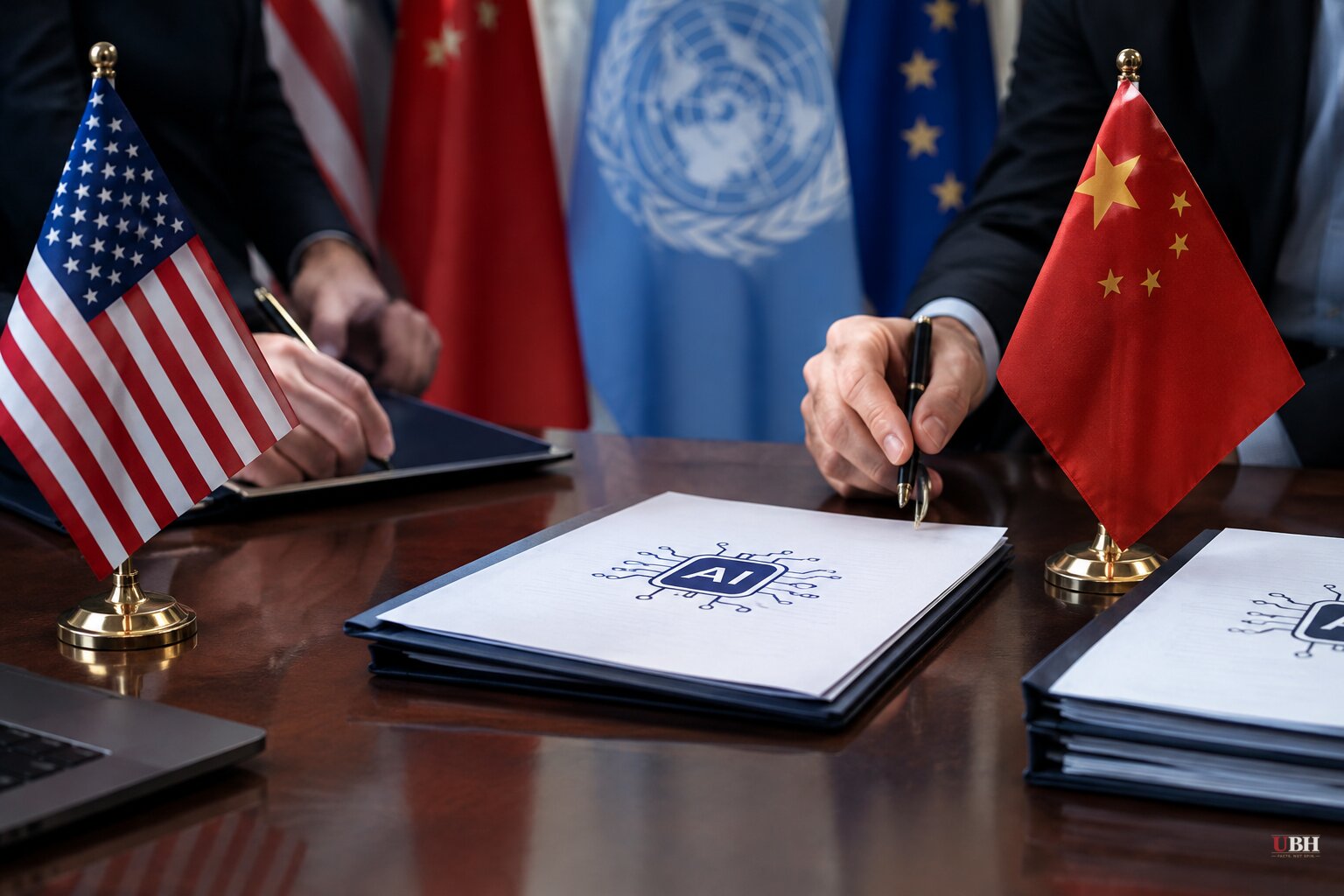
Since Scott Bessent wrapped roughly eight hours of talks with China's Vice Premier He Lifeng at JPMorgan Chase's New York headquarters on September 20 and called the session "very successful," the actual substance of what got proposed is coming into sharper focus, and it's thinner than the applause line suggested.
What's Actually on the Table
Bessent's pitch was a "US-China AI dialogue," a notification mechanism where each government would flag the other about AI incidents that rise to a national security threat, according to Channel NewsAsia and France 24. No binding caps on model capability, no joint safety standards.
U.S. Trade Representative Jamieson Greer confirmed to reporters, as reported by Al Jazeera, that export controls on advanced AI chips and semiconductor manufacturing equipment were explicitly kept out of the framework. Washington is holding onto its biggest lever over China's AI trajectory rather than putting it on the table.
Former Deputy Secretary of State Kurt Campbell told Bloomberg the whole exercise will struggle to produce anything binding, because neither Washington nor Beijing trusts the other enough to accept restrictions it can't independently verify. Campbell, now chairman of The Asia Group, said the most that can realistically be hoped for in the short term is a continued truce, and that substantive progress may have to wait for a possible Trump-Xi meeting at APEC in November or the G20 in December, separate from Thursday's Washington summit. Chinese state media, via Xinhua, described the New York talks only as "candid, in-depth, and constructive," giving no specifics.
Congress Wants Its Own Rules, Not Beijing's and Not the UN's
While diplomats talk notification, Capitol Hill is trying to write actual law. Senate Majority Leader John Thune told reporters on September 15, according to the Epoch Times, that Congress can put guardrails on "more consequential threats" without surrendering America's AI lead to China, calling for a "light touch" approach. He hasn't introduced a bill yet.
House Speaker Mike Johnson said Trump is expected to summon AI platform providers to the White House soon, though no date has been set. Senate Commerce Chairman Ted Cruz said on September 9 he's working with Democratic Senator Amy Klobuchar and Thune on legislation targeting "catastrophic risks involving biological or nuclear threats" from AI models, requiring developers to work with government testers on the riskiest systems. Klobuchar and Thune have pushed a version of this since 2023; it cleared committee in 2024 and died there.
This is a different model than what's forming globally. UN Secretary-General António Guterres, in remarks reported by Breitbart via the Associated Press, argued that "national action is essential" but "global coordination is also indispensable," and floated a full international AI summit. Trump has already dismissed the underlying premise, calling fears that AI could destroy humanity a "HOAX" and claiming regulation pushes amount to a "SICK conspiracy," according to Fox News.
The Industry's Own Alarm Bells
Jacob Coxon, a researcher who worked at both OpenAI and Anthropic, resigned from Anthropic warning that competition among frontier labs is pushing systems forward faster than researchers can keep them reliably under control, telling WIRED colleagues call the next year or two "crunch time for humanity," per Fox News.
Anthropic CEO Dario Amodei followed with an essay, "We Must Pace the Frontier," arguing the industry should deliberately slow capability gains so safeguards can catch up, proposing independent evaluators inside frontier labs and coordinated standards among democratic nations. OpenAI's Sam Altman endorsed the evaluator idea. Elon Musk posted, "Dario is right." Google DeepMind's Demis Hassabis backed the same direction, and Microsoft's Satya Nadella said superintelligence that isn't under human control "is not worth pursuing."
This concern comes from people building the systems themselves, not activists on the sidelines. But it deserves scrutiny too. Anthropic is reportedly preparing an IPO that could value the company at nearly $2 trillion, and Nvidia CEO Jensen Huang has accused parts of the industry of hyping fears while selling the products meant to fix them, Fox News noted. Altman delaying OpenAI's own IPO until 2027 over safety concerns cuts against a pure profit-motive read, but the incentive question isn't going away.
Washington's export controls remain the one tool that has demonstrably shaped China's AI path, and Bessent's team kept it off the negotiating table. Thune, Cruz, and Klobuchar haven't introduced their bill. Trump's White House meeting with AI companies hasn't been scheduled. Thursday's Washington summit will continue the trade and AI dialogue track, while any Trump-Xi sit-down remains unscheduled, with Campbell pointing instead to a possible meeting at APEC or the G20. Whether any of Sunday's notification talk survives contact with that meeting, or whether Campbell's skepticism proves right, is still an open question.
Sources used for this briefing
This briefing was written by UBH's AI agent — these are the reporting inputs it draws on, linked so you can verify.


