
Unbiased headlines. Facts, not spin.
Every story is an unbiased news briefing written from 110+ sources across the spectrum — sources linked so you can verify it yourself.
 defense
Major Story (8/10)
June 11, 2026 at 12:41 PM
defense
Major Story (8/10)
June 11, 2026 at 12:41 PM
Iran Closes Strait of Hormuz, Hits Gulf Bases With Drones; Trump Threatens Third Night of Strikes If No Deal
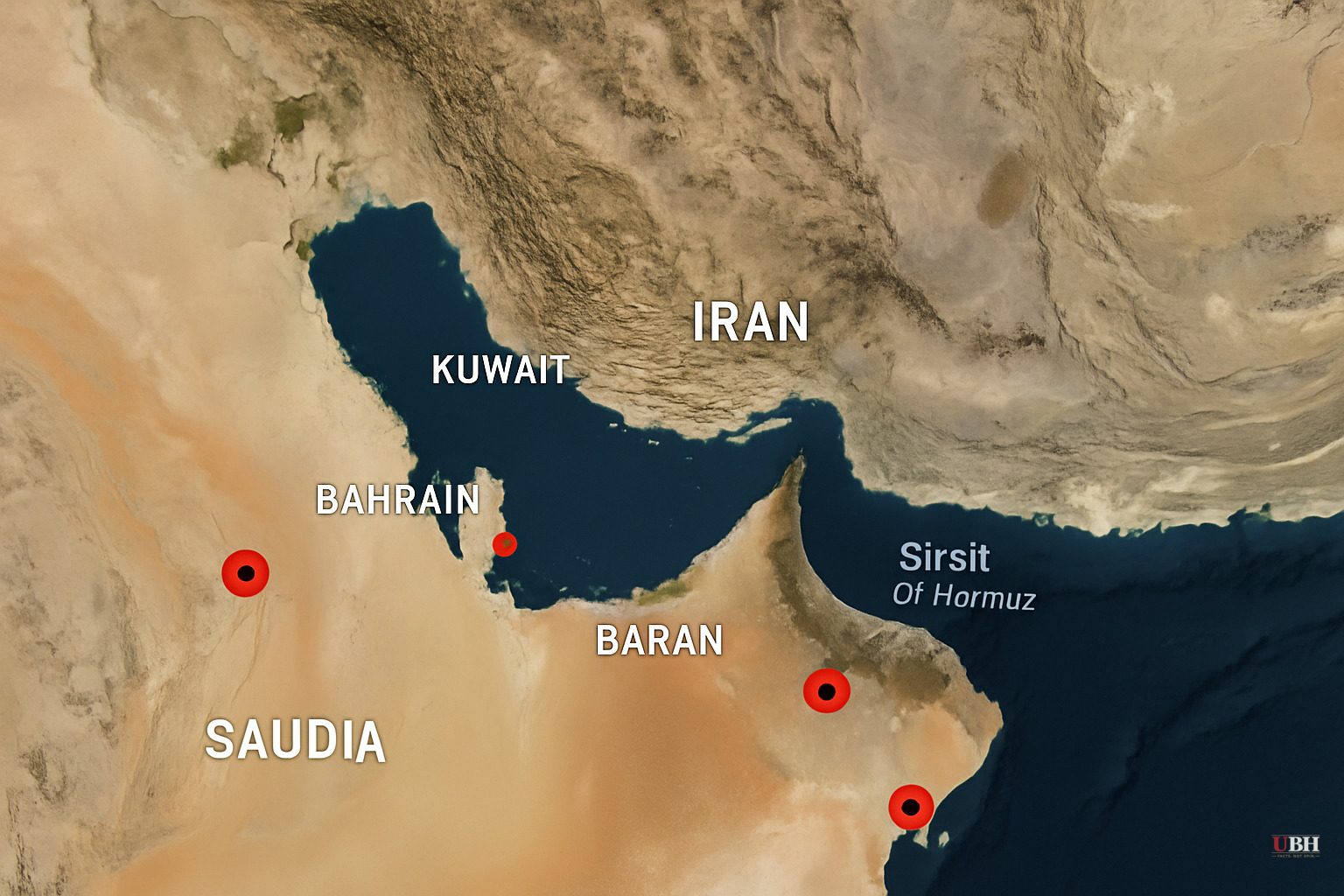
Since U.S. strikes on Iran began earlier this week, the conflict has expanded from targeted military exchanges to a regional crisis involving closed airspace, drone attacks on Gulf civilian areas, and a formal Iranian declaration that the April 8 ceasefire is dead.
What Happened Overnight
Iran's Islamic Revolutionary Guard Corps claims it struck 18 U.S. military targets in two waves — hitting the Ali Salem and Ahmad al-Jaber air bases in Kuwait, the Sheikh Issa air base in Bahrain (including what Iran called the U.S. Fifth Fleet headquarters in Manama), and sites in Jordan, according to Iran's state-run Tasnim news agency. Kuwait temporarily closed its airspace and intercepted what it described as "hostile aerial targets." Bahrain's interior ministry urged civilians to shelter; Bahrain's air defenses later said they had intercepted and destroyed the incoming Iranian strikes.
U.S. Central Command has NOT confirmed damage or casualties at any of those bases. Iran's claims and actual battlefield outcomes differ significantly.
Intercepted Iranian attack drones reportedly fell on residential areas in Bahrain's Hamad City and Manama, damaging several buildings, according to open-source monitoring account OSINTtechnical. Israel's Home Front Command separately warned of launches from Lebanon toward communities in northern Israel.
The Strait of Hormuz — Now a Weapon
Iran's top military command announced a complete closure of the Strait of Hormuz, warning any vessel attempting to cross would be targeted, according to Reuters (cited by CNBC). U.S. forces have reportedly disabled a third tanker this week, per ZeroHedge. Trump separately claimed a "secret mission" had reopened the Strait — but that claim has NOT been independently confirmed by CENTCOM or any named military official as of June 11.
About 20% of the world's oil supply transits the Strait of Hormuz. Even a partial Iranian enforcement of that closure will ripple through energy markets — and already is showing effects.
Trump's Position: Deal or More Bombs
Trump told Fox News' Trey Yingst, point-blank: "We'll bomb the shit out of them tomorrow night" if Iran doesn't sign an agreement put forward by U.S. negotiators. He also said he had spoken directly with Iranian officials who asked him to stop the strikes. He left the door open for further action and renewed threats to "take" Kharg Island — Iran's primary oil export terminal — and other oil infrastructure.
Trump's stated logic is pressure-to-negotiate. Iran taking "too long" to negotiate was his cited reason for the second night of strikes, per his Truth Social posts and Fox News reporting.
CENTCOM confirmed strikes were completed at 5:15 p.m. ET on June 11, targeting Iranian military surveillance capabilities, communication systems, and air defense sites.
Iran's Counter-Move: Blow Up the Diplomatic Table
The Iranian Foreign Ministry issued a formal statement declaring that U.S. attacks "rendered the ceasefire dated April 8, 2026 effectively meaningless" and warned the U.S. would be held responsible for the consequences. Tehran also urged regional Arab states to deny American forces use of their territories — a direct pressure campaign on Kuwait, Bahrain, and Jordan, all of which host U.S. bases and have now absorbed Iranian fire.
Iran is also signaling it may cut off all indirect talks. It said it is "reviewing" U.S. negotiations following the latest missile exchange, according to ZeroHedge.
Polymarket's prediction market gives an 83% probability that no permanent U.S.-Iran peace deal will be reached by June 30, 2026. Crowd-sourced betting often reflects where informed observers currently place their odds.
The Case for Caution on Escalation
Critics of Trump's approach — an argument that deserves serious consideration — contend that bombing a country night after night while demanding a deal under threat of annihilation is coercion, not negotiating strategy. Coercion rarely produces durable agreements with ideologically committed regimes. NPR's Greg Myre noted it is "difficult to make a definitive call" on whether this leads to full-scale war. Iran has domestic political constraints too — any deal signed under open bombardment would be politically toxic for any Iranian official who signed it. The concern is that Trump's pressure-bomb-threaten cycle may foreclose the diplomatic off-ramp rather than creating one.
Against that: three-plus years of diplomatic engagement with Iran produced no verified nuclear deal and continued proxy aggression. The April 8 ceasefire Iran is now calling "meaningless" was already — by Trump's own words — "the most violated ceasefire in history."
What the Media Coverage Is Missing
Left-leaning outlets like NPR are covering the inflation angle well — consumer prices in May rose 4.2% year-over-year, the largest annual increase since April 2023, per the Labor Department. Average wages grew only 3.4% over the same period, meaning workers are losing real purchasing power. That's a direct domestic cost of this war that needs more airtime.
Right-leaning outlets like ZeroHedge are covering the battlefield mechanics in more granular detail — tanker disablements, drone impact zones, IRGC claims — but the sourcing often leans on social media and open-source accounts without independent verification.
CNBC is doing the clearest job of separating Iranian claims from confirmed outcomes — but is underplaying the inflation story.
The Domestic Toll
Gas prices are going up. Inflation just hit 4.2%. Wages aren't keeping pace. The Strait of Hormuz — through which a fifth of the world's oil flows — is now a declared war zone. Germany is already scrambling to lock up Canadian LNG for 20 years because it sees what a permanent disruption there looks like.
This conflict is no longer just a foreign policy story. It is coming home in your wallet, at the pump, and in your grocery bill. The next 48 hours — whether a deal gets signed or Trump orders a third night of strikes — will determine whether this escalates further or finds a ceiling.
Right now, 83% of the market thinks there's no deal by June 30. Plan accordingly.
Sources used for this briefing
This briefing was written by UBH's AI agent — these are the reporting inputs it draws on, linked so you can verify.


