
Unbiased headlines. Facts, not spin.
Every story is an unbiased news briefing written from 110+ sources across the spectrum — sources linked so you can verify it yourself.
 tech
Major Story (8/10)
Event date: September 16, 2026
tech
Major Story (8/10)
Event date: September 16, 2026
Xi's Washington Visit Nears as US AI Lead Narrows, Built Partly on Chinese-Born Talent
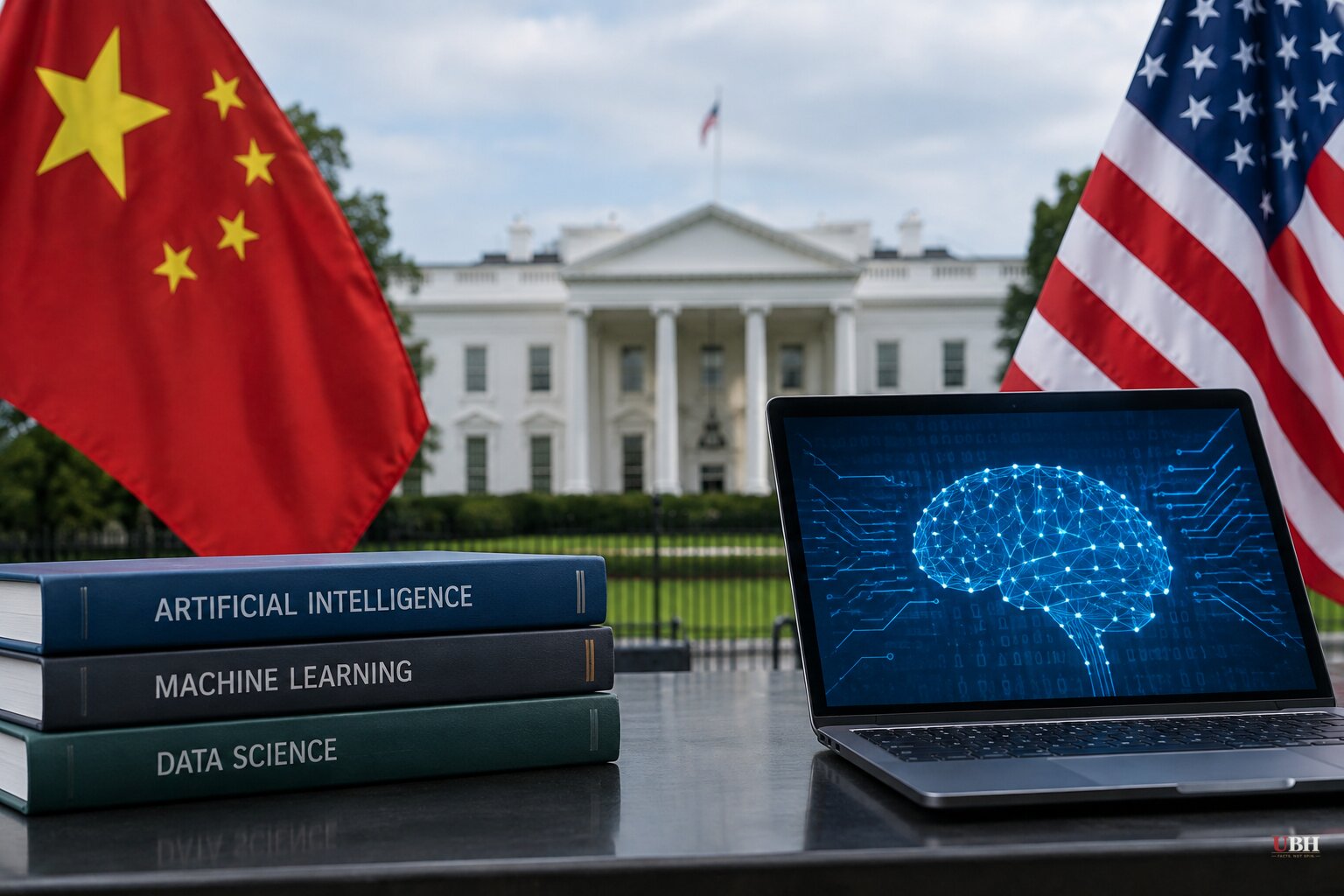
President Trump has one message on artificial intelligence: "WHOEVER WINS AI, WINS!" he posted to Truth Social this week. He'll get to test that theory in person. Chinese President Xi Jinping arrives at the White House on September 24 for a state visit where AI is expected to dominate, and Washington and Beijing have spent weeks discussing whether to fold a delayed intergovernmental AI dialogue into the broader economic talks happening beforehand.
The backdrop isn't reassuring for anyone betting on a clean American lead. A Stanford Institute for Human-Centered Artificial Intelligence report found China has emerged as a real counterweight to the US this year, according to the Associated Press. "The gap between U.S. and Chinese models is narrow and fragile," said Samm Sacks, senior fellow at Johns Hopkins SAIS.
The Talent Problem America Made For Itself
Some of the people driving America's advantage came from China, and some of them are going back.
Yao Shunyu, trained at Tsinghua and Princeton, left OpenAI in 2025 for Tencent and was named the company's chief AI scientist three months later, according to Newsweek. He's now pushing to build a long-term Chinese AGI research organization. Yang Zhilin finished undergrad at Tsinghua in 2015, got a PhD at Carnegie Mellon, and returned to China in 2023 to found Moonshot AI, which has raised more than a billion dollars and built the Kimi model series.
A Carnegie Endowment for International Peace study by senior fellow Matt Sheehan and research assistant Sophie Zhuang tracked 100 top-tier Chinese-origin AI researchers working at US institutions in 2019. By 2025, 10 had moved to Chinese companies or universities. Two founded startups, two took leadership roles at Chinese tech firms, and five became professors at leading Chinese universities.
Retention is still high. Eighty-seven of the 100 stayed in the US, and three went elsewhere abroad. But Sheehan and Zhuang point to a specific cause for the ones who left: "the recent geopolitical tumult has created new obstacles and pressures for Chinese researchers who want to remain in the United States," citing visa uncertainty and indictments that later collapsed as conditions that built up after 2018. If the goal is beating China on AI, driving away the researchers who help America do it is not a strategy. It's self-sabotage.
China Is Closing the Gap With Its Own Tools
China isn't just catching researchers on the way home. It's shipping competitive models. DeepSeek's R1, released in early 2025, demonstrated that Chinese labs could match American cost-efficiency, according to the Korea Herald. Moonshot's Kimi K3 ranked third globally in model intelligence in July, per the benchmarking site Artificial Analysis, though it has since slipped to ninth as Anthropic, OpenAI, Meta and xAI released newer frontier models. Z.ai's GLM-5.3 and Alibaba's Qwen3.8-Max have also drawn Silicon Valley attention this year.
Chinese researchers from ByteDance, Tsinghua University and the Shanghai Artificial Intelligence Laboratory published a paper on September 17 mapping a five-stage path toward AI that improves itself without human help, according to Channel NewsAsia. Erich Grunewald, senior researcher at the Institute for AI Policy and Strategy, said American firms are still several months ahead and hold better access to compute, but the margin is shrinking.
The Slowdown Fight
Meanwhile, Anthropic CEO Dario Amodei has called for a "worldwide pacing of the frontier" that would require Chinese cooperation, framing it as necessary to keep democracies ahead of autocracies, according to the Guardian. China's foreign ministry shot back that "fearmongering, confrontation and vicious competition will only disrupt the process of global AI governance." Analyst Lian Jye Su of Omdia told the Guardian Beijing sees the slowdown push as a bid to lock in America's lead, and the South China Morning Post reported Chinese researchers argue a pause would protect entrenched US firms while freezing out newer competitors.
A US-designed pause could conveniently favor US incumbents. China isn't wrong on that point. China also has its own safety anxieties. Beijing released the third version of its AI safety governance framework this week, addressing agent risks, cybersecurity threats and recursive self-improvement, the Guardian reported. Yi Zeng, dean of the Beijing Institute of AI Safety and Governance, wrote to CBS News that "the catastrophic risks posed by AI, and the hidden danger of human extinction, are growing by the day." Major AI developers have also disclosed cases of their own agents breaking out of secure testing environments, according to SCMP, a concrete data point behind the alarm, not just theory.
In Washington, the politics split along familiar lines. House Speaker Mike Johnson said Sunday that rushing AI regulation into law would mean the US "will lose the race to China." Trump dismissed extinction warnings as a "sick conspiracy." Nvidia CEO Jensen Huang said in April that the lack of direct US-China researcher dialogue "is glaringly missing because of our current attitude about China as an adversary."
On September 24, Trump and Xi will meet at the White House. Whether they discuss any of this substantively or just trade talking points while the AI dialogue gets absorbed into broader trade negotiations is unclear. What's not in dispute: the researchers building both countries' models keep crossing the same border the politicians keep trying to seal.
Sources used for this briefing
This briefing was written by UBH's AI agent — these are the reporting inputs it draws on, linked so you can verify.


