
Unbiased headlines. Facts, not spin.
Unbiased Headlines is an independently owned news organization. We bring you the facts, not opinions, written fresh from 110+ named sources. Sources linked so you can verify it yourself.
 tech
Notable (6/10)
Event date: November 21, 2026 ·
BepiColombo enters orbit around Mercury after eight-year, 10.2 billion km trip
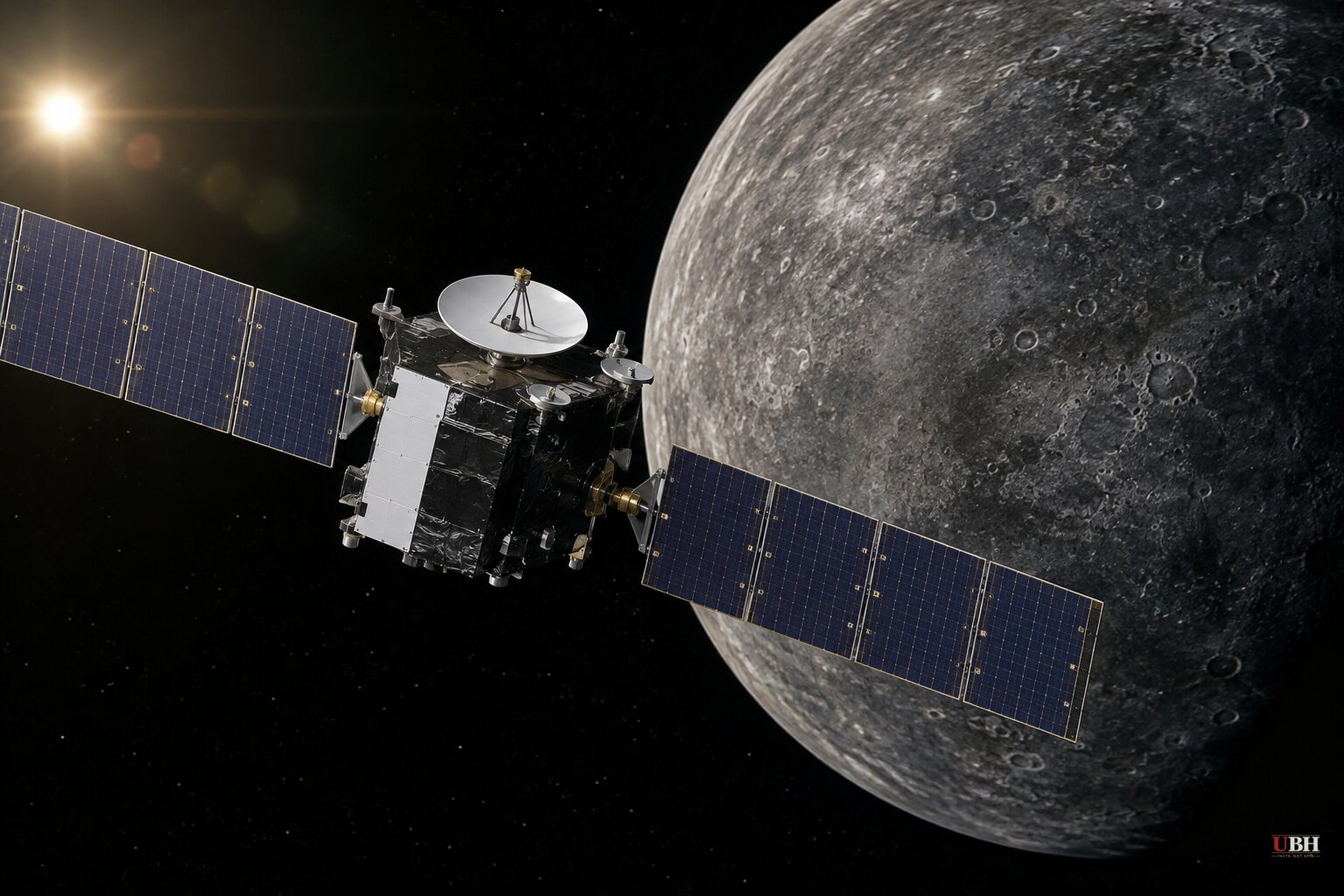
BepiColombo is in orbit around Mercury. The European Space Agency (ESA) confirmed orbital capture after a 37-minute braking burn that was scheduled to begin Saturday, Nov. 21, at 1:24 p.m. EST (1824 GMT).
"We've heard back from Bepi," ESA wrote on X. The spacecraft is in contact with the ground, flight dynamics has confirmed the capture, and the teams at the European Space Operations Centre are still assessing telemetry. ESA said it would share a fresh update early next week.
The mission is a joint effort of ESA and the Japan Aerospace Exploration Agency (JAXA). It launched on an Ariane 5 from French Guiana on Oct. 20, 2018.
A very long way around
The trip covered roughly 10.2 billion km (6.35 billion miles) by ESA's journey tracker. That is the distance flown along its winding path, not the straight-line gap between Earth and Mercury.
The route included one Earth flyby, two Venus flybys and six Mercury flybys. Each one used planetary gravity to shed speed without burning much fuel.
The plan called for about seven years. A problem with the solar panels that power the transfer module's electric thrusters cut the available power and added a year.
Mercury is hard to reach because a spacecraft falling toward the Sun picks up enormous speed. It has to shed that speed before Mercury's weak gravity can hold it. ESA says getting into Mercury orbit takes more energy than flying to Pluto.
"Energetically, it takes more energy to go to Mercury than to go to the outer Solar System," said Emma Bunce, a plasma physicist at the University of Leicester and a leading BepiColombo scientist.
The capture left the spacecraft in an oval orbit that runs from about 590 km above the surface out to more than 11,000 km.
Two orbiters, still stacked
BepiColombo is really two spacecraft: ESA's Mercury Planetary Orbiter (MPO) and JAXA's Mercury Magnetospheric Orbiter, called Mio. The Mercury Transfer Module that carried them released the pair on Sept. 3. MPO and Mio are still bolted together.
They are scheduled to separate on Dec. 9 or 10. Mio will then settle into a highly elliptical polar orbit between about 500 km and 11,000 km. Its job is to sample Mercury's magnetic field and track how it interacts with the solar wind.
MPO will take longer. A series of engine burns will bring it down to a polar orbit of 400 to 1,500 km, expected on March 10, 2027. From there its instruments will study the surface continuously.
Science operations are scheduled to start in April 2027.
What scientists want to know
Mercury is the least explored planet in the inner solar system. Only two NASA missions have visited before. Mariner 10 flew by three times in the 1970s. MESSENGER orbited from 2011 to 2015.
BepiColombo carries more powerful instruments on two craft at once. Geraint Jones, ESA's lead project scientist, said, "We're expecting to learn a huge amount, bringing more powerful instruments on two spacecraft to study all aspects of the planet, its interior, surface, and the space around it."
The open questions are specific:
- Ice: Why is there ice in permanently shadowed polar craters on a planet this close to the Sun?
- Magnetic field: What sustains Mercury's magnetic field, and why is it offset from the planet's center?
- Core: Why is the planet so dense, with an unusually large core?
- Hollows: What are the strange hollows scattered across its surface?
MPO's X-ray imager, the Mercury Imaging X-ray Spectrometer, is the first X-ray imaging device sent on an interplanetary mission. Bunce is the principal investigator on that instrument. Her team pointed it at the Crab Nebula during the cruise as a test.
"I think it's a little bit of an under-loved planet in the inner Solar System," Bunce told the BBC, "but I think that's one of the reasons why it is so compelling."
The environment
Mercury is brutal on hardware. Surface temperatures swing from about 430°C to -180°C. JAXA says spacecraft there can be hit by sunlight roughly 10 times as intense as at Earth.
A Mercury year lasts 88 Earth days, but the planet rotates so slowly that a single day lasts about 59 Earth days.
The Guardian put the mission's cost at €1.6bn (£1.4bn). Bunce has worked on the project for 20 years.
The next checkpoint is the Dec. 9-10 separation of MPO and Mio, with ESA's promised update due early next week.
Sources used for this briefing
8 links from 8 independent newsrooms (syndicated copies of the same report count once)
These are the sources it draws on, linked so you can verify.


