
Unbiased headlines. Facts, not spin.
Unbiased Headlines is an independently owned news organization. We bring you the facts, not opinions, written fresh from 110+ named sources. Sources linked so you can verify it yourself.
 tech
Breaking / Critical (9/10)
Lean and Mathlib Groups Say They Have Full Confidence in Alpöge's Claude-Built Riemann Proof After Day-Long Check
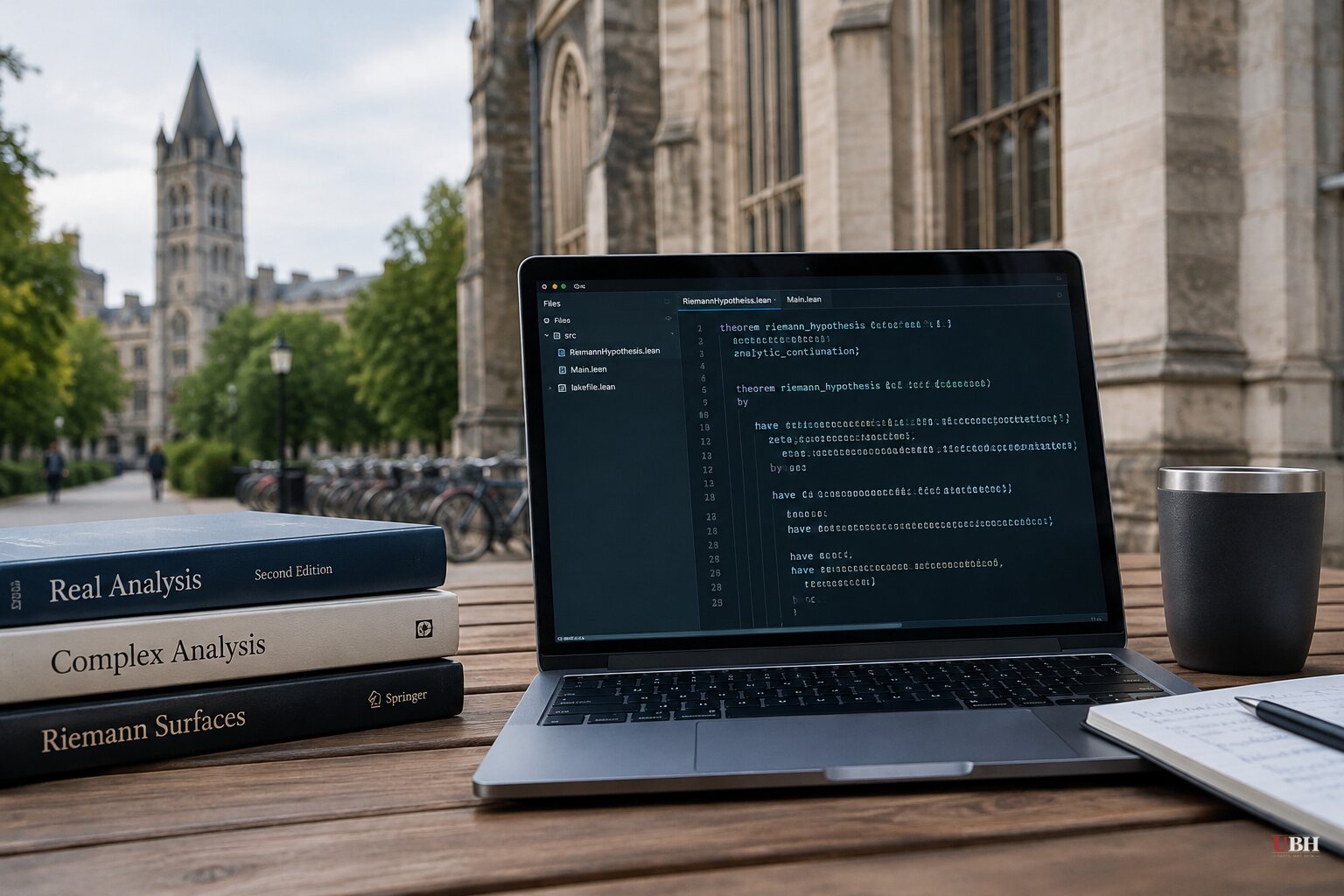
Since Levent Alpöge posted his Claude-assisted proof of the Riemann Hypothesis on Friday, Nov. 20, the main open question has been whether the code actually proves what it claims. On Saturday, Nov. 21, the groups that run Lean's proof tooling gave their answer.
The Lean FRO, which develops the Lean proof language, and the Mathlib Initiative, which backs Lean's main math library, said they have "full confidence that Alpöge's proof of the Riemann Hypothesis is correct."
What the Lean community says it checked
The two groups said members of the Lean and Mathlib communities spent the past day checking the 17-million-line library. They certified both the statement and the proof as correct under four criteria laid out in a Nov. 12 post on the Xena Project blog.
Dozens of people compiled Alpöge's code and reproduced the same raw proof export, the groups said.
The community then added a file containing only Mathlib's own statement of the Riemann Hypothesis, which the groups said experts in Lean and number theory had carefully vetted. Two independent tools confirmed that the theorem Alpöge's library proves is exactly that statement.
The exported proof then went through several checkers. These included Lean's official kernel and independent ones contributed by third parties in different programming languages.
Two of them, con-leche and con-ron, carry a formal proof that they cannot accept a false proof. The groups said that answers the concern that the proof might exploit a flaw in Lean's own logic.
The checks ran on an inert export of the proof, walled off from any malicious code that might be hidden in the Lean sources. A detailed overview of the checks is posted on MIT's mathematics site.
How this fits the Friday checks
The Saturday statement goes well past what was confirmed Friday. MIT mathematician Andrew Sutherland, using Claude Code, reported that the source compiled without errors, that five main theorems relied only on Lean's standard axioms, and that a separate proof-checking program accepted the full exported proof. Two further checks were still in progress at his Friday afternoon update.
An independent verification project also confirmed Friday that the downloaded archive matched Alpöge's mirror and that the top-level theorem statements compiled against Mathlib. The full replay of the proof was still running at that point.
At the time, mathematician and author Kit Yates and other experts said reviewers still had to confirm several critical points before anyone could call the problem solved. The two groups' statement is their answer to those points, specifically the exact match to Mathlib's statement and the soundness of the checkers.
What a verified file does not do
A clean Lean check settles whether the formal argument is valid. It does not explain the argument to human mathematicians. Alpöge himself called the AI-written version "some massive unreadable travesty," and said an experimental version ran past 250,000 pages. He wrote that Claude "far outpaced me near the finish line."
The two groups acknowledged the gap. They said they now look to the wider mathematical community to help explain the new ideas in the proof.
The Clay Mathematics Institute still lists the problem as unsolved. Its rules require publication in a qualifying outlet, at least two years since publication and general acceptance by the global mathematics community before it will consider awarding the $1 million Millennium Prize. A personal website post and a code archive do not qualify.
Alpöge has said he plans to prepare a conventional write-up.
What bettors are saying
On the prediction market Polymarket, bettors put the odds of Clay declaring the hypothesis solved this year at 2%. They put the odds at 10% by the end of 2027, down from 26% on the 2027 contract when the claim broke Friday. Those numbers reflect Clay's timeline rules, not doubts about the code.
What comes next
Alpöge also claims the method yields the Generalized Riemann Hypothesis for Dirichlet L-functions. The groups' statement addresses the Riemann Hypothesis itself, and the reference to the broader result in their statement is not detailed.
The next concrete step is Alpöge's conventional write-up and its submission to a qualifying outlet. Under Clay's rules, the two-year clock starts only after that publication, so no prize decision can come before late 2028 at the earliest.
Number theorists must now decide whether they can turn a machine-certified proof into an argument people can follow, and whether they accept it as the field's settled answer.
Sources used for this briefing
8 links from 8 independent newsrooms (syndicated copies of the same report count once)
These are the sources it draws on, linked so you can verify.


