
Unbiased headlines. Facts, not spin.
Unbiased Headlines is an independently owned news organization. We bring you the facts, not opinions, written fresh from 110+ named sources. Sources linked so you can verify it yourself.
 tech
Notable (6/10)
Event date: November 19, 2026 ·
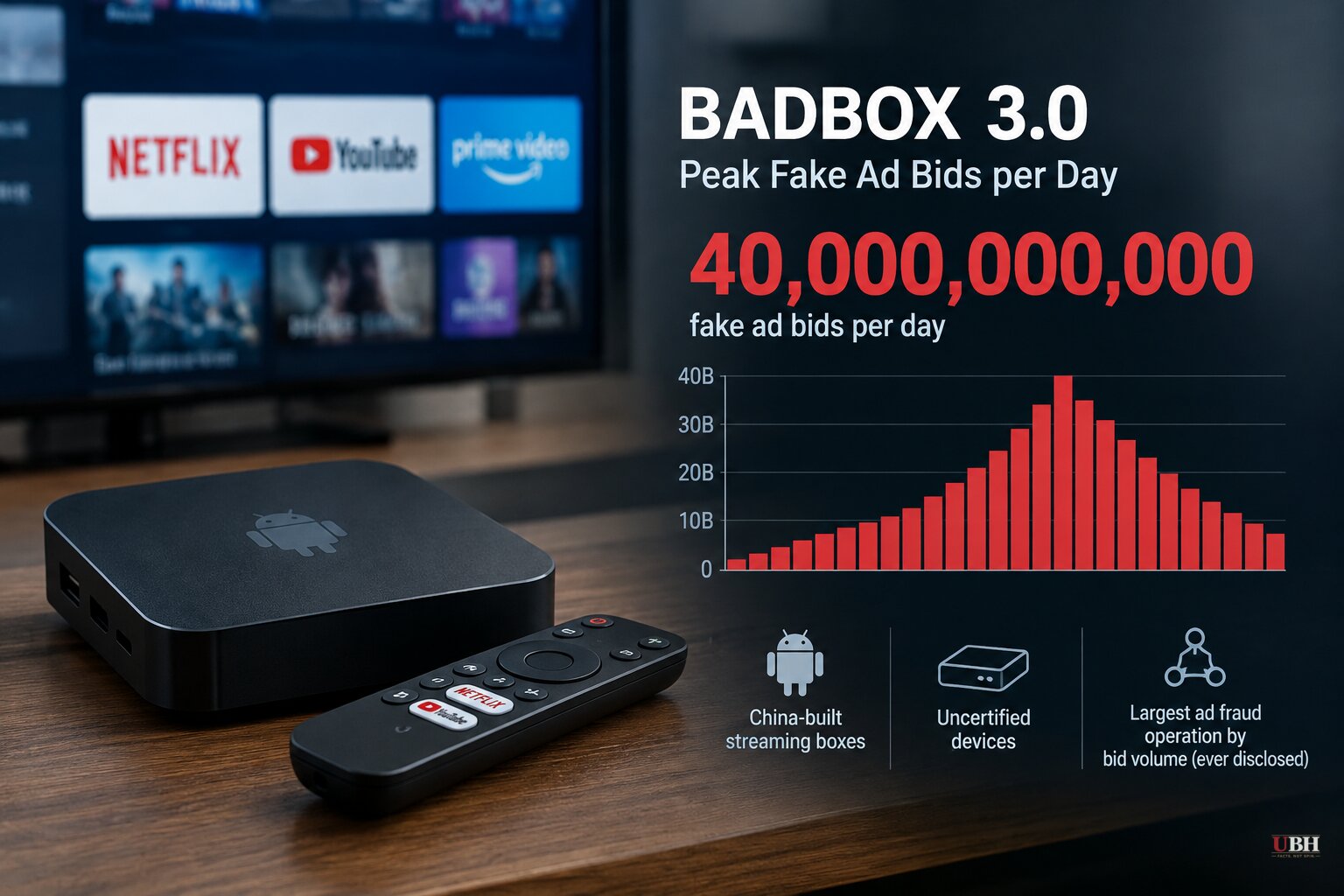
HUMAN Says BADBOX 3.0 Peaked at 40 Billion Fake Ad Bids a Day Through Cheap Android TV Boxes
The BADBOX botnet is back for a third round, and it set a record.
HUMAN Security announced on Nov. 18, 2026, that its Satori Threat Intelligence and Research Team had disrupted BADBOX 3.0. At its peak, the operation generated roughly 40 billion fraudulent ad bid requests a day, according to HUMAN. That was more than three times the previous record holder, VASTFLUX.
HUMAN says the peak also exceeded the combined peaks of the last five years of its published Satori investigations. At its height, BADBOX 3.0 accounted for more than 4% of all connected TV traffic observed by the Human Defense Platform.
What the 40 billion number means
The figure counts requests to bid on ad space. It does not count ads watched, money paid, or devices infected.
HUMAN has not published a comparable count of infected devices for BADBOX 3.0. The 10 million figure that circulates belongs to the earlier version: Google said BADBOX 2.0 had infected more than 10 million Android-based devices by April 2025.
How the fraud worked
The affected devices are cheap, uncertified boxes running the Android Open Source Project. HUMAN says they are built in mainland China and ship internationally. They are not Android TV OS devices and are not Play Protect certified.
Researchers found a backdoor packaged as a system app. It contacts a command-and-control server, which points the box to a maintained catalog of fraud modules in public code repositories. Backup copies sit on separate hosting services, so pulling one copy does not stop the boxes from fetching the code.
Once loaded, the modules play video ads in a hidden window, outside the visible screen. The bid requests impersonate legitimate connected TV apps that never ran on the boxes.
HUMAN also found spoofed server-side ad insertion. Those requests falsely told advertisers an ad had been inserted into a viewer's stream when no device and no ad playback existed.
Satori tested one impersonated app on its intended hardware and found no malicious behavior. That complicates the defense: blocking every request tied to that app would reject real traffic along with the fake.
Your home internet, rented out
The same malware could enroll a box in any of 11 residential proxy networks, without the owner's knowledge or consent. Those networks route strangers' traffic through household connections.
HUMAN says one of them, PXYEDGE, is the successor to IpMoYu, a proxy service tied to BADBOX 2.0. PXYEDGE advertised about 200,000 proxy nodes, while HUMAN's monitoring showed unique connections peaking near 340,000. HUMAN says Nokia researchers independently reached similar conclusions in their own published analysis.
Some of the fraudulent ad traffic was routed through those proxies to look like ordinary home viewing and slip past anti-abuse filters. For one impersonated app, about 40% of all requests, and 80% of U.S. requests, came from addresses flagged as residential proxy exits.
Researchers also found code from the Vo1d Android TV botnet alongside the new fraud modules, strengthening a link noted in earlier BADBOX research.
"If you bought one, it was compromised before you plugged it in," said Gavin Reid, HUMAN's chief information security officer. "Neither the advertisers paying for those ads nor the people who bought the boxes had any idea."
The manufacturer link
HUMAN's researchers tied the module catalog to TXCZ, a Chinese electronics manufacturer. They cite a TXCZ domain that served downloads and ad settings, modules that check for TXCZ-specific device properties, and repository records listing active TXCZ devices by model and firmware version.
That is HUMAN's assessment. No charges or court findings against TXCZ have been announced.
The disruption so far
HUMAN says it took part in Google's disruption of a related malware operation, XCPE, earlier in November. That effort took down multiple command-and-control domains used by BADBOX 3.0. HUMAN says XCPE was linked to more than one million infected devices across more than 200 countries and territories.
One malware repository has also been taken down, and HUMAN says its systems now filter ad traffic associated with BADBOX 3.0.
The history shows how durable this operation is. BADBOX was first found in early 2023 on a T95 Android TV box bought on Amazon. German cybersecurity agencies warned in December 2024 that it had infected tens of thousands of devices.
In March 2025, HUMAN and the Shadowserver Foundation cut more than 500,000 BADBOX 2.0 devices off from their control servers, and Google removed 24 apps that spread the malware from Google Play. Google announced legal action against the BADBOX 2.0 operators in July 2025. The operators rebuilt anyway.
Shailesh Saini, Google's director of Android Security & Privacy Engineering & Assurance, said Play Protect certified devices "undergo rigorous security testing" and urged users to confirm their device is certified and built with Android TV OS.
HUMAN's advice is the same: buy certified Android devices from reputable manufacturers and make sure Play Protect is available and active.
HUMAN warns that the operators are likely to adapt, as they have after every previous takedown. The uncertified boxes already in homes are still there, and HUMAN has not said how many remain infected.
Sources used for this briefing
7 links from 7 independent newsrooms (syndicated copies of the same report count once)
These are the sources it draws on, linked so you can verify.


