
Unbiased headlines. Facts, not spin.
Unbiased Headlines is an independently owned news organization. We bring you the facts, not opinions, written fresh from 110+ named sources. Sources linked so you can verify it yourself.
 tech
Major Story (8/10)
Event date: November 13, 2026 ·
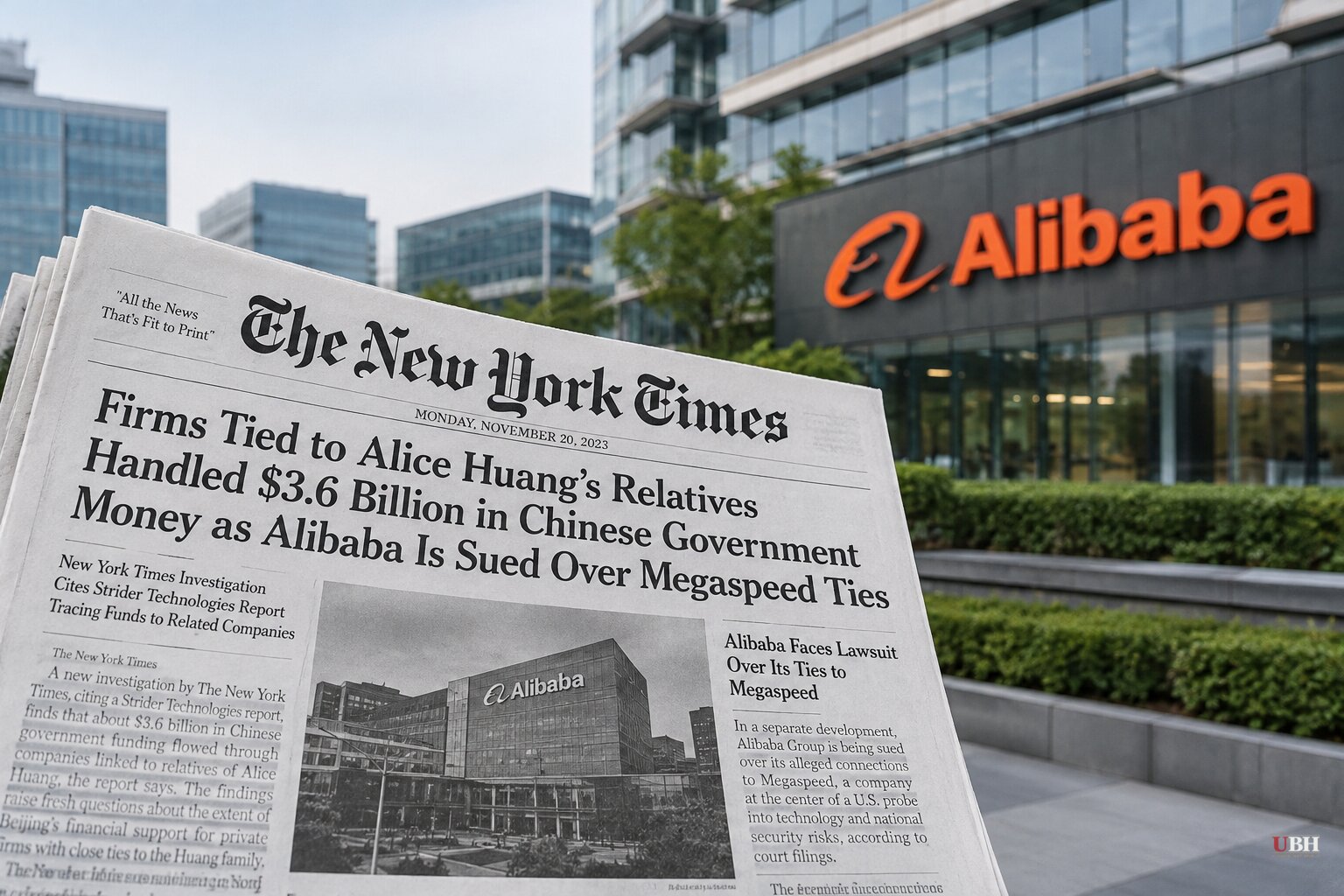
NYT Says Firms Tied to Alice Huang's Relatives Handled $3.6 Billion in Chinese Government Money as Alibaba Is Sued Over Megaspeed Ties
Since The New York Times first reported on Oct. 29 that Jensen Huang had been the target of a suspected Chinese intelligence plot, and Nvidia announced his resignation on Nov. 12, the story has widened from one man's judgment to a question about where America's most sought-after chips end up. Three new developments push in that direction.
The $3.6 billion trail
A New York Times investigation published today says companies connected to Alice Huang's family members and business associates have extensive links to China's defense industry. The paper cites a confidential report by Strider Technologies, a corporate intelligence firm staffed by former intelligence officers and China specialists.
The Strider report found roughly $3.6 billion in Chinese government funds passed through businesses tied to her relatives and associates. That money financed technology projects, including data centers equipped with Nvidia processors, according to the Times. Some of the companies are linked to state-owned defense contractors that supply China's military.
The gap in the findings is large. The Times says investigators have not established whether Nvidia chips were ultimately used in Chinese military projects. The exact nature of Alice Huang's own relationship to the defense sector also remains unclear.
These are the Times' findings and Strider's, not a charge by any government. The Chinese government has denied involvement in any plot, calling the earlier reports "groundless speculation." Megaspeed has said Alice Huang left the company in August 2025 and that media reports about its business were "not supported by verifiable evidence."
Alibaba hit with a class action
On Thursday, Nov. 19, shareholder Withida Bihan filed a proposed class action against Alibaba in the U.S. District Court for the Southern District of New York. The suit also names CEO Eddie Wu. It covers investors who held shares between May 23, 2024, and Nov. 11, 2026.
The complaint alleges Alibaba concealed ties to Megaspeed and Alice Huang and understated the risk that export-control problems would hurt its business. It says Alibaba's financial reports for 2024, 2025 and 2026 misled investors. Citing Financial Times reporting, the complaint alleges Alibaba "maintained a business relationship with Alice Huang and, through her, Megaspeed, which is suspected of smuggling certain hardware to China illegally."
Those are allegations in a civil complaint. No court has ruled on them, and the suit asks for unspecified damages.
Singapore says Washington gave little help
Singapore's account has also sharpened. Singapore's Home Affairs Ministry confirmed it asked both the Justice Department and the FBI for help with its investigation. One source with knowledge of the matter told CBS News that Washington was "not forthcoming" and has provided no substantive assistance to date.
That source said Singaporean police impounded Alice Huang's passport in June 2025, the day she gave a voluntary interview to U.S. Bureau of Industry and Security investigators. Police held it for eight months. By February 2026 they had not charged her and had to return it, the source said.
The ministry has said there was insufficient evidence she committed the suspected offenses tied to false declarations in server purchases, and that Singapore did not investigate her for espionage. She received a stern warning and was barred from re-entering after police assessed she had knowingly given inaccurate information about her role at Megaspeed. Inquiries into Megaspeed continue. Singapore's investigators have been examining whether Megaspeed worked with California-based Supermicro to ship Nvidia-equipped servers to China, according to the source.
Washington still divided on what she was
Inside the U.S. government, the spy label remains contested. Attorney General Todd Blanche said there are "no conclusions reached by the Department of Justice, or by me, or by [FBI] Director Patel around who she is or is not." Multiple sources told CNN the intelligence collected so far does not prove she acted as Beijing's spy.
Sources told CNN that some officials at the Office of the Director of National Intelligence, including people close to Director Jay Clayton, regard the "spy" description as over-torqued. A CIA source told CNN the agency is not yet convinced the intercepted communications show she knowingly passed information to Beijing.
Other Trump officials see it differently. They told CNN it strains credulity that a successful Chinese businesswoman working with one of America's most powerful companies was not acting for the Chinese government. They point to Chinese national security law, which can compel citizens to help gather intelligence. Even without proof she did so, some officials view her access to Huang as a clear counterintelligence risk. The Times has reported that people who reviewed the underlying intelligence are confident in their information about her contacts with Chinese intelligence and consider her an "asset" rather than a trained officer.
The argument over her status has left a more practical question open. The Justice and Commerce departments began investigating Megaspeed in 2024 as part of a broader probe into shell companies suspected of diverting restricted Nvidia chips to China, a person briefed on that probe told CNN. Officials inside the White House are now asking why Commerce never put Megaspeed on the entity list.
The Times has also reported that Trump was briefed on the intelligence in 2025 and again in May 2026 and chose not to act, and that no defensive briefing was given to Huang. Blanche and Trump have both said no determination has been made about whether she was a spy.
The next answers depend on three open items: whether investigators can show Nvidia hardware reached Chinese military users, how Alibaba responds in the Southern District of New York, and what Singapore's continuing Megaspeed inquiries produce.
Sources used for this briefing
6 links from 5 independent newsrooms (syndicated copies of the same report count once)
These are the sources it draws on, linked so you can verify.
More coverage: China


