
Unbiased headlines. Facts, not spin.
Unbiased Headlines is an independently owned news organization. We bring you the facts, not opinions, written fresh from 110+ named sources. Sources linked so you can verify it yourself.
 politics
Major Story (8/10)
White House Orders Agencies to Get Counsel's Sign-Off Before Employees Agree to Testify to Congress
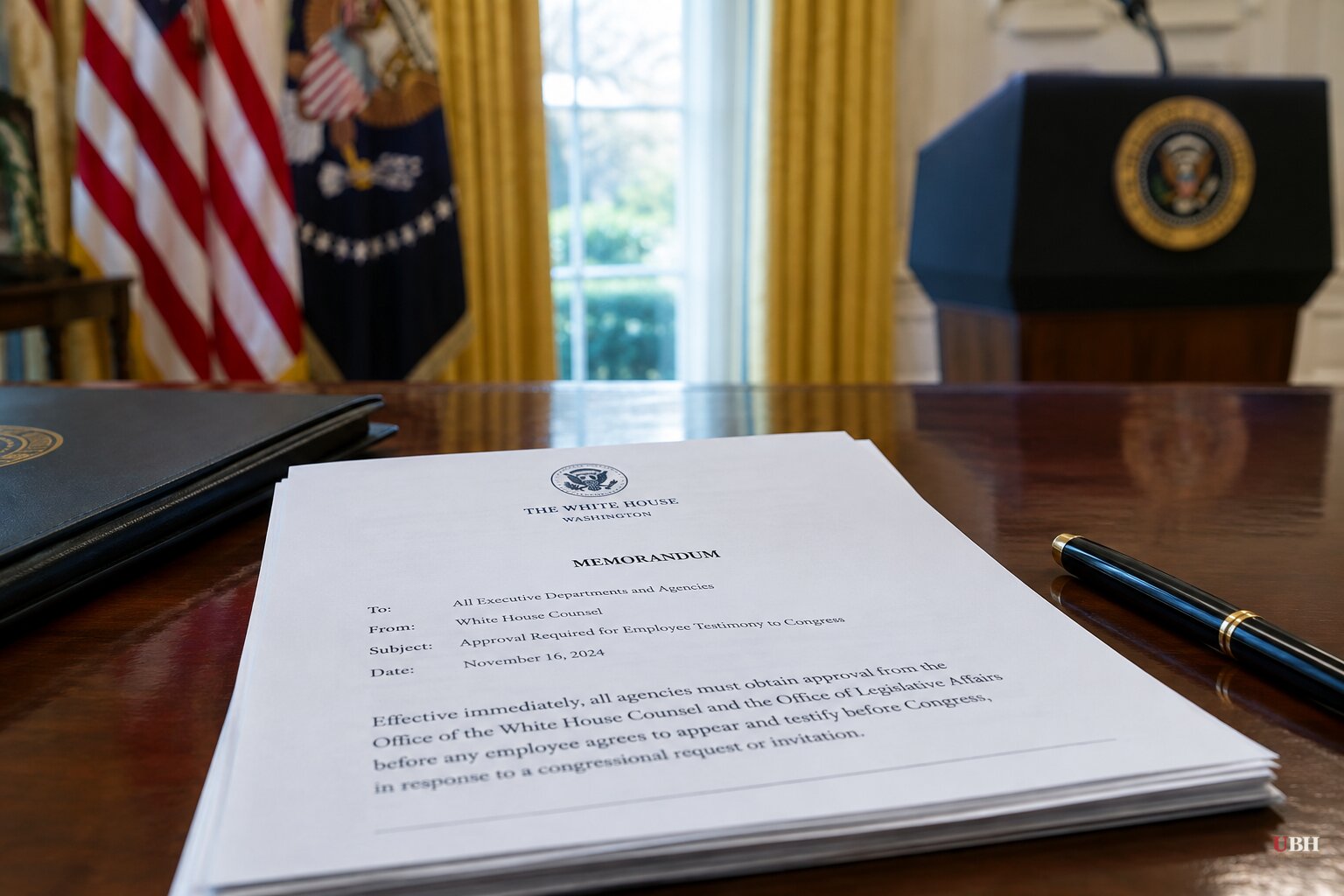
The White House told every executive branch agency today, Nov. 16, that no employee may agree to testify before a congressional committee without prior approval from the White House.
In a one-page memo to agency general counsels, White House Counsel Will Scharf wrote that departments "must obtain approval from the White House Office of Legislative Affairs (OLA) and the Office of the White House Counsel (WHCO) before any agency personnel may agree to appear before any congressional committee." He called this "the established White House consultation process."
The memo closes with a line promising more to come: "Further guidance regarding other engagements with Congress is forthcoming."
The timing
The directive lands about seven weeks before Democrats take control of Congress after the midterms. Incoming leaders have promised heavy oversight of the Trump administration.
A White House official gave the administration's explanation in an emailed statement: "The Trump Administration will not be extorted, intimidated, or threatened into submission by politically motivated baseless investigations." The official added that the administration is "ready to engage with Congress" and that the process "ensures reasonable requests are respected."
The official also said agencies can still meet "legitimate congressional oversight requests while keeping Cabinet officials focused on their foremost responsibility: serving the American people and delivering results for them."
The letter that came first
The memo follows a three-page letter Scharf sent Nov. 9 to Rep. Robert Garcia, D-Calif. Garcia is the ranking Democrat on House Oversight and is set to chair the committee in January.
"Congressional investigations must further a legitimate legislative task; Congress cannot employ them to exercise powers of criminal prosecution assigned to the Executive and the Judiciary," Scharf wrote. He warned that process "designed merely to abuse or instill fear in the recipient may cross the line into blatant criminality."
The letter quotes Democratic lawmakers on subpoenas. Rep. Emily Randall promised to hand them out "like candy." Rep. Analilia Mejia said she would toss them out "like Mardi Gras beads." Sen. Ed Markey joked about needing "new forests" for the paper. The letter also cites Garcia's "LAWYER UP" campaign aimed at administration officials.
Garcia has pledged public hearings on the Jeffrey Epstein investigation, which he called "the largest White House cover-up in history." He answered Scharf that Congress draws its oversight authority from Article I of the Constitution. Garcia has also said voters gave Democrats a mandate to pursue accountability.
Scharf told Bloomberg over the weekend that the administration's approach to congressional subpoenas will be "prudential." Asked whether the White House would comply with requests expected in the next Congress, he said it depends.
Democrats are already asking for records
The White House official pointed to four letters House Democrats have sent to agencies, including the Department of Homeland Security, asking that documents be preserved. The official called them "exorbitant demands."
Rep. Bennie Thompson, D-Miss., asked DHS for written assurances that it will preserve its records. He gave the department until Dec. 2 to turn over documents he requested earlier. Rep. Bobby Scott, D-Va., sought similar assurances from the Department of Agriculture.
House Natural Resources Democrats sent letters covering official communications on personal devices, including disappearing messages. Rep. Zoe Lofgren, D-Calif., sent preservation requests to companies, individuals and federal agencies.
In August, the Justice Department issued guidance meant to bolster protections for people who deal with government officials but are not formally government employees. An Office of Legal Counsel opinion argued that executive privilege can extend to certain confidential communications with the president's private advisers.
What the memo does and does not do
The memo is narrow on its face. It governs whether an employee may agree to appear. It does not itself say any request will be refused.
The White House has not said how it will define a "reasonable" or "legitimate" request. It also has not said whether approval can be denied for a particular witness or topic, or what happens if a committee issues a subpoena anyway.
The administration's argument has a basis in its own terms. Scharf says oversight must serve a legislative purpose, and he points to Democratic lawmakers' own words about subpoenas as evidence of an intent to intimidate. Taxpayers also have an interest in Cabinet officials running departments rather than sitting in hearing rooms for open-ended fishing expeditions.
Congress has its own constitutional footing. Garcia's Article I position holds that the legislative branch does not need the executive's permission to examine how the executive spends money and enforces law. Rank-and-file civil servants, unlike political appointees, often hold the day-to-day facts that lawmakers want. Routing every one of those appearances through the White House counsel's office puts a political checkpoint in front of them.
A fight over who defines "legitimate" is the likely result. That fight usually ends in court, or in a negotiated deal over what documents and witnesses a committee actually gets.
What comes next
The first concrete test is Thompson's Dec. 2 deadline for DHS to turn over documents, well before the new Congress is sworn in. The "further guidance" Scharf promised on other agency engagements with Congress is expected to follow.
Sources used for this briefing
6 links from 5 independent newsrooms (syndicated copies of the same report count once)
These are the sources it draws on, linked so you can verify.
More coverage: Congress


