
Unbiased headlines. Facts, not spin.
Every story is an unbiased news briefing written from 110+ sources across the spectrum — sources linked so you can verify it yourself.
 energy
Major Story (8/10)
September 16, 2026 at 09:50 AM
energy
Major Story (8/10)
September 16, 2026 at 09:50 AM
Von der Leyen Says Iran War Has Cost EU €90 Billion in Extra Fossil Fuel Bills, Unveils New Spending Plans
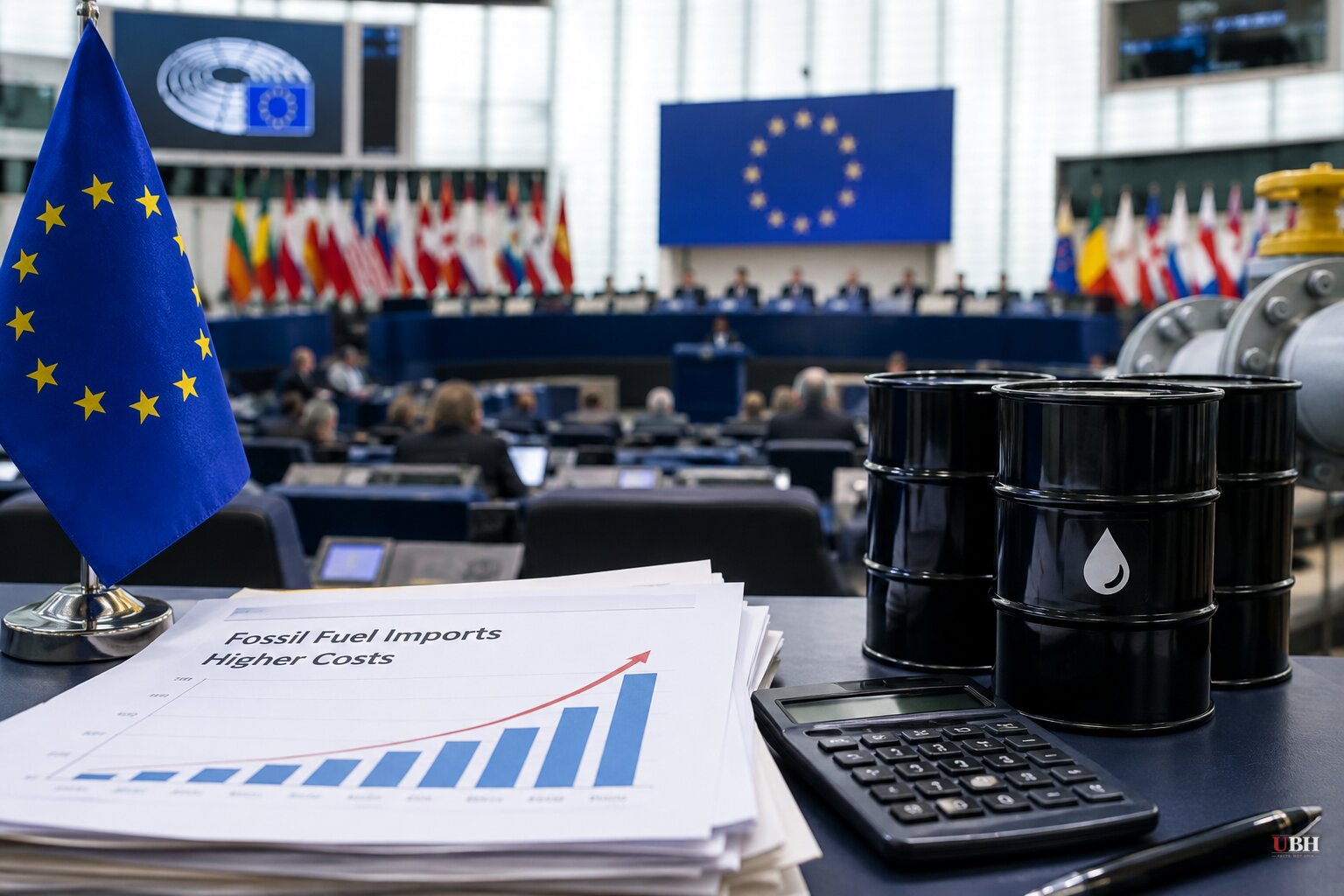
European Commission President Ursula von der Leyen told the European Parliament on Wednesday that the war with Iran has added €90 billion to the EU's fossil fuel import bill since fighting broke out, with what she called "not a single molecule of energy added" for that money.
The figure landed during her annual State of the Union address. The European Commission had already put the EU's total 2025 fossil fuel import bill at €340 billion, with more than half the bloc's energy still coming from oil, gas and coal. Von der Leyen's €90 billion number is the extra cost piled on top of that, blamed on disruption tied to the Strait of Hormuz since the U.S. and Israel launched military action against Iran on February 28, 2026, according to Euronews.
A separate report from the Centre for Research on Energy and Clean Air, cited by Euronews on August 26, put the damage in narrower terms. Just four EU countries, the Netherlands, Italy, France and Spain, absorbed roughly €41 billion in extra fossil fuel costs between March and August, according to CREA. Worldwide, the group tracked 134 countries paying more than expected for diesel, with global additional fossil fuel costs topping €282 billion, oil alone accounting for €140 billion of that. LNG prices jumped 60% in the Atlantic and 75% in the Pacific; diesel and petrol rose 59% since the war started, per CREA's numbers.
Those two figures aren't apples to apples. Von der Leyen's €90 billion covers all 27 EU members over a longer window; CREA's €41 billion is four countries through August. Both point the same direction: Europe is paying real money for a war it isn't fighting.
Notably, Russian State Media Ran With the Number
Ground News tracked von der Leyen's €90 billion figure being picked up by Interfax.ru and RIA Novosti, both flagged as Russian state-linked outlets. The EU spent years trying to cut its dependence on Russian energy after the Ukraine invasion, only to end up handing Moscow-aligned press a fresh talking point about European energy vulnerability, this time thanks to Iran instead of Russia.
The New Spending Pitch
Von der Leyen used the cost figure to launch several new initiatives. A climate insurance alliance would help cover catastrophe losses, since she said only a quarter of such losses are currently privately insured, leaving national budgets as "the insurer of last resort." A climate resilience framework, due next month, will map 100 of the EU's most vulnerable regions. A European Water Initiative is meant to address vanishing river flows in the Danube and Rhine. And a new European Corporation on Critical Raw Materials would stockpile elements needed for clean-energy tech and defense, given that roughly 90% of rare earths currently come from China, according to the Commission.
She also touted an 80% increase in EU defense spending over the past five years, part of a broader pitch that Europe is becoming more self-reliant.
The EU could reasonably be criticized for using a wartime price shock to justify a permanent expansion of Brussels' regulatory and spending reach. Critics of EU bureaucracy might argue that a "European Corporation on Critical Raw Materials" and a continent-wide water initiative go well beyond emergency energy relief. Von der Leyen's own framing counters that argument somewhat, tying the raw materials push directly to reducing dependence on China, which lines up with the same energy-security logic driving the fossil fuel pivot.
The War Itself Isn't Cooling Off
While Brussels tallies its bill, the shooting hasn't stopped. Iran's parliament speaker, Mohammad Bagher Ghalibaf, warned on September 7 that Tehran would strike U.S. oil and gas assets in the Gulf, writing on X that "the oil and gas production chain here is sprawling, accessible, and exposed." That came a day after Pentagon chief Pete Hegseth warned on X that U.S. forces would sink Iranian oil tankers if Iran attacked Navy ships.
Senior Iranian security official Mohsen Rezaei said on September 6 that Iran would soon announce a new restricted zone in the Gulf and approve maps for a shipping corridor through the Strait of Hormuz, adding that Iran would only reopen the strait fully once U.S. "sabotage, threats, and attacks" stop, according to the Epoch Times.
American drivers are feeling it too. AAA put average U.S. gas prices at $4.15 a gallon on September 7, with diesel hitting a record $5.90, the Epoch Times reported.
Vice President JD Vance told the New York Post on Monday that the war will enter "a much different phase" within a couple of months, describing a first phase focused on destroying Iran's nuclear program and military, and a second phase aimed at preventing Iran from rebuilding. "We're just not" engaged in aggressive operations right now, Vance said, adding that Iran is "occasionally shooting at commercial shipping, usually not successfully."
Energy Secretary Chris Wright has said a nuclear deal with Iran may not happen until the current regime falls, telling ABC News the U.S. Navy's mission includes blocking Iranian oil exports outright.
If Iran actually rolls out the restricted shipping zone Rezaei described, the EU's €90 billion bill could grow before Vance's promised "different phase" ever arrives.
Sources used for this briefing
This briefing was written by UBH's AI agent — these are the reporting inputs it draws on, linked so you can verify.


