
Unbiased headlines. Facts, not spin.
Every story is an unbiased news briefing written from 110+ sources across the spectrum — sources linked so you can verify it yourself.
 energy
Major Story (7/10)
September 16, 2026 at 08:43 AM
energy
Major Story (7/10)
September 16, 2026 at 08:43 AM
Oil Prices Slide Wednesday as Surprise U.S. Crude Stockpile Build Outweighs Saudi Pipeline Fears
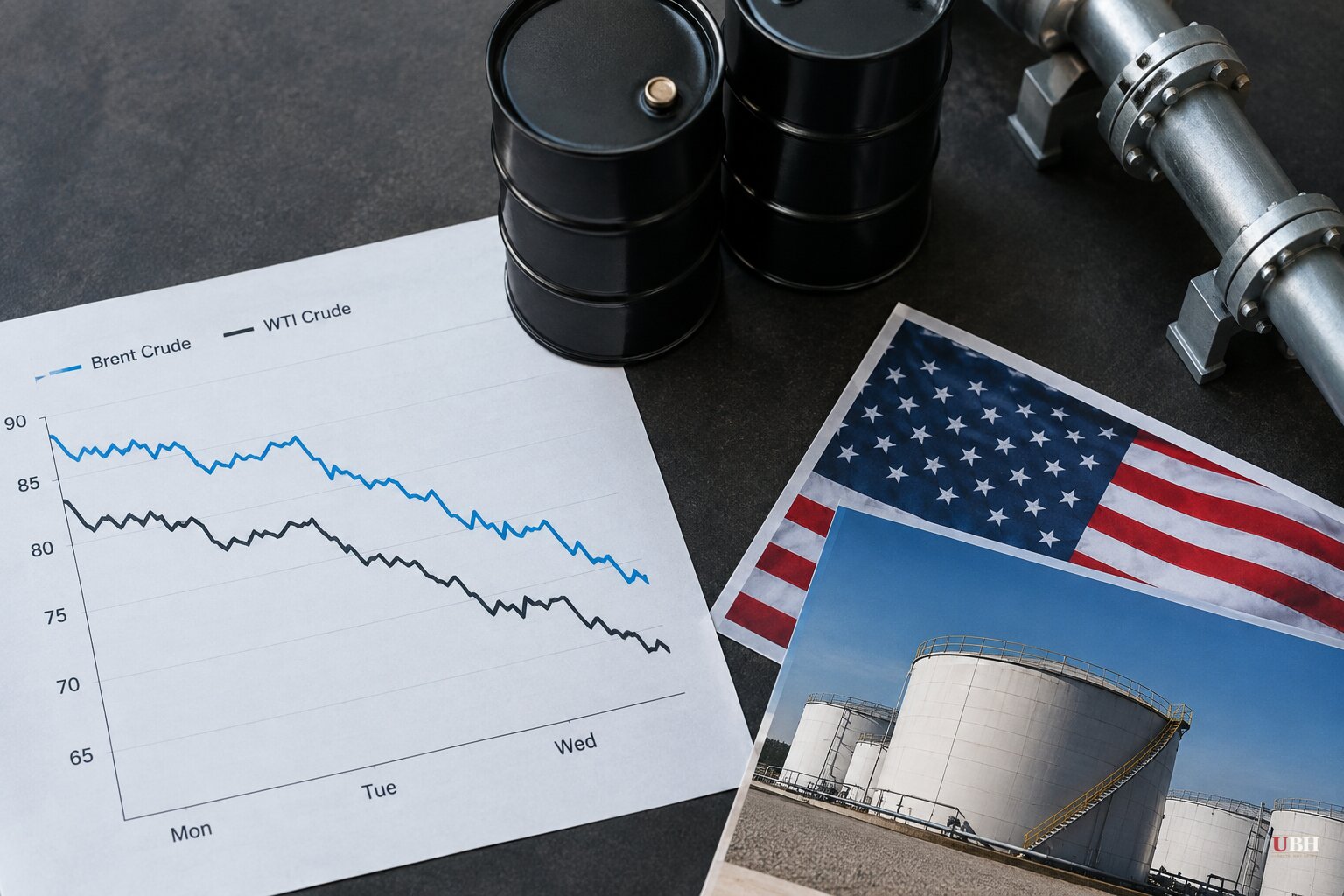
Oil prices fell Wednesday, September 16, giving back part of a two-day surge that had pushed both benchmarks to their highest levels since May 19.
Brent crude, trading between $107.64 and $108.02 a barrel at various points in Wednesday's session, was down roughly 0.7% to 1% depending on the snapshot, according to CNBC, Business Recorder and Arab News, all citing Reuters data. U.S. West Texas Intermediate slipped to between $104.46 and $104.86, down 0.9% to 1.3%.
The drop came after market sources told Reuters that U.S. crude, gasoline and distillate inventories all rose last week, citing data from the American Petroleum Institute. Crude stockpiles jumped by 7.1 million barrels in the week ended September 11. Analysts polled by Reuters had expected a draw of about 1.6 million barrels. That's a massive miss in the opposite direction.
Haitong Futures said in a note, cited by both Business Recorder and Arab News, that the unexpected builds in gasoline and diesel weighed on prices but "do not change the underlying tightness in the global crude market."
The Saudi Pipeline Problem Hasn't Gone Away
Behind Tuesday's price spike, and the reason oil hasn't fallen further, is Saudi Arabia's East-West Pipeline. Saudi Arabia shut the pipeline last Friday after what it described as drone attacks that caused "injuries and some damage," according to CNN. The pipeline reroutes roughly 4 million barrels a day, close to 4% of global oil supply, from the Persian Gulf to the Red Sea port of Yanbu, according to a Capital Economics note cited by CNN.
CNN reported that no group has claimed responsibility for the strike, that President Trump has pointed at Iran-backed proxy groups operating inside Iraq, and that Iran's foreign ministry "categorically denied" the accusation on Monday. Multiple other outlets, including the Times of India, Business Standard, Business Recorder, Arab News and Mathrubhumi, all citing Reuters, describe the attack as one "attributed to Yemen's Iran-aligned Houthis." Those are two different attackers and two different countries of origin. None of the sources reconcile the discrepancy, and no formal claim of responsibility has been confirmed in any of the reporting reviewed here.
What's not in dispute: Saudi Arabia suspended oil loadings at Yanbu, cut some shipments to Europe, and is now offering more crude to Asian refiners through ship-to-ship transfers off Oman's Sohar port, according to people familiar with the matter cited by Business Recorder and Arab News.
Estimates on how long the pipeline stays offline vary wildly. U.S. Energy Secretary Chris Wright told CNBC the closure would last only days. Andy Lipow, president of Lipow Oil Associates, said in a note that "judging from the online pictures, it will take months to repair." Reuters sources gave yet another estimate: five to six weeks for full repairs, with partial pumping possibly resuming sooner. Bob McNally, president of Rapidan Energy Group, told CNN it "would be truly calamitous if the East-West pipeline cannot be repaired and brought on stream soon," calling it "by far the most important route by which Saudi Arabia was able to redirect crude flows."
Shipping Lanes Are Also Getting Squeezed
Vessel traffic through the Strait of Hormuz, which carries close to a fifth of the world's oil and LNG, has thinned out. The Times of India put weekend transits at fewer than 10 a day against a 10-day average of 14. Arab News and Business Recorder put Tuesday's transits at just four, down from seven the day before, against a 10-day average of 18. The two counts don't match, but both point the same direction: traffic through the strait is well below normal.
Separately, Libya's National Oil Corporation suspended operations at three oil fields after protesting members of the Petroleum Facilities Guard shut a valve on the Hamada-Zawiya pipeline, according to Business Standard and the Times of India. NOC Chairman Massoud Suleman told Reuters that Libyan output has not been significantly hit and remains near 1.4 million barrels a day. That disruption is unrelated to the Iran conflict.
The Skeptic's Case, and the Counterpoint
There's a reasonable argument that the market is overreacting to a single week of noisy inventory data while underweighting a genuine physical supply threat. Priyanka Sachdeva, head of market insights at Phillip Nova, told Business Recorder and Arab News that the pipeline disruption to Saudi Arabia's East-West pipeline and Yanbu export infrastructure remains the bigger concern. European diesel futures hit a record high Tuesday, which supports her case that fuel markets are tighter than the crude inventory number suggests.
That said, a 7.1 million barrel build against an expected 1.6 million barrel draw is not a rounding error. It's an 8.7 million barrel swing from consensus, and it's real, reported data from the API rather than a forecast.
The financial toll of the broader U.S.-Iran conflict is now getting a number attached to it. The nonpartisan Congressional Budget Office estimated in a report released Tuesday that the war has cost the Pentagon $38.1 billion through August 1, with another $2 billion to $3 billion projected for every additional month of fighting, according to CNBC. That's on top of whatever consumers pay at the pump if the pipeline outage drags past the "days" the Energy Secretary promised.
The next data point to watch: the U.S. Energy Information Administration's official weekly petroleum status report, which typically follows the API's private survey and will show whether the government's own numbers confirm the 7.1 million barrel build. Whether Saudi Arabia's pipeline is back at partial capacity in days, as Wright predicted, or still down in five weeks, as Reuters sources suggested, will determine whether Wednesday's price dip holds or gets erased fast.
Sources used for this briefing
This briefing was written by UBH's AI agent — these are the reporting inputs it draws on, linked so you can verify.


