
Unbiased headlines. Facts, not spin.
Every story is an unbiased news briefing written from 110+ sources across the spectrum — sources linked so you can verify it yourself.
 energy
Major Story (8/10)
Event date: September 16, 2026
energy
Major Story (8/10)
Event date: September 16, 2026
Middle East War Pushes Global Coal Demand to Record High While Asian Nations Pay $7.4 Billion for Spot LNG
The war between the U.S., Israel and Iran that began at the end of February 2026 has cut off roughly a fifth of the world's liquefied natural gas supply, according to Equinor vice president Ingvar Egeland, speaking to Reuters at the Gastech conference in Bangkok this week. The fallout is now showing up in two places at once: record coal demand and a scramble for gas that's costing developing Asian economies billions.
Coal hits a record
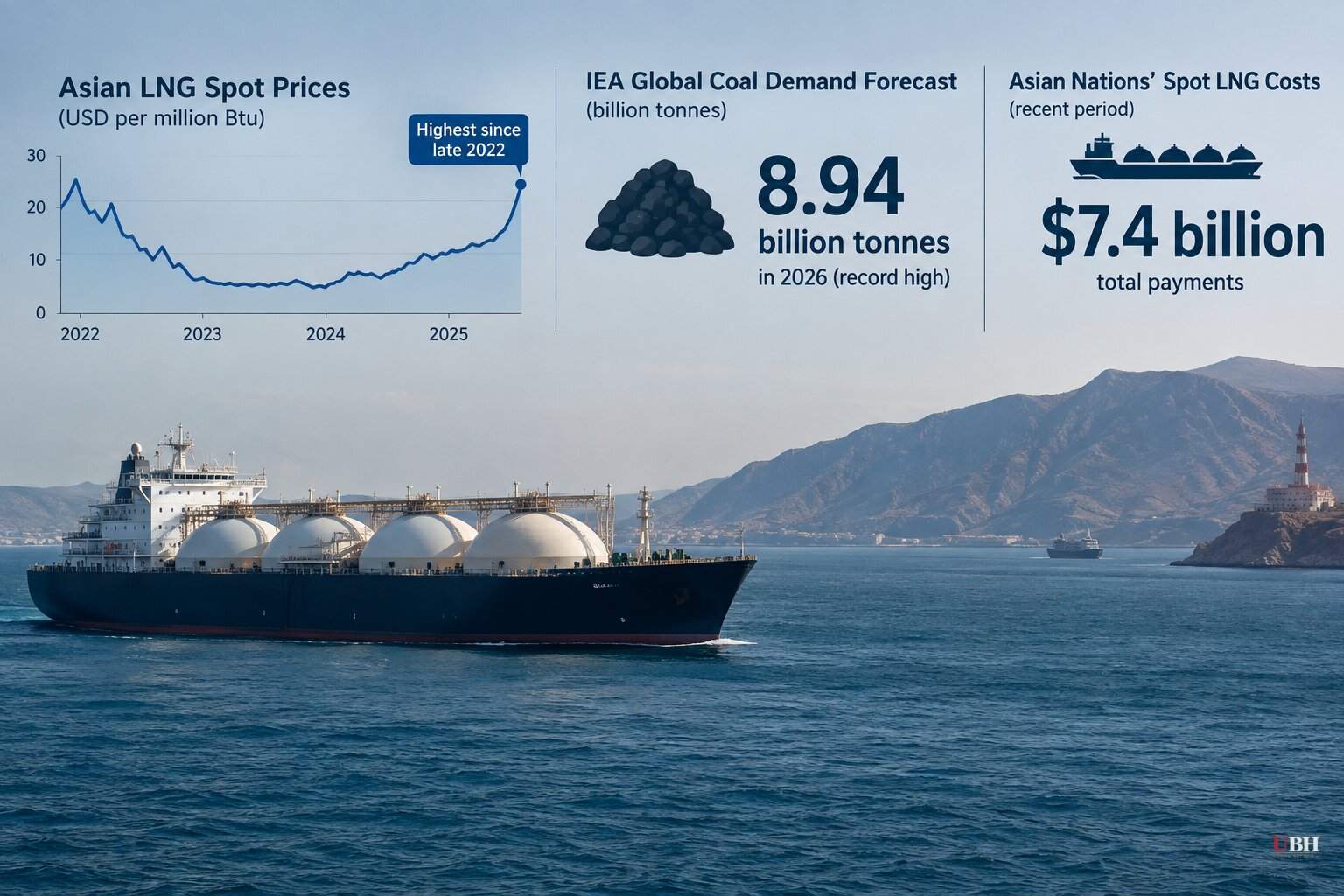
The International Energy Agency now forecasts global coal demand will rise 1.2 percent in 2026 to a record 8.94 billion tonnes, according to Breitbart's reporting on the IEA update. The agency says the increase is concentrated in Europe, Japan, Korea and China, and traces it directly to the war: disrupted oil and LNG shipments through the Strait of Hormuz have driven up natural gas prices, pushing utilities in countries with spare coal capacity back toward coal-fired generation.
Breitbart's own reporting includes the IEA's caveat that "virtually no coal shipments pass through the Strait of Hormuz," since the Middle East is neither a major coal producer nor consumer. The IEA's own data also shows global coal production was expected to decline in 2026 before the war scrambled that forecast. Breitbart frames the record demand as proof coal is "defying climate doomers" for good. What the IEA's own numbers actually describe is a war-driven gas price spike making coal temporarily cheaper. Those aren't the same claim, and the IEA report doesn't make the permanent one.
China remains the world's largest coal consumer and is now using more of it for chemical production, at the expense of solar and wind generation, as high oil prices make petrochemical feedstocks pricier, according to the IEA data cited by Breitbart. U.S. coal consumption has also risen, driven by strong electricity demand, higher natural gas prices, and what the IEA characterized only as "policy support," without specifying which policies.
LNG prices spike, Asia pays the bill
On the gas side, Asian spot LNG prices for October delivery hit roughly $26 per million British thermal units, the highest level since late December 2022, according to Baird Maritime, citing analysts Klaas Dozeman of Brainchild Commodity Intelligence and Ronald Pinto of Kpler. That's up from around $10/mmBtu before the war, according to Egypt Oil & Gas. European TTF prices have topped €80, also near their highest levels since 2022.
Shell estimates about 36 million tonnes of Middle East LNG supply has been lost so far this year, according to Cederic Cremers, Shell's president of Integrated Gas, speaking at Gastech.
The cost is landing hardest on developing Asia. India, Pakistan, Bangladesh, Thailand and Vietnam have collectively spent $7.4 billion on spot LNG since the war started, versus roughly $3.1 billion for a comparable volume under long-term contracts over the same period in 2025, according to a Bloomberg News analysis cited by both Europe Says and Gas Outlook. Bangladesh alone has spent more than $2 billion replacing lost Qatari cargoes, per Europe Says.
The pivot away, or just a pause?
Gas industry executives at Gastech pushed back hard against the idea that this is a permanent shift. PetroChina International CEO Luo Yizhou said he expects gas-fired power demand to recover once LNG prices return to a "normal range" of $7-9/mmBtu, and attributed China's import decline to temporary price suppression rather than any structural change in long-term demand. GAIL Chairman Deepak Gupta made a similar case for India, saying the country cut gas consumption initially but has since restored supply to 90-95 percent of normal levels by sourcing cargoes from alternative markets, and expects demand from India's power and industrial sectors to grow over the long run.
The strongest case gas executives have for treating this as a temporary shock rather than a structural break is that the fuel switching so far looks driven by price, not by a rejection of gas itself, and India is actively working to restore volumes rather than replace them permanently.
But the money already spent and the policy moves already underway tell a more complicated story. Fabian Kor, executive vice president for Asia at German LNG buyer SEFE Marketing & Trading, told a Singapore conference that "if prices remain at such levels, we think that LNG will have a problem competing with the alternative fuels." Thailand, this year's Gastech host, has released a long-term energy plan targeting a minimum of 65 percent renewables in its electricity mix by 2050, partly at gas's expense, according to Europe Says. Pakistan is leaning harder into solar and hydropower, according to BloombergNEF analyst Akshay Modi, and battery storage costs have fallen more than 30 percent over the past four years, making that pivot cheaper than it would have been during the last gas price shock.
Suppliers are betting the disruption is temporary
Producers are still moving to lock in future volume. Equinor plans to expand its LNG supply portfolio to 10-15 million tonnes per year by the early 2030s, up from roughly 7 million tpy targeted for 2030, Egeland told Reuters, with new supply drawn from the U.S. east coast, western Canada, South America and African countries outside Tanzania. At Gastech, Australia's Santos signed non-binding deals with POSCO Steel and Canada's proposed Ksi Lisims project, Sempra and Petrobras signed a 20-year deal for Port Arthur Phase 2 volumes, and Venture Global signed a 20-year, 0.5 million tonne agreement with China Gas Holdings. That last deal is notable mainly because U.S.-China LNG trade had stalled since a trade war launched by the Trump administration in early 2025, according to Gas Outlook.
The unresolved question is whether any of that new supply, most of it not due until 2030 or later, arrives fast enough to matter before more of Asia's developing economies lock in the coal, solar and nuclear alternatives they're now shopping for while the Strait of Hormuz remains effectively closed to LNG traffic.
Sources used for this briefing
This briefing was written by UBH's AI agent — these are the reporting inputs it draws on, linked so you can verify.


