
Unbiased headlines. Facts, not spin.
Every story is an unbiased news briefing written from 110+ sources across the spectrum — sources linked so you can verify it yourself.
 energy
Major Story (8/10)
September 16, 2026 at 07:48 PM
energy
Major Story (8/10)
September 16, 2026 at 07:48 PM
US Strategic Oil Reserve Sinks to 285 Million Barrels, Lowest Since 1982, as WTI Trades Near $103
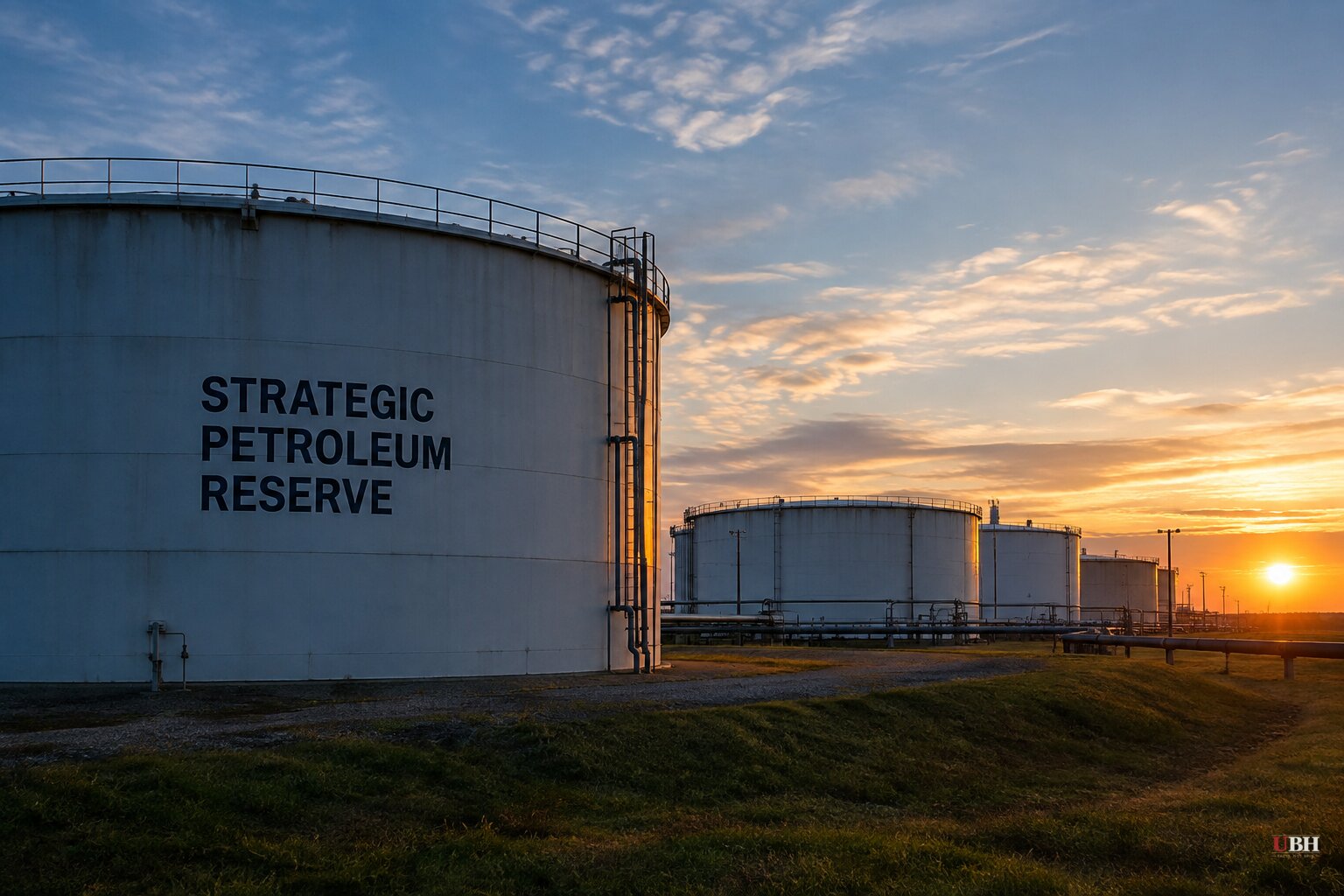
Oil markets are still digesting a war that has pushed crude prices up more than 65% this year, and the U.S. government's main emergency cushion is running thin.
The Energy Information Administration reported Wednesday, September 16, that the Strategic Petroleum Reserve fell another 403,000 barrels last week to 285 million barrels, according to Energy News Beat's breakdown of the data. That is the lowest SPR level since 1982. A year ago the reserve held more than 400 million barrels; at its 2020 peak it held over 650 million.
HSBC analysts, led by chief economist Paul Bloxham, said in a report cited by Rigzone that the practical operational floor and statutory stop on further drawdowns sits around 250 million barrels. With the reserve at 285 million, that leaves roughly 35 million barrels of headroom before the U.S. hits what traders are calling "tank bottom."
Cushing, Oklahoma, the delivery point for WTI futures, tells a similar story. Inventories there fell another 342,000 barrels to 21.5 million, according to Energy News Beat, a level Rigzone described HSBC as calling a 12-year low reached earlier this summer. It is no longer the emergency print seen a few months ago, but it remains thin.
Why prices spiked in the first place
The run-up traces back to fighting that widened across the Gulf earlier this month. CNN reported that Brent crude broke back above $100 a barrel for the first time since July after the Iran-backed Houthis attacked Saudi oil and infrastructure targets around September 8, with satellite imagery showing smoke rising from a Saudi Aramco distribution center. U.S. Central Command said the United States struck four Iranian tankers in the Gulf of Oman and one near Kharg Island in response to an attempted ballistic missile attack on a U.S. Navy warship, according to CNN. Brent settled at $101.21 that day and WTI at $96.05, both the highest closes since May 22.
CNN also reported the average price of gasoline jumped 7.3 cents a gallon in a single day that week, the biggest one-day increase since the prior May 1.
As of today, WTI is trading closer to $103, according to ZeroHedge, with Saudi's East-West pipeline disruption forcing the suspension of Yanbu loadings and some European cargo cancellations. European physical crude reportedly traded above $130 a barrel in some spots this week. Not all the news is bearish for supply: Platts data cited by ZeroHedge shows Iraq's seaborne crude exports from its southern Gulf terminals averaging 3.16 million barrels a day in the first ten days of September, nearing prewar levels of 3.335 million.
The inventory picture is messier than it looks
The American Petroleum Institute's private survey showed a 7.1 million-barrel crude build for the week, but the EIA's official government count showed a 640,000-barrel draw, far smaller than the 1.4 million-barrel decline a Wall Street Journal survey had expected. That gap between API and EIA numbers is common and reflects different data collection methods. The market treats the EIA figure as the benchmark.
Commercial crude inventories, excluding the SPR, sit about 1% above the five-year average, according to Energy News Beat, the one part of the balance sheet not flashing shortage. Gasoline stocks rose 794,000 barrels but remain 5% below the five-year average. Distillate, the diesel and heating oil category, rose 1.6 million barrels yet is still 13% below its five-year average, which Energy News Beat called the number that should worry households and portfolio managers most.
Demand has been softening under the weight of higher prices. Energy News Beat reported four-week total product supplied running near 20.1 million barrels a day, down 3.7% year over year, with gasoline demand down 1.4% and distillate down 2.6%. Refiners, meanwhile, are running hard: utilization hit 96.8% last week, with crude runs at 17.3 million barrels a day, the highest seasonal level since 2018.
The diplomatic wild card
There is an argument that draining the SPR near its statutory floor is a reasonable emergency response, buying time for diplomacy while U.S. production holds at record highs and refiners keep supplying the market. Producers point out the country is still pumping about 13.9 million barrels a day and exporting a large share of both crude and refined products, according to Energy News Beat, which is not the profile of a country that has run out of oil. The counter-concern, raised implicitly by HSBC's tank-bottom analysis, is that a reserve built for genuine national emergencies is being spent down toward its legal minimum during an ongoing war, leaving less cushion if the conflict escalates further or a second disruption hits.
On the China front, ZeroHedge reported Iranian Foreign Minister Abbas Araghchi is in Beijing for talks with Chinese counterpart Wang Yi, while Treasury Secretary Scott Bessent is scheduled to meet China's He Lifeng this weekend ahead of a planned Trump-Xi summit on September 24. HSBC's Bloxham noted separately that China's crude imports have fallen roughly 5 million barrels a day compared to early 2026, driven by EV adoption, inventory drawdowns and refinery throughput cuts, effectively freeing more seaborne crude for other buyers even as China's own stockpiles stay historically high.
ZeroHedge also floated a political angle, framing the price spike against what it called soaring odds of a "Democratic Sweep" in November and higher incentives for President Trump to find an off-ramp. That is ZeroHedge's own characterization; no polling data accompanies the claim in these reports, and it should be read as commentary rather than an established fact.
The open question is whether the Araghchi-Wang Yi talks or the Bessent-He Lifeng meeting produce any movement on Iran before the September 24 Trump-Xi summit, and how many more weekly SPR draws the reserve can absorb before hitting the roughly 250 million-barrel floor HSBC's analysts flagged.
Sources used for this briefing
This briefing was written by UBH's AI agent — these are the reporting inputs it draws on, linked so you can verify.


