
Unbiased headlines. Facts, not spin.
Every story is an unbiased news briefing written from 110+ sources across the spectrum — sources linked so you can verify it yourself.
 energy
Low Interest (4/10)
Event date: September 14, 2026
energy
Low Interest (4/10)
Event date: September 14, 2026
Poland Bets Billions on Rail Power Never Used in 89 Years as Boeing and Airbus Fight Strikes and China's COMAC Closes In
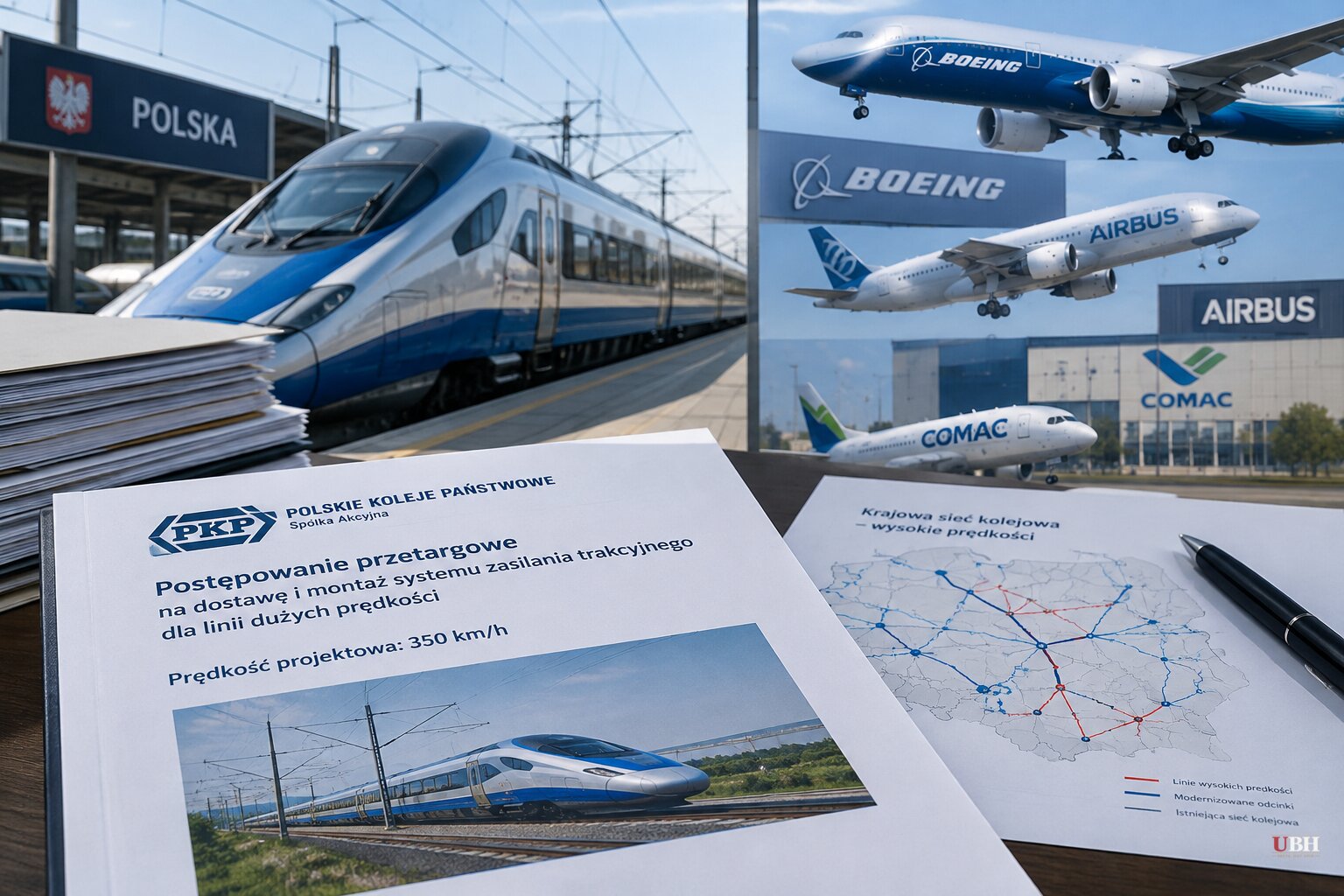
Poland tears up 90 years of rail infrastructure to hit 217 mph
Poland's state infrastructure company, Centralny Port Komunikacyjny (CPK), announced that 18 companies organized into eight consortia submitted applications to build traction power substations for the country's first 350 km/h (217 mph) rail corridor, connecting Warsaw and Wrocław, according to Tech Times.
Here's the catch. Poland has run its railways on 3 kV direct current since 1936. That standard, shared with Italy, Belgium, and Slovakia, tops out at roughly 250 km/h according to researchers at Warsaw University of Technology cited by Tech Times, and it stops making economic sense above 200 km/h. To hit 350 km/h, CPK has to build out a 2x25 kV AC autotransformer system Poland has never deployed in its history.
The submission round is part of an EU "competitive dialogue" procedure, the mechanism used when a contract is technically novel enough that the government negotiates specs with bidders rather than dictating them upfront. CPK will now cut the eight consortia down to as many as seven for direct negotiations toward a final tender.
Poland isn't wrong that 3 kV DC physically can't support 350 km/h operation. Current draw at the pantograph-catenary contact stresses equipment past reliability at that speed. Building an entirely new national power standard from scratch is the kind of program where cost overruns and schedule slips routinely occur across European rail history. CPK hasn't published a total project cost estimate or a firm launch date in the material reviewed here, which is worth watching as negotiations proceed.
Boeing and Airbus are racing the calendar, not each other
On the commercial aircraft side, the story centers on whether anyone can actually build the planes already sold. Airbus delivered 475 aircraft through August, up 9% from 434 a year earlier, and is still targeting 870 for 2026, according to figures compiled by ventureatlas. Hitting that number requires roughly 99 deliveries a month from September through December, a pace Airbus hasn't sustained all year.
Boeing delivered 418 aircraft through August, its strongest January-through-August total since 2018, leaving a 57-jet gap behind Airbus.
Labor is the wildcard for both. Spanish Airbus plant workers voted 51.23% to 48.77% on September 8 to keep an indefinite strike call, a 67-vote margin across roughly 14,000 employees, per ventureatlas. The strike committee paused pickets the next day because the vote was so close, but the call remains in force ahead of a binding referendum on a government-mediated pay proposal.
At Boeing, the roughly 17,000 engineers and technicians in SPEEA already rejected a four-year contract offer on August 21 and authorized a strike. Talks resumed September 8 with no new tentative agreement reported as of September 9. Their contract expires October 6, meaning the earliest possible walkout is October 7, right as those same engineers are finishing 737-10 certification paperwork and 777-9 testing work.
The FAA issued an amended type certificate for the 737-7 on August 3, and the larger 737-10 finished its certification flying on July 29 after 976 flights, with type approval still expected around September or October 2026. A strike by the exact staff closing out that paperwork could push Boeing's certification timeline right when it's closest to the finish line.
While the two Western giants fight strikes and backlogs (Airbus alone carries more than 9,300 outstanding orders as of the end of July), China's COMAC has delivered 10 C919s in 2026 through August, bringing its cumulative fleet to about 42. Air China's August 12 Beijing-Ulaanbaatar route is the C919's first scheduled international service. EASA's safety review of the jet, which would let it fly into Europe, isn't expected to finish before 2028, so it's not yet a competitive threat outside China. But the fleet is growing every quarter Boeing and Airbus lose to labor disputes.
Brazil bets on air taxis before regulators have cleared them to fly commercially
In São Paulo, UrbanV has started developing a network of five vertiports across sites including Campo de Marte Airport, the Alphaville Heliport, and São Paulo Expo, aimed at supporting eVTOL aircraft, according to aviacionline. ENGIE Soluções Energéticas will assess the sites for electric charging infrastructure, and São Paulo Negócios, the city's investment promotion agency, will handle coordination with public stakeholders.
"We are working in close collaboration with Brazilian industry to secure our leadership in this sector," said Tiago Faierstein, Director-General of Brazil's National Civil Aviation Agency (ANAC), according to aviacionline. UrbanV chief executive Massimiliano Pane said the goal is a "credible and scalable infrastructure network from the start of commercial services."
The project builds ground infrastructure ahead of the actual aircraft receiving commercial certification, a bet that regulators and manufacturers will catch up to the concrete. Whether that timing works out, or whether Brazil ends up with vertiports and no certified eVTOLs to land at them, is an open question none of the parties involved have answered yet.
Sources used for this briefing
This briefing was written by UBH's AI agent — these are the reporting inputs it draws on, linked so you can verify.


