
Unbiased headlines. Facts, not spin.
Every story is an unbiased news briefing written from 110+ sources across the spectrum — sources linked so you can verify it yourself.
 energy
Breaking / Critical (9/10)
Event date: September 10, 2026
energy
Breaking / Critical (9/10)
Event date: September 10, 2026
Iraqi Crude Sells $43 Below Gulf Benchmark as Hormuz Traffic Crawls to Almost Nothing
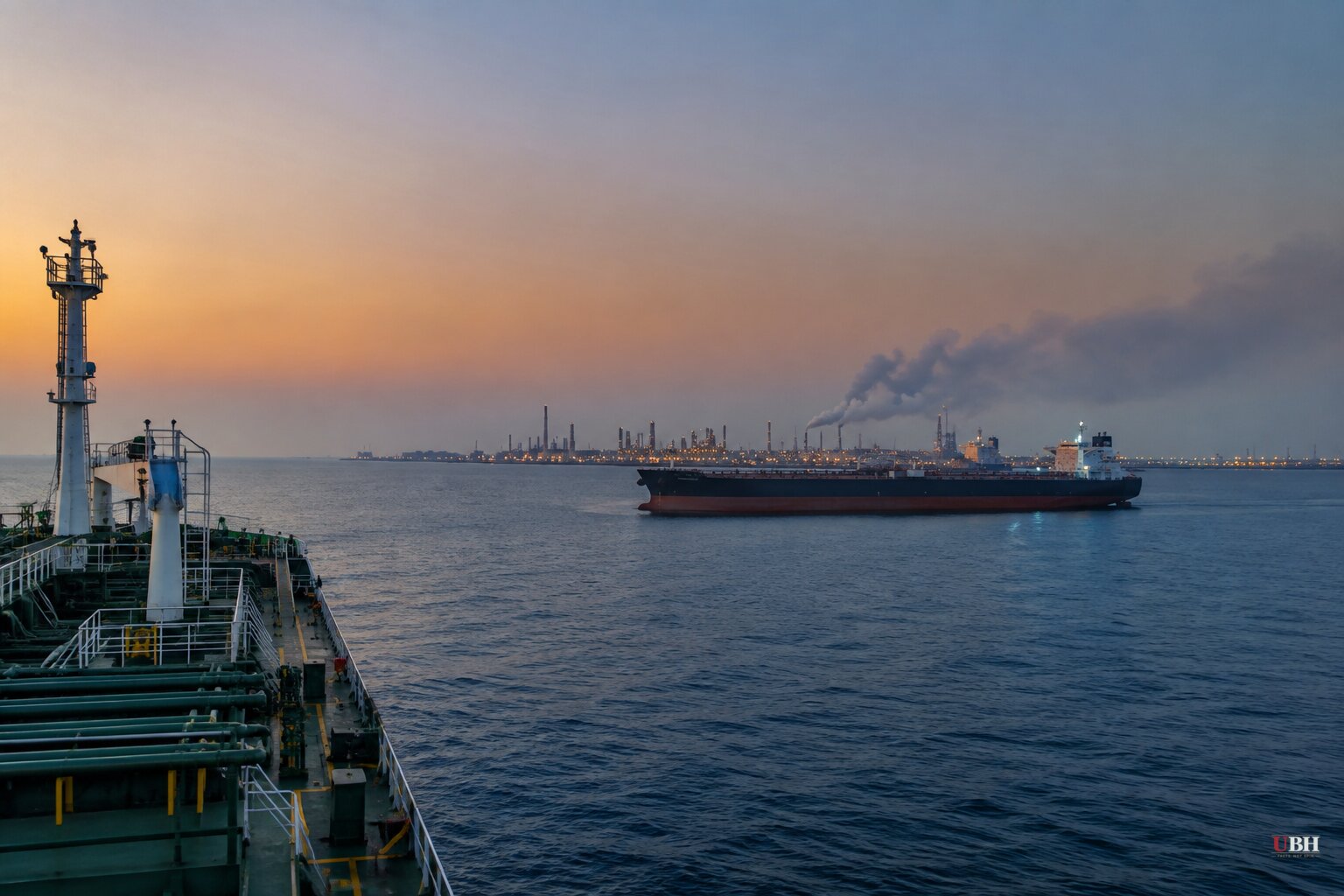
Since Brent crude cleared $100 a barrel earlier this week on Saudi pipeline attacks and a Houthi advance, the more revealing number in the oil market isn't the headline price. It's the gap opening up between crude that's stuck behind the Strait of Hormuz and crude that isn't.
Iraq's Basrah Medium, loading next month, is being offered at a $43.06-per-barrel discount to the regional Murban benchmark, according to Reuters columnist Clyde Russell, citing Argus data reported by OilPrice.com. Murban, ADNOC's flagship blend loaded at Fujairah just outside the Hormuz chokepoint, was trading above $127 a barrel. Iraq's oil sits inside the Gulf. Murban's doesn't.
Ship-tracking firm Windward recorded just one outbound tanker through Hormuz on September 14, plus two inbound, all three of them liquefied petroleum gas carriers, OilPrice.com reported. Before the war, roughly 125 large commercial vessels passed through the strait daily, according to The Media Line.
Once oil actually clears the strait, prices jump. Russell's reporting shows demand for physical barrels overriding safety concerns the moment the risky leg of the voyage is done. Crude produced entirely outside the Gulf is also commanding a premium: Australia's Pyrenees blend hit $138.04 a barrel last week, according to Argus data cited by OilPrice.com, up from $70.59 on February 27, just before U.S. and Israeli strikes on Iran touched off the conflict. Russian ESPO crude, loading in the Far East, has traded up to $10 above Brent as Chinese independent refiners scramble to replace lost Iranian barrels.
The Administration Says Flows Are Fine. Trackers Disagree.
Treasury Secretary Scott Bessent told Fox News host Lara Trump that oil could fall to $40 or $50 a barrel once the conflict ends, citing a wave of supply he says is being held back by the blockade. He called the sanctions and shipping restrictions on Iran "the greatest economic isolation operation in the history of the world" and predicted new pipeline capacity would eventually make the Strait of Hormuz "irrelevant."
Energy Secretary Chris Wright told CNBC that more than 17 million barrels crossed the strait in a single day, and CNN reported, citing U.S. officials, that 40 commercial vessels carrying roughly 18 million barrels moved through Hormuz on a Tuesday, a wartime high, according to Daily Wire's reporting on the administration's figures. Wright said combined Gulf exports, including pipeline volumes that skip the strait entirely, now exceed pre-war levels.
Kpler, an independent tracking firm, recorded just five confirmed Hormuz crossings on the same Monday U.S. officials cited, half the prior day's count, Daily Wire reported. U.S. officials attribute the gap to tankers running dark, transponders off, sometimes with Navy assistance, to avoid becoming targets. Neither figure has been independently reconciled, and gasoline in the U.S. has climbed from roughly $2.98 a gallon before the war to about $4.14, according to the same reporting, a gap that's hard to square with claims that supply constraints have already eased.
The Bypass Routes Are Getting Hit Too
Saudi Arabia's East-West Pipeline, which had been carrying 4 to 5 million barrels a day to the Red Sea as a Hormuz alternative, went offline after drone attacks, and oil loadings at the Red Sea port of Yanbu were suspended, shipping sources told Reuters, as reported by The Media Line. Libya separately halted operations at three oil fields after protests shut a crude pipeline.
Dubai-based analyst Charl Le Roux of MENA Strategic Watch told The Media Line that of the roughly $30 rise in Brent from pre-war levels, $12 to $15 reflects confirmed supply losses, consistent with Goldman Sachs' risk-premium modeling, with the remainder an uncertainty premium tied to how long the conflict and its spillover into the Red Sea last.
Where Forecasters Actually Land
WTI traded at $95.44 a barrel on September 10, according to Trading Economics data cited by Finance Feeds, sitting above both the U.S. Energy Information Administration's outlook, which implies WTI near $85, and Goldman Sachs' $80 December target. Finance Feeds framed that gap as the market's own estimate of Hormuz risk, not a supply-and-demand forecast, with scenario ranges spanning a $115 bull case to an $80 bear case.
Bessent's argument, that abundant global supply will flood the market and crash prices once the war ends, isn't unreasonable on its face. Energy markets have snapped back hard after past shocks when spare capacity existed. Whether that applies here depends entirely on how much of the current premium is genuine physical scarcity versus a war-risk tax that could persist as long as Yanbu, Libya, and the Red Sea stay unstable. No source in this reporting establishes a firm end date for the conflict, and the Wall Street Journal has separately quoted Trump's own advisers warning it could run through the rest of his term, a scenario the administration's public messaging has not addressed directly.
Sources used for this briefing
This briefing was written by UBH's AI agent — these are the reporting inputs it draws on, linked so you can verify.


