
Unbiased headlines. Facts, not spin.
Every story is an unbiased news briefing written from 110+ sources across the spectrum — sources linked so you can verify it yourself.
 energy
Major Story (8/10)
Event date: September 5, 2026
energy
Major Story (8/10)
Event date: September 5, 2026
LNG Buyers Rush to U.S. Gas as Hormuz Risk Persists, McKinsey Survey Shows Lasting Shift
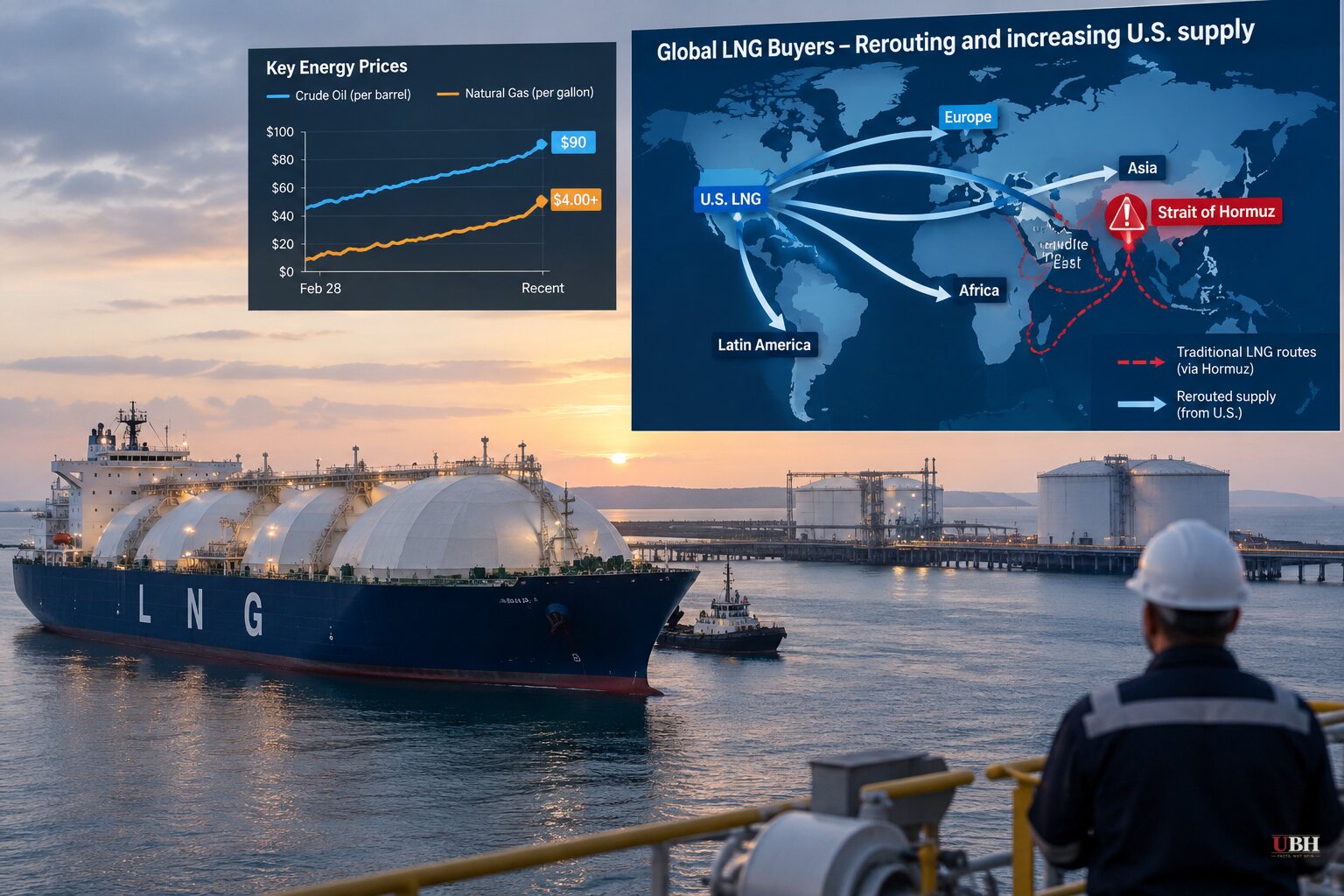
Since the war between the United States and Iran began February 28, crude has climbed from about $70 a barrel to roughly $90, and the average U.S. gas price has risen from about $2.98 a gallon to over $4. That price shock is now reshaping how the world buys natural gas, according to a McKinsey survey published September 14 and reported by IndexBox, citing TradeArabia News Service.
The survey polled 30 LNG buyers across 14 countries in April 2026, representing companies that account for roughly 80% of global LNG demand. About 80% of respondents said they expect to change their procurement strategy because of the Hormuz disruption. Ninety-three percent said they plan to diversify suppliers geographically over the next two to three years, and every respondent in China and other Asian markets said the same, compared to 80% of buyers in Europe, Japan and Korea.
More than half of respondents, 52%, said they intend to strengthen contract protections, with force majeure clauses identified as the top priority. Sixty-six percent said their companies are increasing spending on storage, shipping, and regasification infrastructure. McKinsey said the findings point to a durable shift in how LNG gets bought and sold, not a temporary reaction.
On the supply side, buyers are turning to American gas specifically. According to a report from eulerpool, importers are accelerating negotiations for U.S. LNG cargoes to avoid what it called the "political risk premiums" attached to Middle Eastern supply. The site argued that producers operating under stable legal and regulatory conditions are winning contracts precisely because Gulf shipping has become a bargaining chip in the conflict.
The pipeline dispute
Treasury Secretary Scott Bessent has staked out an aggressive public position on where this ends. He told an NBC affiliate, as reported by NPR, that within two years "the strait is going to become irrelevant" and that 50% to 70% of energy products normally shipped through Hormuz will move instead through underground pipelines, calling it eventually "just another body of water."
That claim runs into pushback from people who track the physical infrastructure. The International Energy Agency's Rebecca Schulz told NPR that even after major pipeline projects are finished, more than 10 million barrels a day, around half of pre-war volumes, will still need to move through the Strait for Gulf exports to return to pre-war levels. The UAE expects a $3 billion pipeline expansion to its port of Fujairah to come online next year, but the IEA said a larger Saudi expansion is likely years away.
David Goldwyn, a former U.S. State Department special envoy, told NPR the disruption is likely to be "a somewhat permanent feature for the next few years" because Iran wants to keep getting paid for its own exports and the U.S. has not achieved a military outcome that forces open navigation. Analyst Robert McNally went further, telling NPR that Bessent's "irrelevant" framing is "way too strong and overstated" given that Hormuz remains, in his words, "the most relevant chokepoint on the planet."
The tanker numbers don't match
A separate discrepancy is worth flagging. U.S. officials told CNN, according to Daily Wire, that 40 commercial vessels carrying roughly 18 million barrels moved through Hormuz on a single Tuesday, a wartime high, and Energy Secretary Chris Wright told CNBC that more than 17 million barrels crossed the day before. But the independent tracking firm Kpler recorded just five confirmed crossings that Monday, down by half from the previous day. U.S. officials attribute the gap to tankers running at night with transponders switched off, sometimes with Navy assistance.
Meanwhile the human cost of the standoff shows up at the pump. Fox News reported gasoline was projected to hit a record $4.03 a gallon nationally on Labor Day, according to GasBuddy analyst Patrick De Haan, with diesel also reaching a record and Labor Day airfares expected to run about 20% higher than a year earlier, per Reuters. U.S. refinery utilization was already running at about 98%, according to Reuters, leaving little room to expand domestic supply even as Gulf tanker traffic climbs.
The open question is whether the administration's pipeline bet pays off before consumers get relief, or whether Goldwyn's prediction of a multi-year, structurally higher price environment turns out to be closer to the mark. The next test comes when the UAE's Fujairah expansion is expected to come online in 2027, the first of the bypass projects the IEA says could actually move the needle.
Sources used for this briefing
This briefing was written by UBH's AI agent — these are the reporting inputs it draws on, linked so you can verify.


