
Unbiased headlines. Facts, not spin.
Every story is an unbiased news briefing written from 110+ sources across the spectrum — sources linked so you can verify it yourself.
 energy
Breaking / Critical (9/10)
Event date: September 10, 2026
energy
Breaking / Critical (9/10)
Event date: September 10, 2026
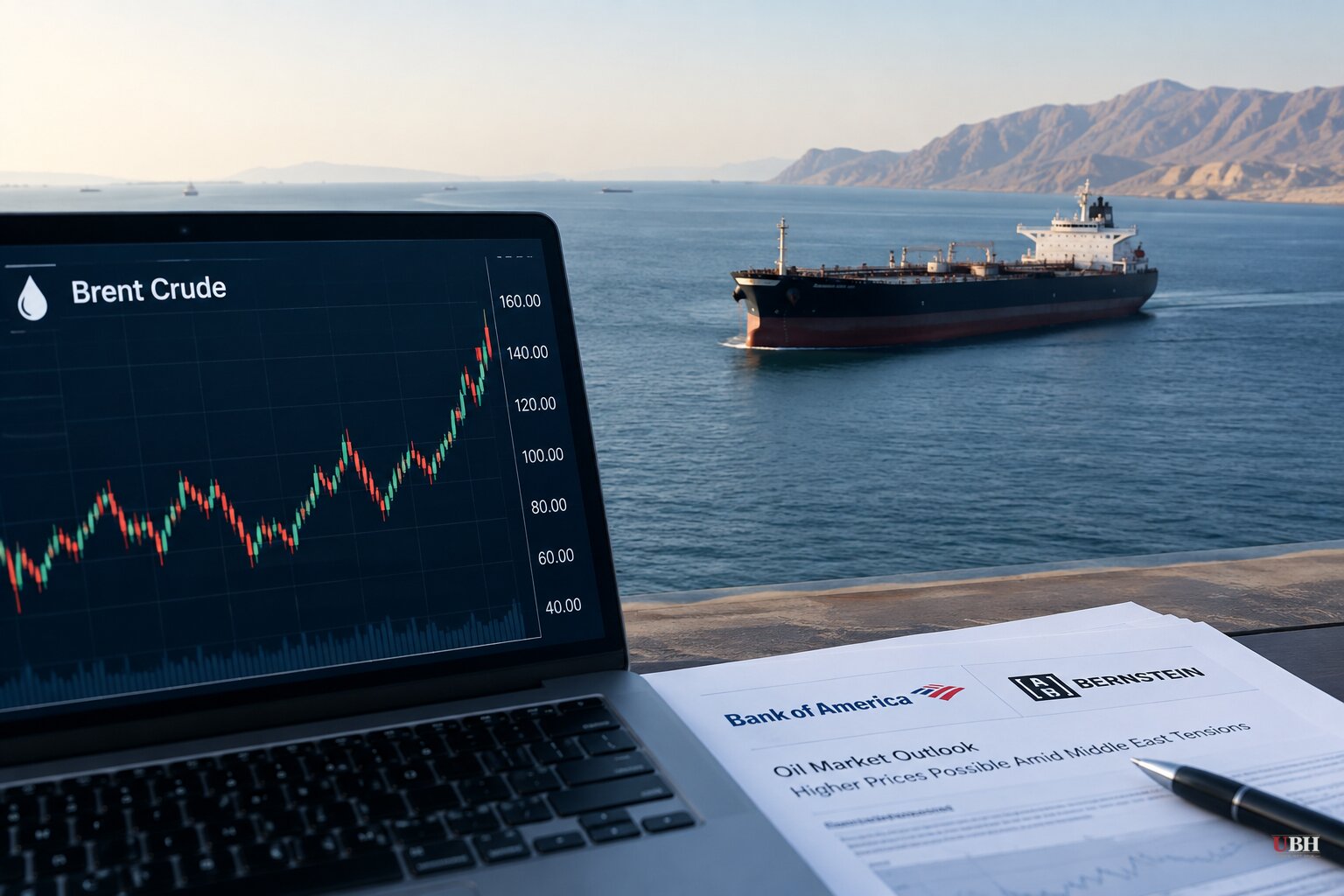
Oil Could Hit $150 a Barrel, Bank of America and Bernstein Warn, as Mideast Oil Routes Lose Two-Thirds of Their Flow
Where Prices Stand Now
Brent crude closed Monday, September 14, at $107.32 a barrel, up 2.59% on the day and briefly touching $108 intraday, according to BigGo Finance. West Texas Intermediate closed at $102.44, up 2.39%. Both benchmarks have climbed steadily since Labor Day weekend, when Brent traded around $98 and WTI sat near $93, according to Business Insider.
Gas prices moved with them. AAA recorded a national average of $4.15 a gallon on Labor Day, the first time regular unleaded has topped $4 on that holiday, Business Insider reported.
How This Started
The United States and Israel began striking targets inside Iran on February 28, 2026, with Iran striking back, according to a Sputnik dispatch carried by News Pravda. Washington and Tehran signed a memorandum in mid-June to halt hostilities, but the ceasefire didn't hold. Strikes resumed, and the conflict remains unresolved as of mid-September.
The latest escalation came over Labor Day weekend. The U.S. struck three Iranian oil tankers on Saturday, September 6, in retaliation for Iranian attacks on two U.S. warships the prior week, Business Insider reported. Saudi Arabia's energy ministry then said several of its energy facilities were hit by Iran-aligned Houthi forces that same weekend.
The Chokepoint Math
Bernstein analysts Neil Beveridge and Brian Ho wrote in a September 14 report, cited by BigGo Finance, that combined oil flows through the Strait of Hormuz, the Bab el-Mandeb Strait and the Suez Canal have fallen below 7 million barrels a day, down from roughly 20 million barrels a day before the conflict. That's a 65% drop through the three passages that normally carry a third of the world's seaborne oil.
The Saudi East-West Pipeline, an overland alternative to the Strait of Hormuz, was shut down after an attack, according to the same Bernstein report, creating a potential supply gap of roughly 4 million barrels a day. Bernstein said the U.S. Strategic Petroleum Reserve is projected to fall to 252 million barrels by the end of September, and that China's rising crude imports are draining what's left of the global buffer.
Beveridge and Ho noted their own earlier 2026 forecast of $90 Brent has already been blown past by actual prices, and said they see the risks skewed to the upside with little chance of near-term de-escalation.
What the Big Banks Are Actually Forecasting
Bank of America's public numbers, reported by the Associated Press and relayed by Sputnik dispatches on Nampa.org and News Pravda, lay out a tiered scenario. If Hormuz passage gets further restricted, the bank sees Brent in a $95 to $120 range. If major energy infrastructure takes direct damage, BofA says prices could go as high as $150. The bank's analysts also raised their base-case second-half 2026 forecast to $83 a barrel, and said they still expect shipping through Hormuz to gradually normalize, not stay disrupted indefinitely.
Goldman Sachs, cited by Business Insider, is more measured. Its base case has Brent at $85 by December. Its upside scenario, tied to sustained low Gulf output, puts Brent above $120 sometime in 2027. Its bear case has oil sliding to $60 in 2027 if Gulf production comes back stronger than expected. Goldman's own note said intensified Hormuz and Red Sea attacks are the most likely trigger for the upside case, not a certainty.
The $150 figure making headlines is a worst-case tail scenario from Bank of America and Bernstein, tied explicitly to infrastructure destruction that hasn't happened yet at that scale. Goldman's base case is $85, less than half the doomsday number. Oil forecasts have overshot before, most notably in 2022 when some banks floated $200 crude that never arrived. None of that means the current disruption isn't real. The Bernstein flow data on Hormuz, Bab el-Mandeb and Suez is a measured fact, not a projection.
The Part Nobody's Pricing In Yet
A Strategic Petroleum Reserve headed toward a critical threshold by month's end leaves Washington with less room to cushion a further shock than it had in past crises. Business Insider's early-September reporting noted markets were then pricing a 58% chance the Federal Reserve would hike rates at its September meeting, pending the August inflation report. Whether that meeting has produced a decision, and whether oil at $107 versus a potential run to $150 changes that math, is the next thing to watch. So is whether the Saudi East-West Pipeline gets repaired before its 4-million-barrel-a-day gap forces OPEC members to draw down their own spare capacity.
Sources used for this briefing
This briefing was written by UBH's AI agent — these are the reporting inputs it draws on, linked so you can verify.


