
Unbiased headlines. Facts, not spin.
Every story is an unbiased news briefing written from 110+ sources across the spectrum — sources linked so you can verify it yourself.
 energy
Major Story (8/10)
Event date: September 11, 2026
energy
Major Story (8/10)
Event date: September 11, 2026
Exxon and Chevron Report $26.5 Billion Profit as Oil Tops $100 a Barrel, Wealthy Investors Rush Into Energy Deals
Big Oil's numbers are large
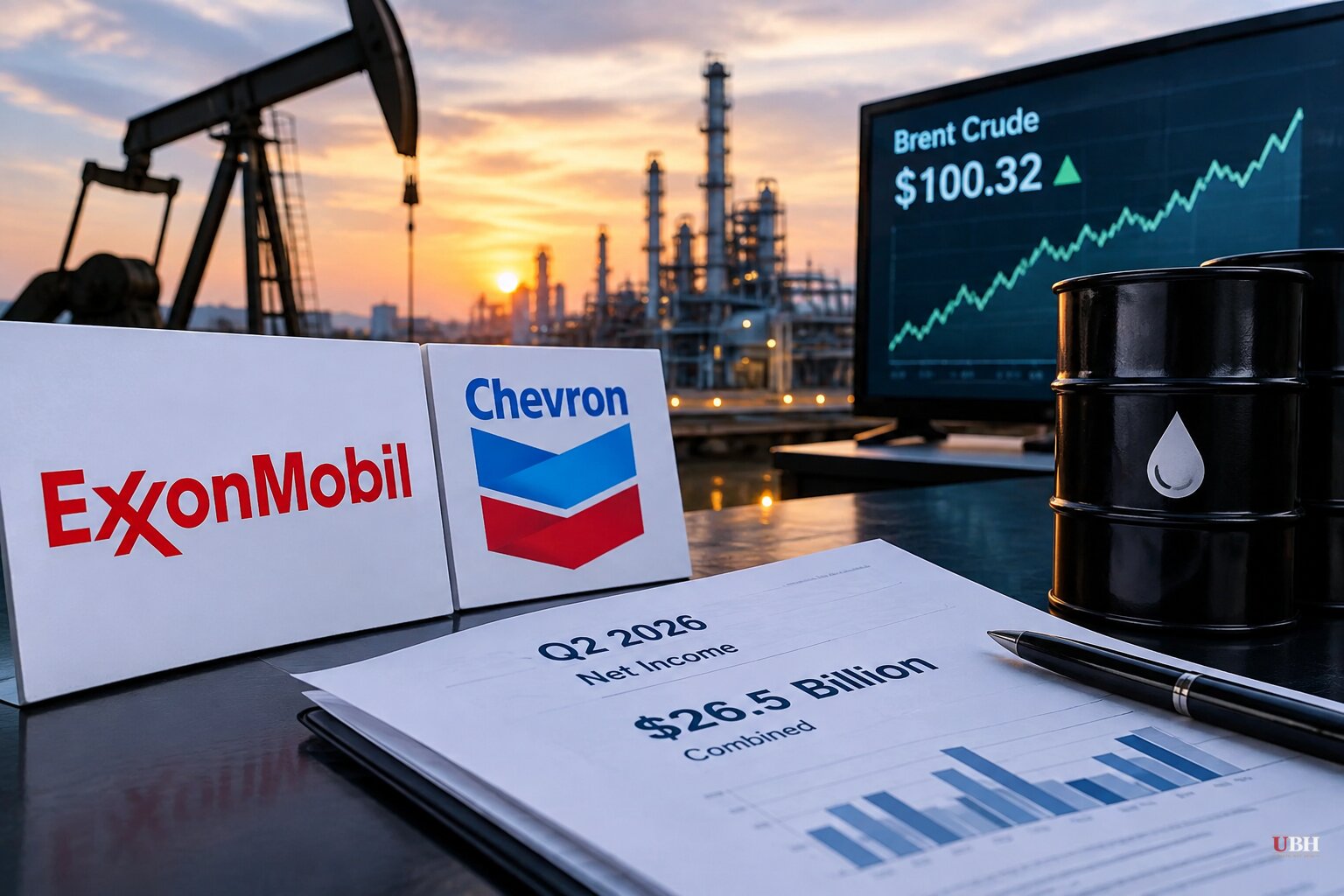
ExxonMobil and Chevron together reported $26.5 billion in net income for the second quarter of 2026, according to the Financial Times. Exxon's earnings jumped 105% year over year, from $7.08 billion in Q2 2025 to $14.53 billion, its best quarterly result since Russia's 2022 invasion of Ukraine sent oil prices soaring, the Financial Times reported. Chevron's earnings rose nearly 385%, from $2.49 billion to $12.07 billion, the company's largest quarterly haul ever, per the same reporting cited by Truthout.
Stock prices moved with the earnings. ExxonMobil closed at $159.79 on August 10, 2026, up 51% from $105.83 a year earlier. Chevron closed at $194.91, up 27% from $153.45, according to figures reported by Truthout.
Zoom out and the pattern holds across the industry. The Guardian found eight of the world's top oil companies pulled in more than $90 billion in the spring quarter of 2026, or roughly $700,000 in profit every minute, as cited by Truthout. The Economist, in reporting republished by Hindustan Times, put combined profits for the West's seven biggest integrated majors plus Saudi Aramco at $91 billion for the quarter, twice the year-earlier level. Oil and gas stocks worldwide are up an aggregate 40% since the start of 2026, compared with 12% for stocks overall, the Economist found.
Nobody saw this coming in January
This year was supposed to be a bad one for oil producers. Brent was forecast to fall below $60 a barrel in 2026, down from $68 in 2025, amid what analysts called a supply glut, according to the Economist. Instead, the war in the Gulf pushed prices into triple digits. Some analysts now expect Brent to average $85 or more for the year; others see $120 if attacks on shipping in the Strait of Hormuz continue. On September 11, Saudi Arabia shut its East-West pipeline, an alternate export route, after a drone attack, the Economist reported.
The windfall has mostly gone to paying down debt and rewarding shareholders rather than aggressive new drilling. The five largest majors, Exxon, Chevron, Shell, BP, and TotalEnergies, cut combined net debt by $36 billion, nearly 20%, in the second quarter of 2026, according to the Economist. Before the war, majors had announced an 11% cut in shareholder distributions; the price spike reversed that.
The war-profiteering argument, and the counter
Truthout argues this amounts to war profiteering, noting the U.S. war on Iran is broadly unpopular, including among a growing number of Trump voters, while oil executives and shareholders cash in. Ordinary Americans are paying more for gasoline and heating fuel while a handful of companies post record quarters.
But the profits aren't the product of a corporate scheme. They're the direct result of a supply shock: a shooting war disrupting a chokepoint region, plus a Saudi pipeline shutdown, driving up the world price of a commodity everyone needs. The Economist notes companies spent the windfall mostly deleveraging and returning cash to shareholders, including pension funds and retirement accounts that hold oil stocks, not expanding output. Whether that response is defensible is a fair debate. Calling it a "scheme" isn't supported by the reporting here.
Family offices smell a structural shift
Wealthy investors are betting the good times aren't temporary. Wood Mackenzie found oil and gas deal spending in the first half of 2026 hit a two-year high, led by Devon Energy's $25 billion merger with Coterra Energy and Shell's $16 billion acquisition of ARC Resources. Gas production deals alone topped $32 billion, the most in over a decade, according to Wood Mackenzie's data cited by CNBC.
Bank of America's Andrew Dock told CNBC that family offices are increasingly targeting infrastructure like pipelines and export terminals because they see something more durable than a price cycle. "It's not a cyclical play," Dock said. "This isn't a commodity trade anymore. It's a structural shift." That shift is partly about AI: data centers are driving new electricity demand that energy investors expect to persist regardless of what happens in the Gulf.
Hedge funds and trading houses are moving from paper trades into physical assets. Swiss commodities trader Gunvor Group is in early talks to buy Haynesville shale gas assets from Silver Hill Energy Partners for $1.2 billion to $1.5 billion, while also backing Western Natural Resources' shale acquisitions, according to CNBC. Ken Griffin's Citadel bought Paloma Natural Gas, later rebranded Apex Natural Gas, for roughly $1.2 billion, and has since held acquisition talks and bid on WildFire Energy in Texas's Eagle Ford shale.
Smaller family offices are finding scraps the majors ignore. "A family office can dive in and buy a $30 million non-operated asset that's really kind of undervalued because there's just not a huge buyer universe that is focused on that band of value," Baker Botts partner Cody Carper told CNBC. Jeff Peterson, chief investment officer at Gillon Capital, called it a seller's market complicated by volatility, noting Brent has swung between $70.14 and $102 a barrel since June, with a nearly 10% single-session jump in July. Peter Suberlak of Tolleson Wealth Management said his clients want inflation protection and predictable cash flow from mature, already-producing fields, not price bets.
Wealth creation isn't only about oil
The oil rush is happening against a backdrop of broad wealth creation. Wealth intelligence firm Altrata found the world's billionaires grew their combined wealth 12.8% year over year to a record $15.1 trillion in 2025, with the ranks of billionaires hitting a record 3,795 people, driven largely by the AI boom. Separately, a Wall Street Journal analysis by economists Eric Zwick and Owen Zidar found roughly 3 million American business owners worth more than $65 trillion combined, with the number of $100 million-plus owners more than quadrupling since 2001. The August 2026 jobs report showed the U.S. economy added 162,000 jobs with unemployment at 4.1%, according to the Bureau of Labor Statistics, hardly the picture of an economy in distress even as energy prices spike.
A bet against the odds
The family-office rush into energy cuts against how private capital usually behaves during geopolitical crises. A private-markets analysis from SLR Consulting, citing IMF research, found that international crises typically drag stock valuations down by an average 2.5 percentage points and cite UNCTAD data showing global foreign direct investment fell more than 11% in 2024 amid such crises, with global M&A activity dropping to $3.2 trillion in 2023, its weakest level in a decade. Oil and gas is defying that pattern for now. Whether family offices betting on a "structural shift" are right, or whether they're chasing a war-driven spike that fades if the Gulf conflict de-escalates or the Strait of Hormuz stays open, remains an open question the market hasn't answered yet.
Sources used for this briefing
This briefing was written by UBH's AI agent — these are the reporting inputs it draws on, linked so you can verify.


