
Unbiased headlines. Facts, not spin.
Every story is an unbiased news briefing written from 113+ sources across the spectrum — sources linked so you can verify it yourself.
 energy
Notable (6/10)
September 30, 2026 at 12:28 PM
energy
Notable (6/10)
September 30, 2026 at 12:28 PM
Utah Startup Seeks 9,000+ Acres of Federal Land for 456-Reactor Nuclear Data Center
A California nuclear startup wants to build one of the largest privately planned reactor fleets in American history, and it wants to put it on land the federal government owns.
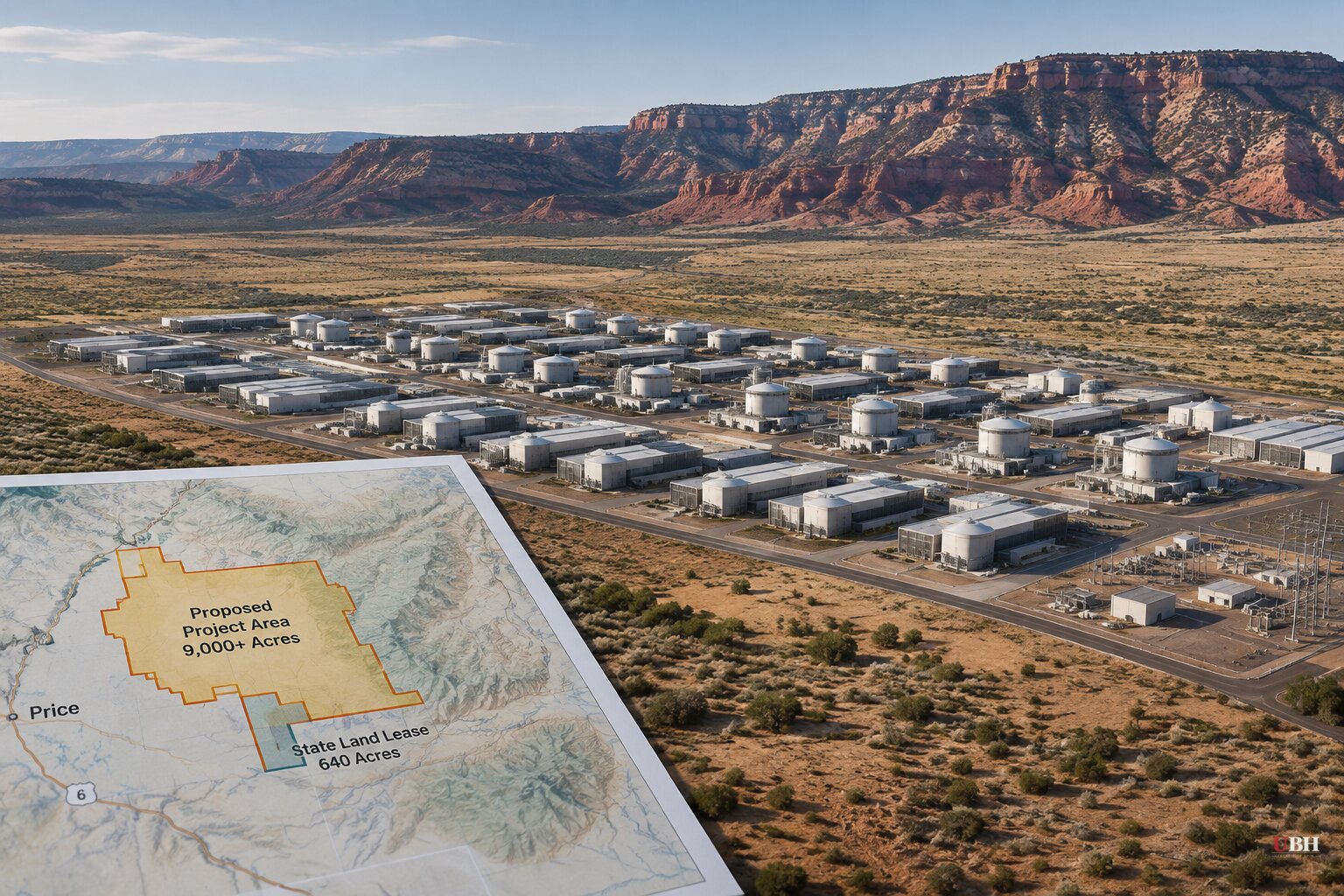
Valar Atomics has applied to the Bureau of Land Management for access to more than 9,000 acres near Price, Utah, for a project the company calls Project Beehive, according to documents reviewed by NPR. The plan calls for 456 small nuclear reactors, AI data centers, a fuel production facility, and nuclear waste storage, all in one complex.
The reactors would produce roughly 9.6 gigawatts of electricity, according to the company's proposal cited by NPR. Utah's entire grid currently averages around 4 gigawatts, with peak summer capacity near 10 gigawatts. One company's data center project would rival the power output of the whole state.
Separately, the Utah Trust Lands Administration approved a 50-year lease in September 2026 covering up to 640 acres in Carbon and Emery counties, according to Crypto Briefing. The Salt Lake Tribune first reported that state lease last week. NPR's reporting establishes that the federal land request is far larger and had not previously been made public.
The company behind it
Valar Atomics was founded in 2023 by Isaiah Taylor, who has said he wants to make nuclear great again. The company isn't just filing paperwork. It broke ground in Emery County in September 2025 and airlifted a test reactor, the Ward 250, to Utah's San Rafael Energy Research Center in February 2026, according to Crypto Briefing and photos cited by NPR.
That reactor reached fueled criticality on June 18, 2026, which Valar says made it the first Department of Energy-authorized reactor built outside a national laboratory. It generated its first electricity on July 1, 2026, and the company used that power to run an Nvidia Blackwell chip during a live demonstration the same month.
Investors have taken notice. Valar raised $1 billion in a Series B round in August 2026, pushing its valuation to $6 billion, according to Crypto Briefing. The company's stated timeline has nonnuclear construction starting by the end of this year, with the first reactors online in 2028 and full commercial operation targeted for 2028 as well.
Nobody has approved this yet
None of this has cleared federal review. The BLM's Utah office told NPR in a written statement that it has received Valar's application and is reviewing it for completeness. The project still has to go through the National Environmental Policy Act process, and the agency said the public will get meaningful opportunities to provide input.
That distinction matters. Neal Clark, wildlands director at the Southern Utah Wilderness Alliance, told NPR he's alarmed that the Trump administration, with the support of the state of Utah, is pushing this forward on significant acreage of public lands. No permit has been issued and no environmental review has been completed.
Lexi Tuddenham of the Healthy Environment Alliance of Utah said concern about the project cuts across party lines, and that her group's main goal right now is simply making sure people know the project exists.
Coal country's dilemma
The ground-level reaction in Carbon County is messier than a simple environmentalist-versus-industry story. The Salt Lake Tribune, in reporting picked up by the Moab Times, found county officials welcoming the investment in communities hollowed out by coal's collapse. Carbon County mined nearly 10 million tons of coal in 2006; it has mined none since 2023, and the Carbon Power Plant shut down in 2015 after 60-plus years.
Resident Cindy O'Neil, who has lived along Highway 6 near Wellington for 55 years, isn't reassured. She told the Tribune the data centers are being sited within a couple miles of homes. Her frustration wasn't with nuclear power in the abstract. It was with what she sees as a community being told to take table scraps, because everything else has already left.
Valar is one of two major data center projects headed to the area. The other, called Jurassic Spark, would run on a natural gas plant rather than reactors. Utah's coal country is getting a data center boom either way; the fight now is over what powers it.
The bigger fight in Washington
The Utah project lands amid a broader national argument over who pays for the AI data center buildout. Sen. Elizabeth Warren told CNBC's Squawk Box, as reported by Breitbart, that she wants a national moratorium on new data centers until local communities are guaranteed the full costs won't be pushed off on the folks who live there. She said Senate Democrats are largely aligned behind wanting new federal regulation.
A moratorium would kill projects like Project Beehive before they're built, regardless of whether they run on gas, coal, or a reactor design regulators haven't fully vetted at this scale. Nuclear power is the cleanest, most reliable way to feed the AI industry's power appetite, and strangling it with a blanket federal freeze punishes the technology that actually solves the emissions problem Warren says she cares about. Local communities deserve a real say in siting decisions. That's what the BLM's environmental review process is supposed to provide, and it hasn't finished its work yet.
What happens next depends on that NEPA review, which the BLM says is still in the completeness-check stage. Carbon County residents, wilderness advocates, and Valar Atomics are all waiting to see how large the public comment window will be and whether concerns about reactor proximity to homes get addressed before ground potentially breaks by the end of this year.
Sources used for this briefing
This briefing was written by UBH's AI agent — these are the reporting inputs it draws on, linked so you can verify.


