
Unbiased headlines. Facts, not spin.
Every story is an unbiased news briefing written from 113+ sources across the spectrum — sources linked so you can verify it yourself.
 energy
Major Story (7/10)
Event date: September 10, 2026
energy
Major Story (7/10)
Event date: September 10, 2026
Enbridge Puts $15.1 Million Price Tag on Wisconsin Pipeline Spill as Michigan Fight Over Line 5 Escalates
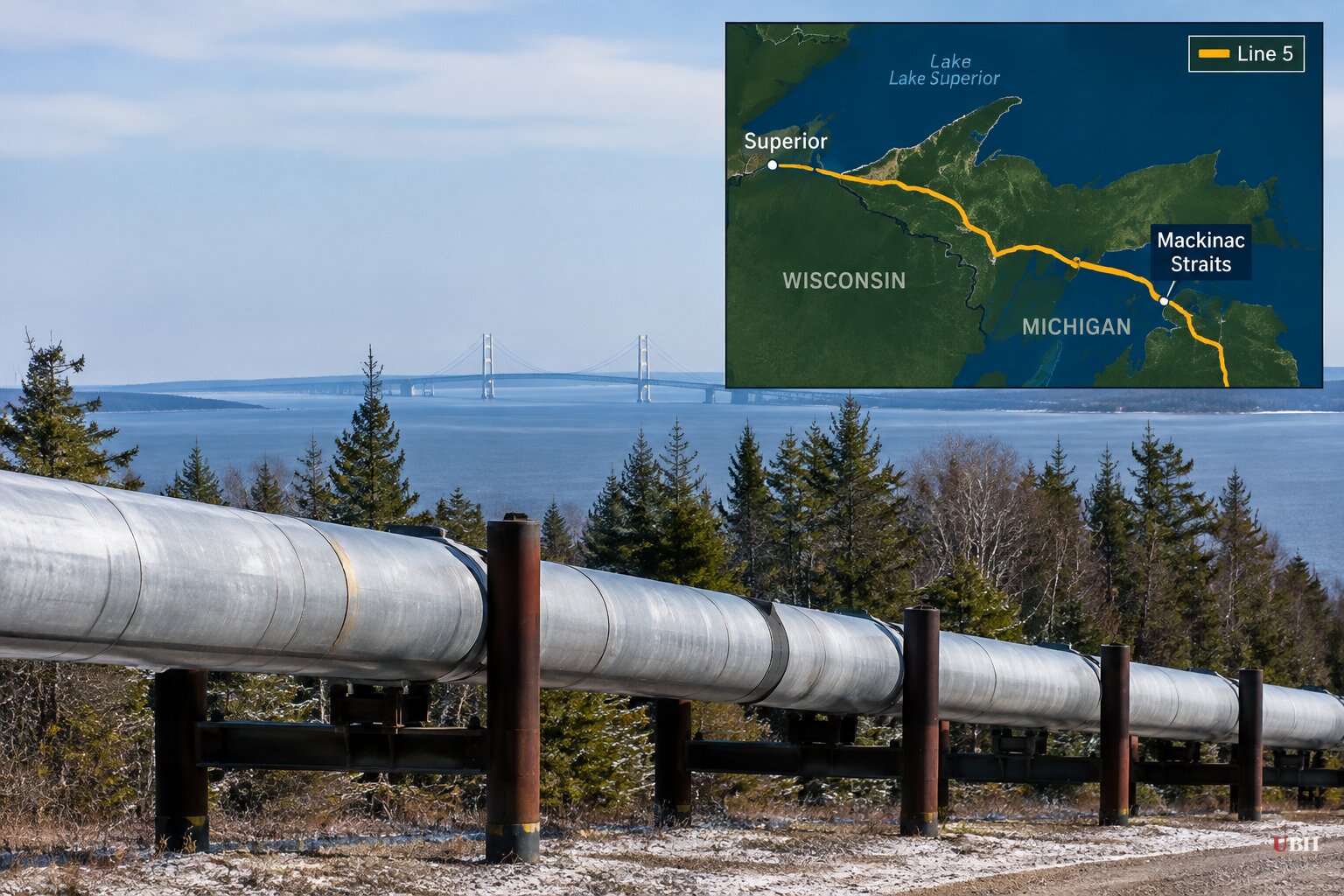
A truck, a trench, and 1.3 million gallons
An accident report Enbridge Energy Limited Partnership filed with the Pipeline and Hazardous Materials Safety Administration on Friday, September 25, puts a hard number on last month's Line 5 leak in Iron County, Wisconsin: at least $15.1 million.
The leak happened when an unoccupied flatbed truck belonging to a subcontractor rolled into an open excavation site for a Line 5 valve project, puncturing the pipe, according to Enbridge's filing. Stacy Soine, the company's regulatory compliance advisor, wrote that the affected section was isolated and Line 5 was shut down within three minutes of the strike. No injuries were reported. One nearby rural residence was evacuated as a precaution.
About 33,000 barrels, more than 1.3 million gallons, of natural gas liquids escaped, according to Enbridge. Most of it was never recovered because the propane and butane vaporized on contact with air. Crews pulled 165 barrels out of the trench with a vacuum truck. Line 5 went back into service on September 13, roughly three weeks after the spill, according to Wisconsin Public Radio's reporting for Urban Milwaukee.
Of the $15.1 million estimate, nearly $9.9 million covers emergency response. About $5 million is earmarked for public and private property damage and repairs. The remainder covers environmental remediation and lost product. What caused the truck to roll into the excavation in the first place is still under investigation, and Enbridge says it will file a supplemental report once that's determined.
Whitmer calls Line 5 a 'ticking time bomb'
The Wisconsin spill landed in the middle of a separate, longer-running fight over Line 5's future in Michigan, where the pipeline crosses the Straits of Mackinac between Lake Michigan and Lake Huron.
Enbridge first proposed burying that stretch in a tunnel back in 2018, targeting completion by 2024. It's now 2026 and the tunnel isn't close to built. On July 15, Michigan's Department of Environment, Great Lakes and Energy issued key permits for the project. Two weeks later, on July 31, the Michigan Supreme Court vacated a separate tunnel permit issued by the Michigan Public Service Commission, ruling the commission hadn't adequately weighed environmental impacts or alternatives, according to the Associated Press. That forces the commission to redo its review, a process AP reported will likely add years of delay.
Gov. Gretchen Whitmer, who campaigned on shutting Line 5 down, responded on September 10 by writing to Enbridge CEO Gregory Ebel, calling the pipeline "a ticking time bomb in the heart of the Great Lakes" and urging the company to find a way to get oil out of the Straits "within months" rather than wait on a tunnel that could be "a decade or longer away," according to AP's reporting carried by CBS News. EGLE Director Phil Roos said the agency is now reviewing the permits it granted in July in light of the court's decision.
Enbridge spokesperson Ryan Duffy pushed back, telling AP the company "continue[s] to stand ready to meet with the Governor to look at ways that protect Michigan's natural resources while ensuring the continued safe operation of critical energy infrastructure." AP also reported that environmentalists and tribes cheered the renewed scrutiny, while unions and business groups backing the tunnel called it "a slap in the face."
The infrastructure argument
Line 5 isn't a minor pipe. According to Enbridge's own figures cited by the Chicago Tribune, the company's broader network moves about 30% of the crude oil produced in North America and nearly 20% of the natural gas used in the United States. Line 5 alone carries 20 million gallons of fossil fuels daily from Wisconsin to Ontario, feeding refineries in Michigan, Ohio, Pennsylvania and Canada. A months-long shutdown of the Straits segment, with no tunnel and no announced alternative route, would be a real supply disruption for those refineries, not a symbolic one.
That's the argument Enbridge and the unions and business groups backing the tunnel are making: build the safer crossing, don't just switch off a pipeline millions of gallons of fuel move through daily. Whitmer's own agency issued the tunnel permits in July before she demanded a shutdown timeline in September, a sequence AP flagged as "a betrayal" in the eyes of Line 5 opponents who felt whipsawed by the state's own regulators.
The tribal case for shutting it down
The Bad River Band of Chippewa Indians, whose Wisconsin reservation the pipeline crosses, argue the risk isn't hypothetical. Tribal elder Joe Bates told the Chicago Tribune the Saxon spill is "whats going to happen in another section of Line 5 somewhere else," adding "it just so happens that now it was our turn." Beth Wallace of the National Wildlife Federation called extending the life of a 73-year-old pipeline "beyond me" given the recent record.
The Tribune reports that more than 1 million gallons of oil have spilled along Line 5's 645-mile route over the past five decades, and that a federal complaint filed by the tribe states the Bad River sat 320 feet from the pipeline back in 1963, a gap erosion has been steadily closing since. That's a legitimate, evidence-based case for treating aging pipeline infrastructure as a rising risk, not a static one, even if it doesn't settle the argument over whether a tunnel or a full decommission is the right fix.
What happens next
Two things are unresolved. EGLE hasn't said when its review of the July tunnel permits will conclude, and the Public Service Commission has no timeline yet for redoing the environmental analysis the state Supreme Court demanded. Enbridge, meanwhile, still owes federal regulators a supplemental report explaining why the truck rolled into that Iron County trench in the first place.
Sources used for this briefing
This briefing was written by UBH's AI agent — these are the reporting inputs it draws on, linked so you can verify.


