
Unbiased headlines. Facts, not spin.
Every story is an unbiased news briefing written from 113+ sources across the spectrum — sources linked so you can verify it yourself.
 energy
Major Story (7/10)
Event date: September 28, 2026
energy
Major Story (7/10)
Event date: September 28, 2026
Renewables Grew 30 Times Faster Than Fossil Fuels Over 18 Months, Federal Data Shows, While Gas Prices Keep Climbing
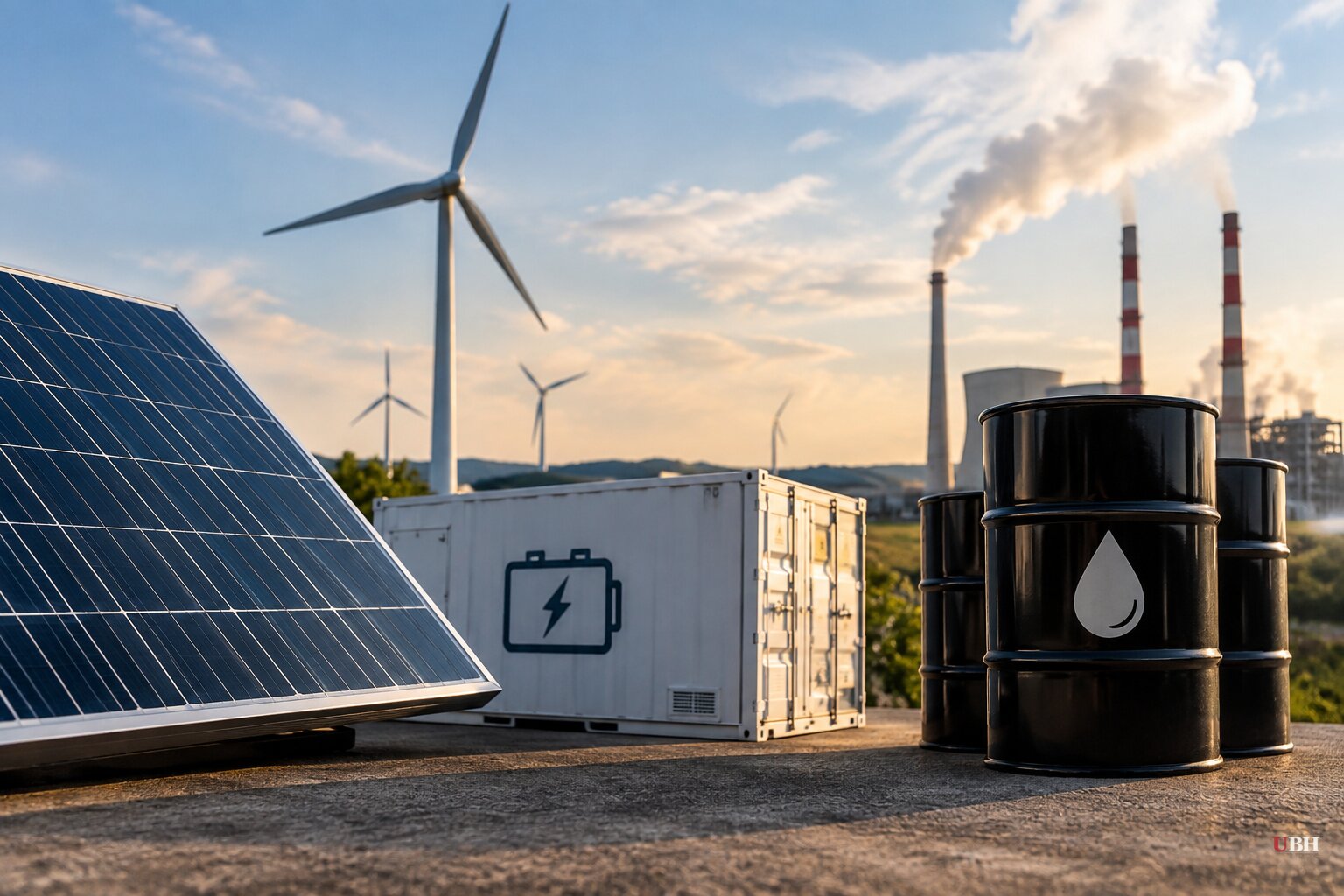
Two things are true at once right now, and neither political tribe wants to admit the other one.
Gas prices are up. And clean energy is growing faster under Donald Trump's second term than it did under Joe Biden's.
The Price Pain Is Real
Simon Stiell, the UN's climate chief, told delegates at UN Climate Week in New York this week that energy shortages tied to the Iran war have cost American consumers more than $100 billion in higher fuel prices, according to the Associated Press. Consumer confidence is falling and gas prices have hit record highs, the AP reported.
Daily Wire ran an opinion piece this week warning of a looming "historic energy crisis," arguing the world is approaching the physical floor of global fuel infrastructure, the point where pipelines lose pressure and refineries have to shut down. The piece cites unnamed analysts at "major financial institutions, including JPMorgan" and quotes an unnamed White House official's theory about the cause, without pointing to a specific published report or figures backing the claim. Energy analysts do discuss this as a legitimate physical concern. Refining and storage systems do have operational minimums. But the piece offers no named study, no data table, and no attributed forecast to support the scale of crisis it describes.
What The Actual Data Shows
The federal numbers tell a different story about where American electricity is actually coming from.
An analysis released this week by the SUN DAY Campaign, using US Energy Information Administration data, found that from February 2025 through July 2026, solar, wind and battery storage added roughly 88.7 gigawatts of capacity. Fossil fuels and nuclear power combined added just 2.6 gigawatts, according to the group's executive director, Ken Bossong.
Broken down: utility-scale solar capacity grew 32.7%, adding 41,051.6 megawatts. Battery storage capacity roughly doubled, adding 26,629.5 megawatts. Wind capacity grew 8%, including 800 megawatts of offshore wind. Coal capacity fell 2.4%, or 4,131.8 megawatts. Natural gas capacity rose just 1.5%, or 7,561 megawatts. Nuclear added only 800 megawatts.
On generation, not just capacity, renewables now account for over 29% of total US electricity, up from 22.3% when Trump's second term began, per the EIA data cited by both Common Dreams and Renew Economy, which independently reported the same SUN DAY Campaign analysis. Coal-fired generation actually fell 10.2% over the same period.
"Clearly, the White House has bet on the wrong horse," Bossong said.
But Cancellations Are Real Too
A separate report from the Environmental Defense Fund and Atlas Public Policy, titled The State of Clean Power in Q2 2026, found the US added 26 gigawatts of clean power capacity in the first half of 2026 alone, bringing total operational clean capacity to 489.6 gigawatts. But it also found roughly 15 gigawatts of clean power projects were canceled, representing about $24.5 billion in investment and 68,000 construction jobs.
David Villagrana, EDF's lead counsel for clean energy tax solutions, said the Trump administration is "actively impeding" clean power deployment by canceling projects and clearing the way for gas buildout. EDF is a clean-energy advocacy group with a direct stake in that framing. The cancellation numbers it cites are real, even as overall clean capacity keeps climbing.
The Legacy System Problem
Leah Stokes, a UC Santa Barbara environmental politics professor writing in Live Science, argues clean energy's growth reflects cost, not politics. Solar paired with batteries is now cheaper than gas in much of the country even without subsidies, she wrote, and 93% of new US electricity capacity is expected to come from solar, wind and batteries in 2026.
Stokes points to a concrete example: a federal order to keep an aging Michigan coal plant running past its planned retirement cost consumers $600,000 a day, by her account, until a federal court rejected the order on September 11. But the transition isn't finished. Fossil fuels still generate 57% of US power today versus 43% from clean sources, because replacing the existing grid takes years regardless of what's being built new.
The Legitimate Counter-Argument
None of this settles the reliability question conservatives raise. Capacity additions aren't the same as dispatchable, storm-proof power. Solar and wind depend on weather; batteries have limited duration; and a grid leaning harder on intermittent sources still needs gas, coal or nuclear as backup when the sun isn't out and wind isn't blowing. That's a real engineering constraint, not a talking point, and it's separate from the pure cost-per-megawatt comparisons clean-energy advocates cite.
It's also separate from what's actually driving pump prices right now. The sourced claim in this cycle, from the UN's own climate chief, ties the recent spike to the Iran war, not to the pace of the renewable buildout. The EIA's own projections show that pattern continuing. Over the 12 months through July 2027, the agency expects solar to add 43,558 megawatts and batteries another 23,428.9 megawatts, while nuclear adds zero and fossil fuel capacity shrinks slightly. Whether that trajectory holds depends on tariff policy, permitting fights already underway in federal court, and whether Middle East supply risk eases. None of which is resolved as of this week's UN Climate Week gathering in New York.
Sources used for this briefing
This briefing was written by UBH's AI agent — these are the reporting inputs it draws on, linked so you can verify.


