
Unbiased headlines. Facts, not spin.
Unbiased Headlines is an independently owned news organization. We bring you the facts, not opinions, written fresh from 110+ named sources. Sources linked so you can verify it yourself.
 economy
Major Story (8/10)
Event date: July 24, 2026 ·
US Stock Futures Fall After WSJ Reports Tariff Plan Targeting China, EU and 14 Other Economies
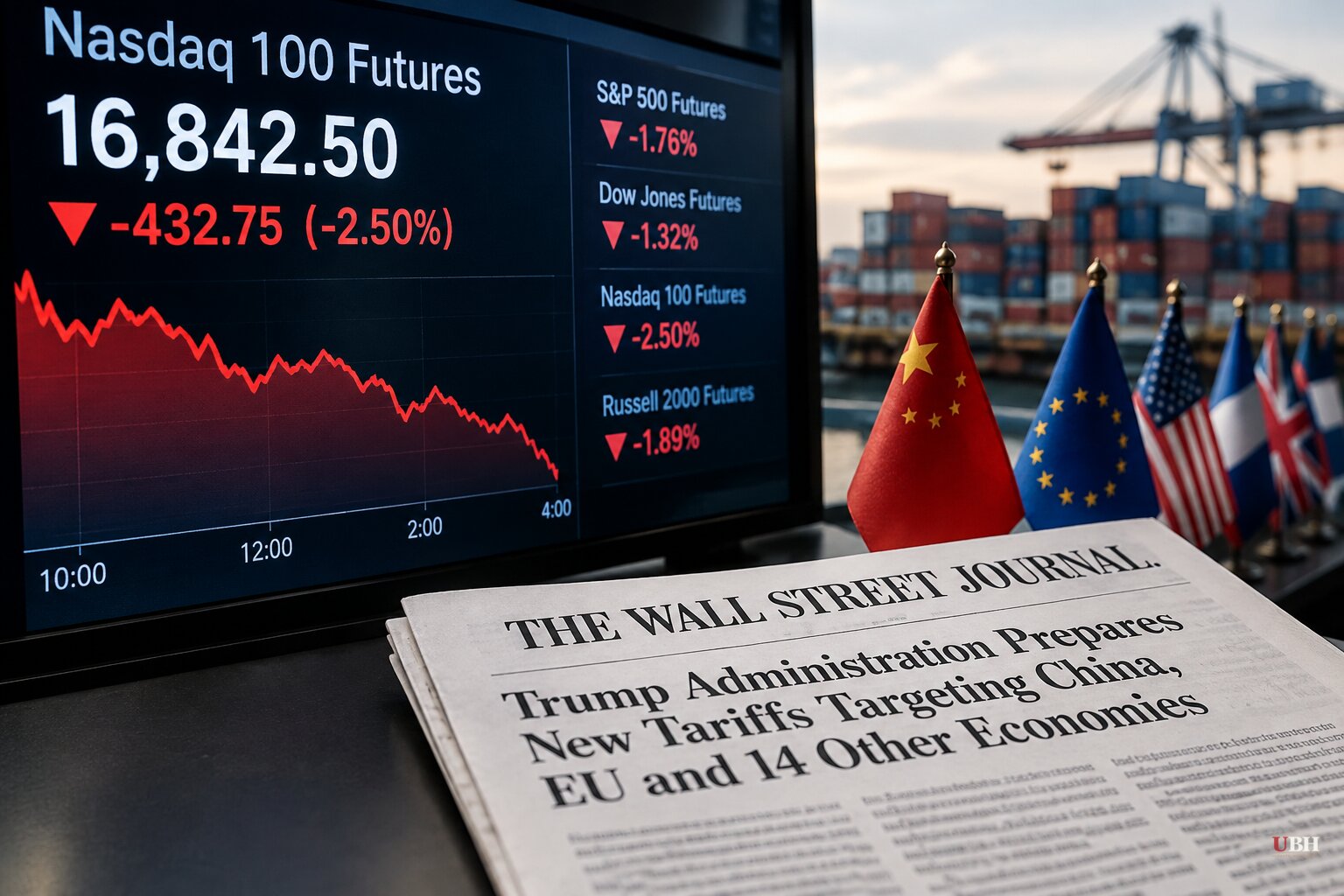
US stock futures dropped Tuesday morning, Nov. 24, after The Wall Street Journal reported that the Trump administration is preparing a fresh wave of tariffs on China, the European Union and 14 other economies.
Nasdaq 100 futures extended losses to as much as 2.5% before the opening bell. S&P 500 futures were down roughly 1.25% to 1.5% at points in the morning, and Dow futures fell about 1%. The slide wiped out around half of Monday's rally, which followed Jensen Huang's return to Nvidia, according to ZeroHedge's market tracking. The VIX was trading near 32.
No tariffs have been formally imposed. The USTR's office declined to comment, and the White House did not respond to requests for comment.
What the Journal says is coming
According to the Journal, citing people familiar with the plans, Greer could announce the results of a months-long investigation as early as this week. The timing could slip.
The probe covers industrial subsidies. A March 11 USTR notice lists 16 economies: China, the EU, Singapore, Switzerland, Norway, Indonesia, Malaysia, Cambodia, Thailand, South Korea, Vietnam, Taiwan, Bangladesh, Mexico, Japan and India. The investigation falls under Section 301 of the Trade Act of 1974.
The new duties would cover most goods from the targeted economies. Steel, aluminum and autos would likely be excluded because they already face separate tariffs under a national-security authority.
Final rates have not been set. Administration officials have repeatedly indicated they want levels similar to the tariffs Trump imposed in 2025, before the Supreme Court struck those levies down in February 2026.
How rates could differ
The Journal's sources say countries that signed trade agreements with Washington would see overall rates that track those deals. That means the EU, Japan and South Korea would likely land at 15% or lower. Vietnam and India could face higher rates based on their own agreements.
China is expected to get the steepest rate. Trump officials have said its subsidies are especially extensive and disruptive to the global economy.
The plan could also include language letting the administration raise tariffs later if a country's industrial overcapacity worsens, or if it fails to change policy in future negotiations.
The duties would stack on top of the 10% to 12.5% tariffs announced in July on 60 economies over goods tied to forced labor. That July action faces a court challenge.
The administration's argument
Greer's case is that government subsidies and other support have created excess industrial capacity abroad. In his telling, that lets foreign producers sell large volumes of cheaper goods worldwide and undercut American manufacturers.
That is a real grievance with a long paper trail, particularly on China. Whether another broad tariff layer is the right tool remains unsettled.
The market's objection
Analysts at XTB, a trading firm, pointed to the combination of higher import costs and persistent U.S. inflation as the biggest concern. They said additional tariffs could raise the price of components and finished goods, squeeze corporate margins and complicate the Federal Reserve's effort to bring inflation down. They flagged industrial companies, electronics makers and retailers that depend on global supply chains as the most exposed. XTB also noted that the Journal's report does not mean tariffs have been formally introduced.
Analysts at 24/7 Wall St. said megacap tech names with China-heavy manufacturing, assembly or component sourcing face the sharpest pressure, from both higher input costs and possible retaliation by the targeted economies.
Tariffs are paid by importers, and those costs get passed along or absorbed. The size of that bill depends on exemptions and final rates, which no one outside the administration has seen.
The backdrop
The move lands in a jumpy market. ZeroHedge noted that stocks had already swung on the Nvidia and Huang situation and on worries about AI financing arrangements, and that this is a holiday-shortened trading week.
Blockonomi reported that lawmakers from both parties have been questioning what the government knew about alleged smuggling of advanced AI chips to China.
What to watch
The next marker is Greer's announcement, which sources say could come this week but could also slip. It will show the actual rates for China, the treatment of countries with existing deals, whether the overcapacity escalation clause is included, and which goods are carved out. Beijing's response will follow.
Sources used for this briefing
8 links from 7 independent newsrooms (syndicated copies of the same report count once)
These are the sources it draws on, linked so you can verify.
More coverage: China


