
Unbiased headlines. Facts, not spin.
Unbiased Headlines is an independently owned news organization. We bring you the facts, not opinions, written fresh from 110+ named sources. Sources linked so you can verify it yourself.
 economy
Notable (6/10)
Event date: November 14, 2026 ·
AAA Projects 81.5 Million Thanksgiving Travelers, a 0.1% Dip, While FAA Forecasts Busiest Skies in 16 Years
Since a rare nationwide FAA ground stop earlier this month, followed by a United system outage, Transportation Secretary Sean Duffy has said air traffic is expected to normalize going into the Thanksgiving rush. The rush starts today, Tuesday, Nov. 24.
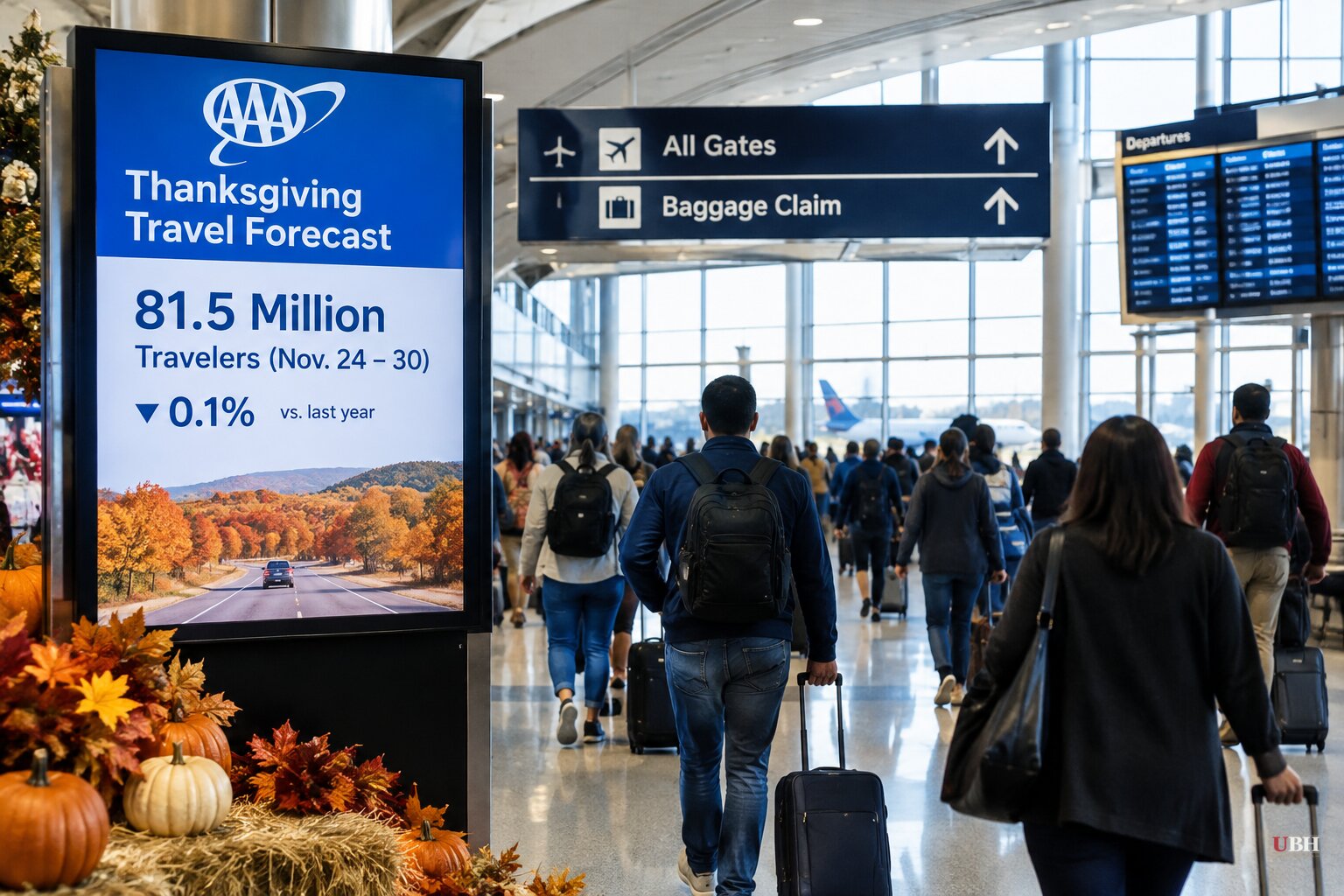
AAA projects 81.5 million Americans will travel at least 50 miles between Tuesday, Nov. 24, and Monday, Nov. 30. Last year it was 81.6 million. That is a 0.1% decline, about 121,000 fewer travelers, and it ends a three-year streak of record Thanksgiving travel that began in 2023.
Where the numbers moved
Cars still dominate. AAA expects 72.9 million people to drive, down from 73.1 million last year. Air travel is forecast at 5.96 million, a 0.2% drop. Buses, trains and cruises are the one growth area: 2.6 million travelers, up 4.1%.
Money is part of it. AAA says domestic roundtrip flights are 17% more expensive, averaging $800 per ticket. Stacey Barber, AAA Travel's vice president, said the dip is partly due to higher travel costs, but that travelers won't notice much of a difference on the roads and at the airports because projected volumes remain near record levels.
Illinois shows the same pattern. AAA projects nearly 4.1 million Illinoisans will travel, down nearly half a percentage point. The Illinois Tollway expects more than 9.8 million vehicles from Wednesday through Monday, with Wednesday heaviest at more than 1.9 million, against an average day of more than 1.7 million.
The FAA says skies will be packed
The Federal Aviation Administration forecasts more than 417,000 flights over the nine-day holiday period, the busiest skies in 16 years. Today is projected to be the single busiest day, with more than 52,000 flights.
That sits awkwardly beside AAA's forecast of slightly fewer air passengers. The two measure different things: the FAA counts flights, AAA counts travelers. Both can be true at once, and the gap is a reminder that crowded airports do not require record passenger counts.
Duffy and FAA Administrator Bryan Bedford have emphasized 24/7 operational efforts and modernization of air traffic control to minimize delays. The administration set up a Transportation Technology Transformation Tiger Team to ensure safety and efficiency during peak travel.
The glitches are not behind anyone yet
Duffy said at a Nov. 13 news conference that air traffic was expected to normalize going into the holiday. Monday offered a mixed preview. The FAA said O'Hare International Airport experienced a brief ground stop because of air traffic control staffing issues, which led to flight delays.
Delta Air Lines also began having problems over the weekend with the automated system it uses to calculate aircraft weight and balance. That is a lot of operational trouble heading into the busiest travel week of the year.
At Newark Liberty on Monday, traveler Herbert Tobias, 32, said: "They say three hours, take the three hours, you're going to need it."
Storms on both coasts
Dave Radell, a National Weather Service meteorologist in New York, described "a one-two-three punch" of rain, wind and coastal flooding. Parts of the Northeast could see one to two inches of rain, falling off and on for up to 12 hours. East-northeast winds of 20 to 30 mph are forecast, with gusts up to 45 mph possible, peaking Thursday afternoon.
That matters for the 100th Macy's Thanksgiving Day Parade. New York City rules prohibit flying large balloons when winds are above 23 mph or gusts above 34 mph. Radell said the effect on the parade depends on how quickly the storm comes through New York.
On the West Coast, the National Weather Service is forecasting coastal flooding in San Francisco, in effect through 4 p.m. Thursday. Peak tides could reach 8.6 feet Wednesday morning, rivaling the 1983 record of 8.66 feet. In Oregon, forecasters are calling for possible snow in mountain passes and potential minor flooding from king tides along the coast.
Gas prices may have changed the math
AAA's own forecast may be dated on one point. Marie Dodds, director of public and government affairs for AAA Oregon/Idaho, said the surveys behind the estimate were conducted four weeks ago, before gasoline prices started markedly dropping. At that point, higher costs were forcing some Americans to cancel travel plans.
Now, with gas prices at their lowest level since March, some travelers might be rethinking those cancellations. "We could end up seeing more people taking road trips than what we projected in our survey," Dodds said. In the Eugene-Springfield area, gas was $4.16 on Monday, down from $4.89 a month ago but still higher than last year's $3.64. The national average on Monday was $3.64, the same as last year's average in Eugene. Dodds said lower crude oil prices, a seasonal drop in demand and the switch to cheaper winter-blend fuel are helping, even as shipping challenges continue in the Strait of Hormuz. AAA noted that August, September and October each set monthly pump-price records.
AAA says the worst driving windows are 2 to 8 p.m. today, noon to 7 p.m. Wednesday, and 1 to 7 p.m. Friday. The return trip is worse: avoid noon to 9 p.m. Saturday, noon to 8 p.m. Sunday and 2 to 7 p.m. Monday.
Two questions will be answered within days. Will the Northeast winds peak above New York's balloon limits on Thursday afternoon? And will actual road traffic come in above AAA's survey-based estimate now that gas is cheaper?
Sources used for this briefing
6 links from 6 independent newsrooms (syndicated copies of the same report count once)
These are the sources it draws on, linked so you can verify.


