
Unbiased headlines. Facts, not spin.
Unbiased Headlines is an independently owned news organization. We bring you the facts, not opinions, written fresh from 110+ named sources. Sources linked so you can verify it yourself.
 economy
Major Story (7/10)
Event date: November 21, 2026 ·
Congress Left Town for Thanksgiving With No Stopgap Text and Funding Set to Expire Dec. 11
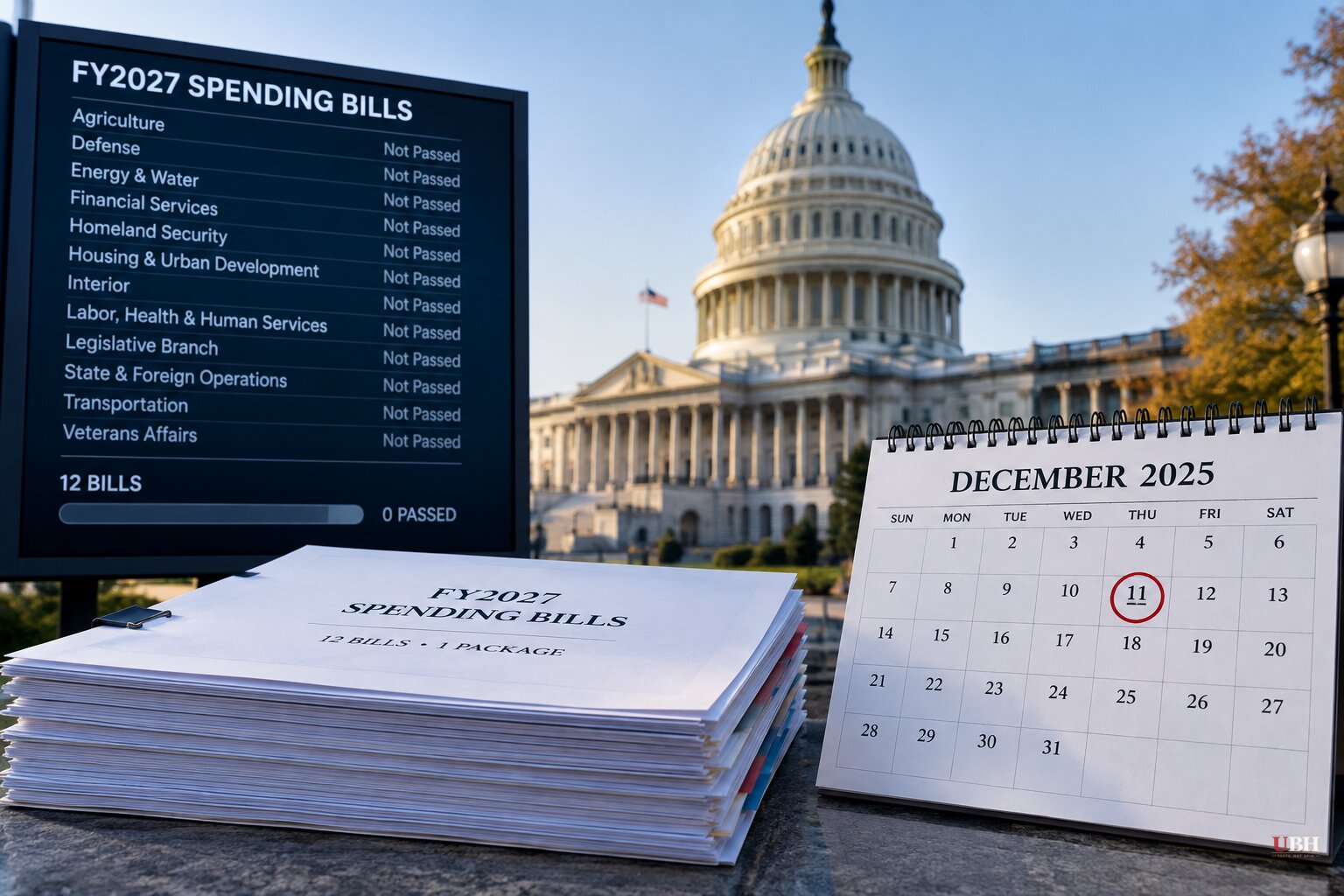
Since President Trump signed the Continuing Appropriations and Extensions Act (P.L. 119-103) on Sept. 2, the government has run on last year's funding levels, and nothing has replaced that law. It expires at 11:59 p.m. Eastern on Friday, Dec. 11. A lapse would begin Dec. 12.
The House finished its votes for the week on Nov. 20. The Senate is out for Thanksgiving. No continuing resolution text has been released in either chamber, leaving roughly eight legislative days before the deadline.
Where the 12 bills stand
Fiscal 2027 began Oct. 1. Not one spending bill has been enacted.
The House has passed three of its 12: Agriculture-FDA (213-210), Military Construction-VA (400-15) and National Security-State (217-209). The other nine cleared committee on party-line votes and never reached the floor.
The Senate has passed none. Senate Appropriations released draft text for five bills on Nov. 12 and the other five on Nov. 16, but the committee has not voted on any of them.
The stopgap itself passed easily: 90-6 in the Senate on Aug. 8 and 370-48 in the House on Sept. 1.
The fight is over length
Rep. Mike Simpson (R-Idaho) has said Congress will have to pass a continuing resolution, and that the real argument is how long it runs. Republicans control both chambers until Jan. 3. Democrats take the majority in both in the 120th Congress.
Roll Call reported Nov. 12 that the administration is weighing a CR running through March. A long stopgap would push the FY2027 fight onto a Democratic Congress dealing with a Republican White House.
House Appropriations ranking member Rosa DeLauro wants any new CR to be "as short as possible." As of Nov. 17, the White House budget office had not sent Congress its list of "anomalies," the agency-specific adjustments that normally travel with a stopgap.
FAA money adds a new demand
Transportation Secretary Sean Duffy has asked Congress for tens of billions of dollars more for the Federal Aviation Administration. He first requested about $30 billion, then raised it to $50 billion after a nationwide ground stop that halted flights. Trump posted that Congress should "give the money, FAST!"
Duffy said the outage was likely tied to work by contractor L3Harris, which was switching an old copper line at an air traffic site in El Dorado, Arkansas, to fiber optic. It is unclear whether faulty equipment or contractor error was to blame.
Democrats say the agency already has the money. Last year's Republican-passed spending and policy law gave the FAA $12.5 billion over three years, including $4.75 billion for telecommunications modernization. No Democrat voted for that law.
Duffy says that money cannot buy what he needs. "I have no money in that $12.5 billion that I can use for a new architecture for telecom," he said on CNN's "State of the Union." He said about one-third of the modernization funds are spent and that the telecom work can be finished by early 2029.
Reps. Rick Larsen and André Carson, the top Democrats on two House aviation panels, asked the administration to explain why more money is needed when funds remain unspent. They said FAA and DOT staff would brief their staff.
A new order on contractors and Congress
On Nov. 20, Trump signed an executive order requiring federal contractors to notify the White House of any pending or future congressional request for information about their work. Contractors may not disclose anything the administration believes falls under executive privilege. Those who do not comply could lose contracts or be suspended or barred from federal work, according to the order.
The order says Congress needs a valid legislative purpose to seek information from agencies, employees or contractors. It says "certain congressional leaders" have threatened to intrude on executive prerogatives and harass private companies. The order's stated rationale is that agencies and the White House will be "chilled" from sharing sensitive information with contractors if confidentiality cannot be assured.
White House counsel Will Scharf recently told White House staff they need administration approval before testifying to Congress.
Legal experts told The Washington Post the order will probably be debated in court.
The timing matters. Rep. Robert Garcia (D-Calif.), set to chair the House Oversight Committee, has pledged to investigate Trump and his family, alleged corporate corruption, DHS and ICE, and the handling of Jeffrey Epstein files. Democrats will hold subpoena power in January, and willful defiance of a valid subpoena can lead to criminal contempt proceedings.
Garcia has also said Democrats are being accused of threatening officials, including the attorney general, with impeachment. According to the Epoch Times, he said there have been "no impeachable acts committed" and called the situation "extortion at the highest level."
What happens next
Lawmakers are scheduled to return Nov. 30 with until Dec. 11 to pass something. A stopgap, with its length undecided, is the outcome Simpson and the administration's own reported planning point toward. House Speaker Mike Johnson has said he would add FAA funding to an upcoming "legislative package," but congressional aides were not clear how leaders will pass new funding. Whether the FAA request or the anomalies list rides along has not been announced. If nothing passes by 11:59 p.m. on Dec. 11, a funding gap could begin Dec. 12.
Sources used for this briefing
6 links from 6 independent newsrooms (syndicated copies of the same report count once)
These are the sources it draws on, linked so you can verify.


