
Unbiased headlines. Facts, not spin.
Unbiased Headlines is an independently owned news organization. We bring you the facts, not opinions, written fresh from 110+ named sources. Sources linked so you can verify it yourself.
 economy
Major Story (7/10)
Event date: November 21, 2026 ·
Hawley and Warren Both Back Trump's 10% Credit Card Cap Talk as Card Balances Reach $1.28 Trillion
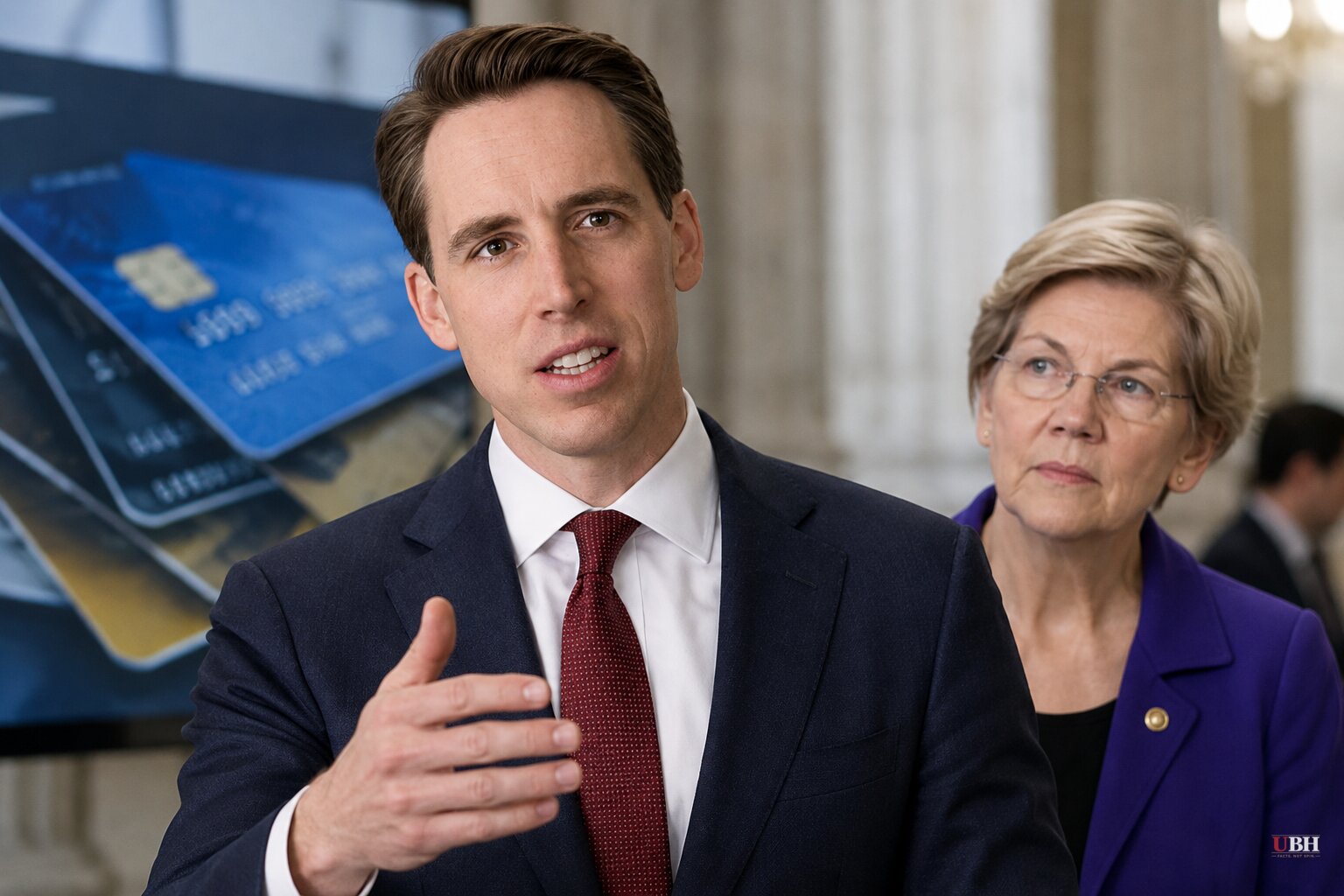
President Donald Trump's Saturday, Nov. 21, comment that he "would do" a 10% credit card interest cap has pulled in support from both parties' populist wings. It has also drawn a warning from a conservative economist about who gets hurt.
No bill text from the White House exists, and no vote is scheduled. What exists are competing Senate proposals and a new Congress arriving in January.
Hawley joins Warren
Sen. Josh Hawley (R-Mo.) answered Trump's interview on X. "The president is right," he wrote. "Let's pass my bill to cap credit card interest fees."
Hawley's bill is co-sponsored by Sen. Bernie Sanders (I-Vt.). Rep. Alexandria Ocasio-Cortez (D-N.Y.) has her own version in the House.
Sen. Elizabeth Warren (D-Mass.) reposted Trump's remarks with her own line: "Let's cap credit card interest rates and save Americans money." Warren is expected to chair the Senate Banking Committee once Democrats take both chambers. On Nov. 8 she told CBS News' "Face the Nation" that she has the bill and is "ready to go."
Rep. Maxine Waters (D-Calif.) of the House Financial Services Committee has also endorsed capping rates in various ways, according to the AP.
The pledge so far
Trump announced the idea on Truth Social on Jan. 9, 2026, calling for a one-year, 10% cap "effective January 20, 2026." That date came and went with no change in what banks charge.
The president has no clear statutory authority to impose a nationwide cap by executive order. Brian Shearer, director of the Vanderbilt Policy Accelerator, has said any binding cap would require legislation. Trump appeared to acknowledge that at Davos on Jan. 21, when he said, "I'm asking Congress to cap credit card interest rates at 10% for one year."
The GOP-controlled Congress did little with the request. In April, Warren wrote to federal banking regulators asking why they had not acted on the president's deadline. "The big banks have predictably refused to act," she wrote.
Sanders accused Trump in July of lying about the cap. Sanders said major banks earned $49 billion in profit in the latest quarter while charging 25% to 30% on cards.
The numbers
The New York Fed reported Friday that card balances rose $22 billion in the third quarter, a 1.7% increase, to about $1.28 trillion. That is $52 billion above a year earlier.
Federal Reserve data put the average rate on commercial-bank card accounts assessed interest at 22.36% in the third quarter. Bankrate put the average card rate at 19.71% as of Nov. 4. The two figures measure different sets of accounts.
The Consumer Financial Protection Bureau says about 195 million Americans held credit cards in 2024 and were assessed $160 billion in interest.
Researchers who studied Trump's campaign pledge estimated a 10% cap would save Americans roughly $100 billion a year in interest. Those researchers also found the industry would take a major hit but stay profitable, with rewards and perks likely scaled back.
For a cardholder with a $5,000 balance, interest runs about $42 a month at 10%. At the current average rate of 22%, it is about $100 a month.
The case against
Banks and card issuers opposed the idea from the day Trump announced it. They say a cap would force them to cancel cards for lower-score customers or cut rewards sharply.
Paul Kupiec, a senior fellow at the American Enterprise Institute, reached a similar conclusion in a study this year. A 10% cap "would likely upend the credit card industry's current business model," he wrote. "It is difficult to imagine that consumers with low-prime and subprime credit scores will continue to have access to traditional credit card accounts under a 10 percent APR cap."
Treasury Secretary Scott Bessent has not endorsed or rejected the cap. In January he told CNBC in Davos that "it is not unreasonable to have a discussion on the practices of these credit card companies." Asked at a congressional hearing in February whether a cap could restrict credit for weaker borrowers, he said that would "be very important to examine."
Trump himself acknowledged the free-market objection in his Fox interview. "I know that some people would say it's not free enterprise," he said. "But what's free enterprise when you're sitting home and you get a bill that some guys set up in an office on Park Avenue?" He added: "I'm a very conservative guy, I guess. I'm a common-sense person. The fees are too high and the interests are too high."
What comes next
Trump told Fox he did not know Democrats had said they would work with him. "I didn't even know they said it. But they've been trying to get that for years. I would do it."
He said the day before, at a White House news conference, that the administration might "get more done" under divided government because some Republicans "were just impossible to deal with."
The open questions are specific. Trump has not said whether he backs Warren's bill, Hawley's bill, or a new version, and the White House has not said whether the cap would run one year, as he proposed in January, or be permanent. Democrats take control of both chambers in January, and Warren's expected committee chairmanship would give her the gavel to schedule a hearing.
Sources used for this briefing
8 links from 8 independent newsrooms (syndicated copies of the same report count once)
These are the sources it draws on, linked so you can verify.


