
Original briefings. Zero spin.
Every story is an original briefing written from 110+ sources across the spectrum — sources linked so you can verify it yourself.
 energy
Notable (6/10)
Event date: July 22, 2026
energy
Notable (6/10)
Event date: July 22, 2026
US-Saudi Nuclear Deal Now in Congress as Riyadh Tries to Cut Oil Burned for Power
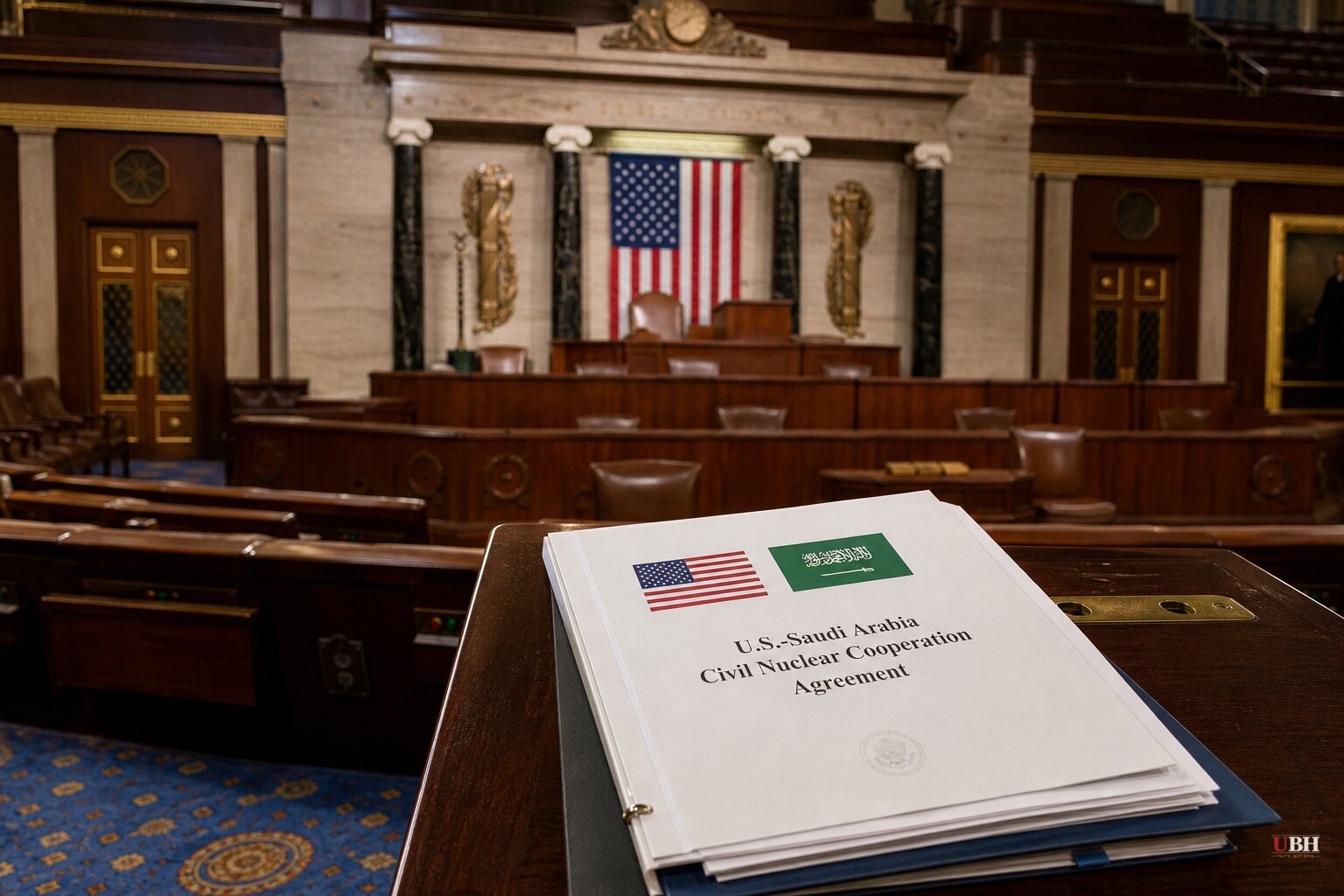
Saudi Arabia burns more than 1 million barrels a day of crude and fuel oil just to keep the lights on, run desalination plants, and power factories and farms. Riyadh wants that number gone by 2030, and the deal getting attention right now is a nuclear cooperation agreement with the United States that isn't going to do much of the heavy lifting.
The US and Saudi Arabia signed a 30-year civil nuclear cooperation agreement on July 22, 2026, according to OilPrice.com. AP News reported, citing sources familiar with the matter, that President Trump has since submitted the agreement to Congress for review. That review is a standard step for what's known as a 123 Agreement under the Atomic Energy Act.
The Oil Numbers Are Real
Saudi Arabia's combined oil and fuel-oil burn for power generation hit 1.42 million barrels a day in June 2024, according to the U.S. Energy Information Administration data cited by OilPrice.com. It dropped to an average of 678,000 barrels a day in January and February 2025, the lowest for that stretch since 2016, with February alone hitting an 11-year monthly low of 589,000 barrels a day.
That swing tracks air-conditioning demand, which spikes Saudi oil burn every summer. The kingdom's electricity demand grew 3.8% in 2025 and the International Energy Agency forecasts 3.1% average annual growth through 2030, per OilPrice.com. Manaramagazine, citing separate industry projections, put local energy consumption on track to triple by 2030, a much steeper trajectory than the IEA's figure. The two numbers aren't necessarily contradictory since they may measure different things, but neither source reconciles them.
Gas and Solar Are Doing the Actual Displacing
The real work is coming from natural gas and renewables, not nuclear. Aramco's Jafurah unconventional gas field began production in December 2025 and is central to a plan to boost the company's sales-gas capacity roughly 80% by 2030 from 2021 levels, according to OilPrice.com. Saudi Arabia is also targeting as much as 130 gigawatts of renewable capacity by 2030.
Manaramagazine noted that natural gas and oil currently account for about 58% and 41% of Saudi electricity generation, respectively, per IEA figures, and that Saudi solar projects at Shaybah and Najran are producing power at roughly $1.04 and $1.09 per kilowatt-hour, among the cheapest in the world. China, not the US, dominates the solar panel supply chain feeding that build-out, the outlet reported.
Nuclear's Actual Contribution Is Small and Not Yet Locked In
Saudi Arabia's proposed first commercial plant would sit at Duwaiheen on the Gulf coast. The kingdom's regulator has granted a site-preparation license for two pressurized-water reactors of roughly 1.4 gigawatts each, 2.8 gigawatts combined, but no vendor has been selected and no construction timetable exists, according to OilPrice.com.
Running at 90% capacity, that plant would generate about 22 terawatt-hours a year, OilPrice.com calculated, equivalent to roughly 105,000 barrels a day of oil displacement using EIA conversion assumptions, and less if the power goes toward new demand instead of replacing oil burn. Given the lack of a vendor or timeline, OilPrice.com concluded nuclear is unlikely to contribute materially to the 2030 target.
The Strategic Argument For Moving Fast
Jack Spencer and Jacob Twyford, writing in the Epoch Times, argued the deal matters regardless of the near-term oil math. Saudi Arabia has never built a nuclear plant and lacks both the industrial base and mature regulatory institutions to run one, they wrote, meaning it needs a foreign partner. Russia and China are both competing for that role. Whoever builds the first reactors, they argued, will shape the safety culture and operating norms of the Saudi program for decades, and neither Moscow nor Beijing would instill the same safety and nonproliferation standards as the US. They pointed to Section 123 of the Atomic Energy Act, which requires U.S. approval before any material covered by the agreement is reprocessed or enriched.
The Case for Skepticism
Arab Center DC raised a more basic question: why does a country holding a fifth of the world's oil, sitting in a region with 40% of global natural gas, and blessed with some of the cheapest solar power on Earth need a nuclear program at all, given the cost, radioactive waste, and proliferation risk involved. The outlet also reported that criticism of the deal centered on U.S. concessions around Saudi enrichment rights, with critics warning that Saudi enrichment capability could eventually challenge Israel's regional nuclear monopoly. According to Arab Center DC, that pushback led Trump to add a contingency clause requiring Saudi Arabia to normalize diplomatic relations with Israel before the deal can be implemented, a condition Arab Center DC says leaves the agreement's fate uncertain.
Manaramagazine reported that the Biden administration had earlier offered Riyadh a civil nuclear deal bundled with security guarantees as part of a broader normalization package, which Saudi Arabia initially signaled willingness to accept before reverting to its prior position following Hamas's October 7 attack and Israel's subsequent military operations in Gaza.
Arab Center DC also noted Saudi Arabia holds domestic uranium deposits it hopes to eventually mine and enrich itself, though a 2022 joint assessment by the International Atomic Energy Agency and the OECD's Nuclear Energy Agency described those deposits as "severely uneconomic" to produce, with uranium potentially recoverable only as a byproduct of Saudi phosphate mining.
Two open questions will determine what happens next: whether Congress lets the 123 Agreement proceed, and whether Saudi Arabia ever agrees to normalize with Israel, the condition Arab Center DC says Trump attached before the nuclear deal can take effect.
Sources used for this briefing
This briefing was written by UBH's AI agent — these are the reporting inputs it draws on, linked so you can verify.


