
Original briefings. Zero spin.
Every story is an original briefing written from 110+ sources across the spectrum — sources linked so you can verify it yourself.
 energy
Major Story (7/10)
Event date: August 27, 2026
energy
Major Story (7/10)
Event date: August 27, 2026
Panama Canal Cuts Daily Transits to 32 Ships as El Niño Deepens, One Vessel Pays Record $5.3 Million to Skip the Line
The Cuts Are Set to Take Effect
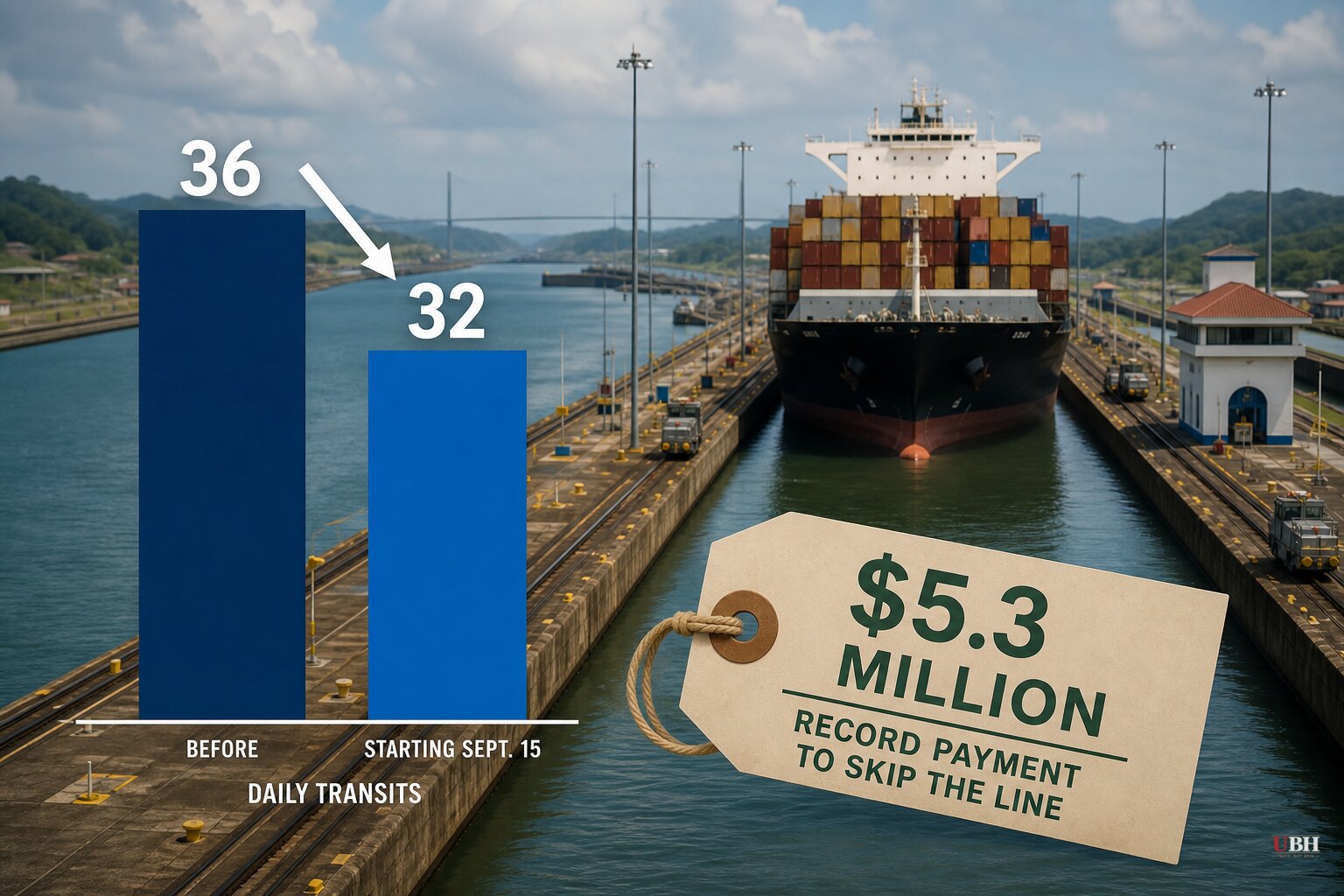
Starting September 3, the Panama Canal Authority will begin capping Neopanamax lock traffic at nine daily slots. Panamax capacity will drop to 25 slots the same day, with a further cut to 23 slots scheduled for September 15, according to NOAA's Climate Prediction Center. Other outlets, including Channel NewsAsia and Africanews, frame the overall daily transit cap slightly differently: 34 vessels total starting in early September, falling to 32 by September 15, down from a baseline of 36. Either way, the direction is the same. Less water means fewer ships.
The trigger is El Niño. NOAA's Climate Prediction Center says there's now a greater than 90% chance the current El Niño becomes a very strong event through this fall and winter, with a 69% chance it exceeds every event on record since 1950 during October through December. The Niño 3.4 region, the benchmark zone forecasters watch, is running 1.8°C above average, with spots further east up to 3.5°C above normal.
Why This One Is Different
Panama Canal Administrator Ricaurte Vásquez told gCaptain the event is expected to last about eight months, hitting a watershed that was already dry. "The soil is drier now, so there is less water retention currently in the surrounding areas and the watershed, which makes things more complicated," Vásquez said.
The numbers back him up. The canal authority disclosed that rainfall from May through August ran 34% below the historical average, while watershed inflows fell 44% below normal, according to Channel NewsAsia. Steve Paton of the Smithsonian Tropical Research Institute said rainfall since April had reached only about two-thirds of average and was still trending downward, warning that "the lake level will continue to drop and drop when it should be rising."
Regional rainfall data tells the same story. Panama City has received 75% of its average rainfall since May 1, while the western city of David has gotten just 60% of its 90-day average, according to CNN. Vásquez told Africanews the dry season, normally expected in December, could arrive a month early and last roughly five months, with rain not expected to return until April or May 2027.
The canal is also delaying planned relief on cargo limits. A scheduled draft reduction to 14.63 meters at the Neopanamax locks, which would let ships carry less weight and float higher, was pushed back to September 2, and a further cut to 14.48 meters was delayed to October 1, per Channel NewsAsia.
The Price of Skipping the Line
Congestion has already produced eye-popping numbers. In August, dozens of vessels waited at the canal's Pacific entrance, some for over a week, with one chemical tanker stuck more than a month, CNN reported. On August 10, a container ship paid $4 million to jump the queue.
That record didn't last. Incoming Canal Administrator Ilya Espino de Marotta confirmed to AFP that a vessel paid $5.3 million to cross on September 1. Bloomberg identified the ship as the G. Spirit, chartered by South Korea's SK Gas Ltd., according to the Tico Times. Espino de Marotta, who formally takes office September 7, said the canal has seen "three auctions like this, with somewhat high bids, recently." For comparison, the average auction price between October 2025 and February 2026 was about $55,000.
Former administrator Jorge Quijano said more than 120 ships are currently waiting to cross, some without reservations, racing to avoid multimillion-dollar penalties from customers for late cargo. The canal also announced changes to its Transit Reservation System for large Neopanamax vessels, effective August 30 for reservations starting September 13, aimed at what it called more "equitable access" to slots.
Who Pays and What's Actually Proven
The canal moves about 5% of global maritime trade and roughly 40% of all U.S. container traffic, according to Inside Climate News. The U.S. accounts for about 70% of everything that transits it, per CNN. Benjamin Gedan of the Stimson Center says the ripple effects run "through supply chains and all the way to consumer prices at stores," though no source in this reporting quantifies a specific expected price increase for U.S. consumers.
On causation, separate two things. NOAA's advisory attributes the water shortage strictly to this El Niño cycle, a naturally recurring Pacific climate pattern, not to long-term warming. Inside Climate News, citing Northeastern University's Samuel Muñoz, raises a separate and longer-term question: whether climate change will make these droughts more frequent or severe going forward. That's a research projection about future risk, not a claim that this specific 2026-27 event was caused by warming. Both things can be true at once, but they're not the same claim, and sources here don't conflate them.
The reservoirs at stake aren't just for shipping. They supply hydropower and drinking water for roughly 2 million people, nearly half of Panama's population, Muñoz noted. The next checkpoint comes September 15, when the deeper cuts take effect and the canal finds out whether 32 daily slots is enough to get through what officials expect will be Panama's longest dry season in decades.
Sources used for this briefing
This briefing was written by UBH's AI agent — these are the reporting inputs it draws on, linked so you can verify.


