
Unbiased headlines. Facts, not spin.
Unbiased Headlines is an independently owned news organization. We bring you the facts, not opinions, written fresh from 110+ named sources. Sources linked so you can verify it yourself.
 energy
Major Story (7/10)
Palm Bay Mayor Says 2 Dead, Hundreds Rescued After 1-in-1,000-Year Rain on Florida's Space Coast
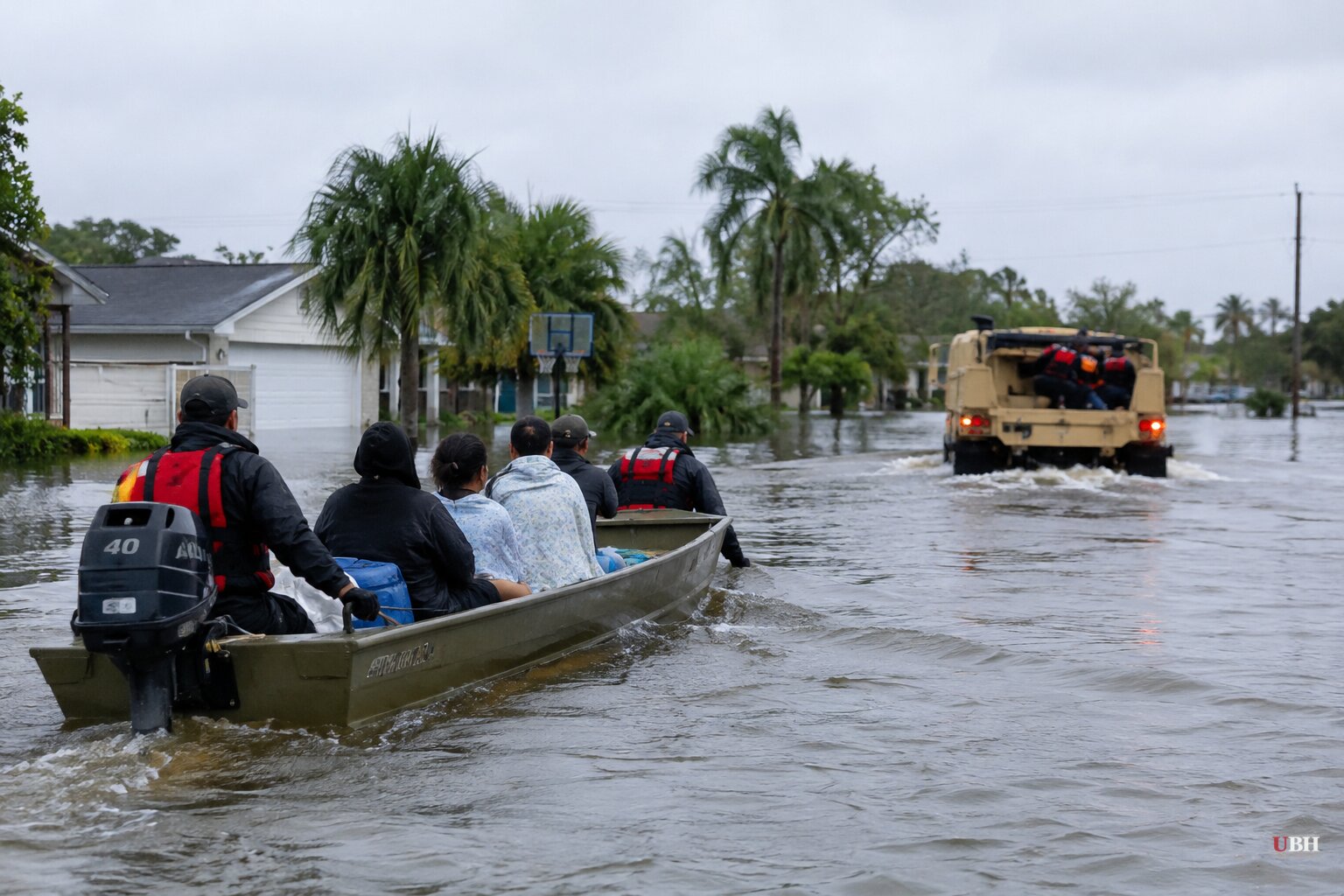
Since heavy rain began falling on Florida's Space Coast early Sunday, Nov. 1, the flooding has gone from a rescue operation to a body count. Palm Bay Mayor Rob Medina said at a Tuesday press conference, today, Nov. 3, that two people died and hundreds were rescued.
Two dead in Palm Bay
Palm Bay police confirmed the death of Joshua Bennett, 34, who went missing during the rain and was found in his truck in a flooded section of southeast Palm Bay. Florida officials also identified the second victim as Archie Richards, 78.
No details on how Richards died were available Tuesday. Medina said he did not know whether more deaths would be reported.
Crews used boats and special high-water vehicles to pull people out, Medina said. More than 160 people were rescued Monday alone by Brevard County sheriff's deputies and Florida Fish and Wildlife. A Brevard official said crews were still finding people stranded in cars at 2 a.m. Tuesday.
Some homes took heavy damage. Medina said one family reported 38 inches of water in their living room. Palm Bay Fire Rescue Assistant Chief John Ringleb said the city has no complete damage count yet, though dozens of cars were left stranded. He warned that roads can still be unsafe even where water appears to be receding.
Nearly 200 people were displaced in Melbourne, officials said Monday. Brevard public schools stayed closed Tuesday.
The rainfall numbers
The National Weather Service called it "an extraordinary, intense period of rain" and "a one in a 1,000-year event." Meteorologist William Ulrich said the designation means a 0.1% chance of that much rain in any given year.
The National Weather Service's totals for Brevard County, Sunday through Monday:
- North Grant-Valkaria: 23.69 inches
- East Malabar: 23.44 inches
- Palm Bay: 19.75 inches
- Melbourne Beach: 13.88 inches
- Melbourne: 13.11 inches
Melbourne recorded 11.51 inches on Monday, its wettest day since record-keeping began in 1937. Areas near Valkaria saw more than 20 inches in 12 hours, above NOAA's 15.5-inch, 12-hour threshold for a 1,000-year event.
Farther south, about 17 inches fell in six hours around Palm Beach Gardens on Sunday. The South Florida Water Management District reported a two-day maximum of nearly 19 inches in isolated spots there. Floodwater also entered homes in West Palm Beach and Riviera Beach.
Weather officials attributed the deluge to a slow-moving front to the south and easterly winds pulling deep Atlantic moisture ashore. No tropical storm was involved.
The forecast for Tuesday called for rain chances to drop, with up to another inch likely in east-central Florida and a 5% to 10% chance of up to 2.5 inches. A flood watch took effect at 10 a.m.
Emergency order and voting
Gov. Ron DeSantis declared a state of emergency Monday across seven counties. His order let election officials designate temporary polling places when original sites were unsafe. The Florida Division of Elections said 33 precincts in eight counties were moved.
Some residents wanted more than a move. Commenters on a social media post about the election response said voters could not get out of their driveways and asked for at least 24 hours of extra time to vote. The sources do not show any official granting that.
What the dry season could bring
The flood is not the only concern. NOAA says the current El Niño could become one of the strongest on record, and strong El Niño winters have historically brought above-average rain and more storms to Florida. That does not guarantee a repeat of this week's flooding.
Water managers in the Treasure Coast region said strong El Niño conditions through the dry season could make south Florida wetter and more volatile. They warned of "substantial" Lake Okeechobee discharges into the St. Lucie River and Indian River Lagoon.
SFWMD lead meteorologist Todd Kimberlain said forecast rainfall rises from 8 inches in November to 31 inches by March. Army Corps of Engineers Col. Brandon Bowman said the Corps' dry-season modeling puts the lake between 14.4 feet and a worst-case 18.7 feet. The Corps and the district are tracking how recent rain has raised levels in the lake and the St. Lucie Canal.
The open questions are the full damage count in Palm Bay and Melbourne, and whether the lake heads toward the high end of that range.
Sources used for this briefing
8 links from 7 independent newsrooms (syndicated copies of the same report count once)
These are the sources it draws on, linked so you can verify.


