
Original briefings. Zero spin.
Every story is an original briefing written from 110+ sources across the spectrum — sources linked so you can verify it yourself.
 energy
Notable (6/10)
Event date: August 26, 2026
energy
Notable (6/10)
Event date: August 26, 2026
Army Puts $2.2 Billion Into Nuclear Microreactors at 5 Bases as Gulf Coast Ports Chase Floating Reactors
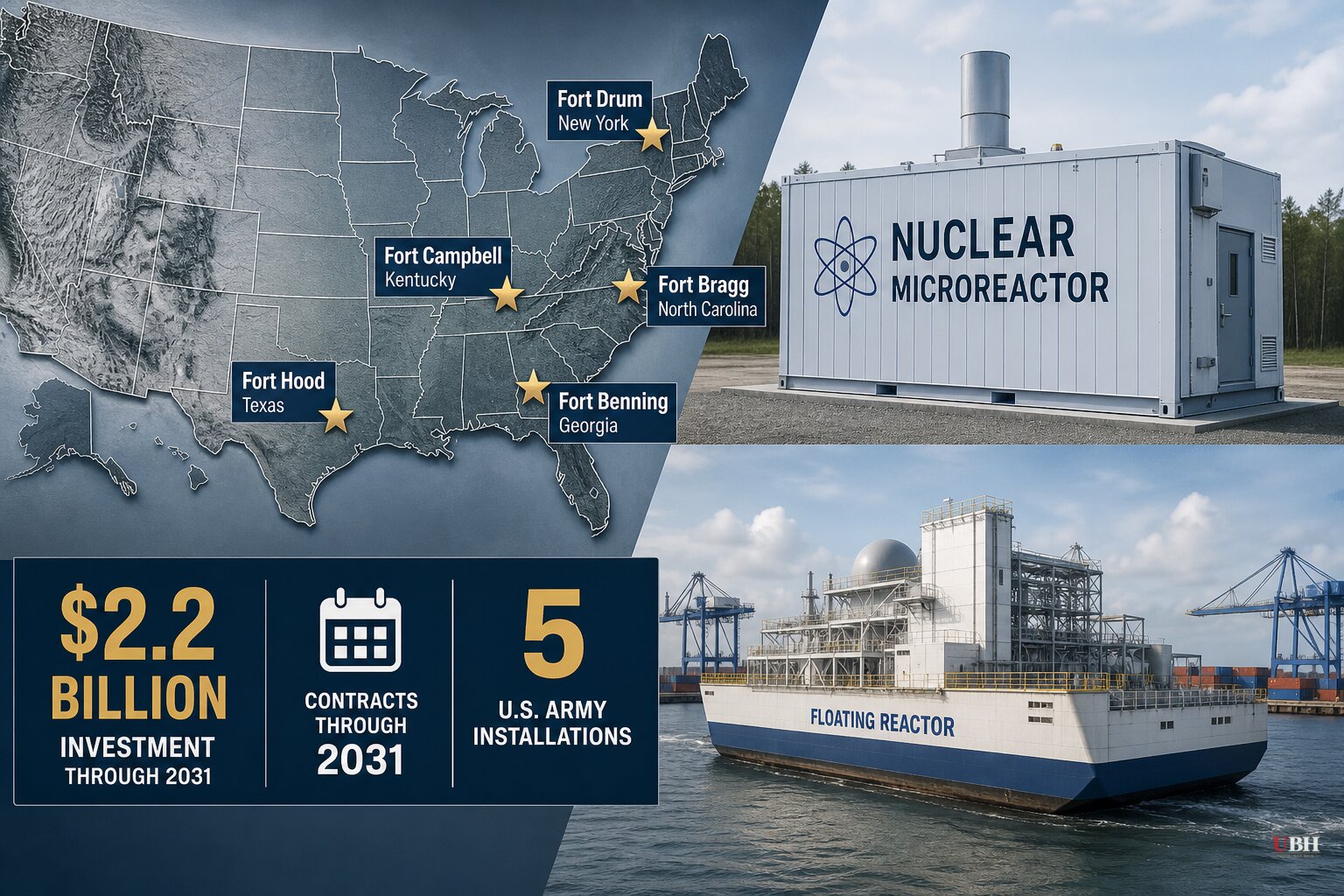
The Army announced on August 26 that it picked five installations to host nuclear microreactors under its Janus Program: Fort Bragg, North Carolina; Fort Campbell, Kentucky; Fort Hood, Texas; Fort Benning, Georgia; and Fort Drum, New York, according to the Epoch Times. Antares Nuclear, BWXT Advanced Technologies, General Atomics Electromagnetic Systems, Radiant Industries and Westinghouse Government Services each landed one site.
The contracts are worth up to $2.2 billion combined through fiscal year 2031, per the Epoch Times, though the total depends on whether each company hits its milestones. AP News put the headline figure at roughly $2 billion.
"Awarding these contracts accelerates our ability to deliver safe, reliable baseload power directly to our installations," said Secretary of the Army Dan Driscoll. The Army wants at least one working microreactor online by the end of fiscal year 2028.
Jeff Waksman, the Army's principal deputy assistant secretary for Installations, Energy and Environment, told reporters the goal isn't a photo-op demo. "We are seeking not just reactors capable of turning on for a brief demonstration, but rather systems able to deliver power with high-capacity factors for years of operation," Waksman said. The reactors will supplement, not replace, the existing grid at each base, and Waksman said the point is backup power if the grid fails. "The intent is that, if the grid fails, then this will provide resilient power to critical infrastructure on those installations."
The Maritime Push: Corpus Christi and Long Beach
Separately, the Maritime Administration is chasing the same technology for commercial shipping. On August 19, Transportation Secretary Sean Duffy, Maritime Administrator Stephen Carmel, Rep. Michael Cloud (R-Texas) and Port of Corpus Christi leaders signed a memorandum of cooperation to explore small modular reactors, port microgrids and shoreside power systems, according to WorkBoat. Long Beach was picked alongside Corpus Christi. Long Beach handles $300 billion in cargo annually, and Corpus Christi's fuel exports alone were worth $80 billion in 2024, according to Forbes figures cited by OilPrice.com.
"Small modular reactors have the potential to reshape America's maritime sector, lower shipping costs, and bolster our supply chains," Duffy said, per WorkBoat.
A second, separate arrangement has Corpus Christi working with Core Power on a study of whether the port could host a floating nuclear power plant or handle calls from nuclear-powered commercial ships, according to a memorandum of collaboration reported by allaboutshipping. That's a feasibility study, nothing built or approved.
Matt Giacona, acting director of the Marine Mineral Administration, said last month that "submerged reactor systems have been safely deployed in naval applications for decades," and that floating reactors "could greatly strengthen America's energy security in the future." He also noted no commercial deployment on the Outer Continental Shelf is currently planned or approved. OilPrice.com noted plainly that not everyone agrees floating reactors add to security, without naming who specifically disputes it.
The Track Record Problem
This technology has a rough history. NuScale, which was supposed to build America's first commercial SMR, canceled the project outright, citing a lack of buyer interest amid rising costs, according to OilPrice.com. The Navy has run reactors at sea for decades, but the one civilian attempt, the NS Savannah, ended up defueled in 1971 after nine years of losing money.
The newest data point is smaller-scale but instructive. Houston-based Deployable Energy got its Unity reactor, a 1-megawatt unit built into a 20-foot shipping container, to criticality at Idaho National Laboratory on June 30, roughly 150 to 155 days after project kickoff, according to figures from the company and INL director John Wagner. But that was "zero-power criticality," a physics demonstration with no meaningful electricity produced, as POWER magazine described it. On August 28, the National Reactor Innovation Center selected Deployable for two follow-on demonstrations: a full-power run at Idaho, and a version installed aboard a working Gulf supply vessel operated by Hornbeck Offshore, a Covington, Louisiana company. Nuclear Engineering International reports the full-power demo is slated for 2027. No date or port has been named for the maritime unit.
A reasonable skeptic's case: the country is being asked to fund a nationwide bet on reactors that, outside naval applications, have mostly canceled, lost money, or not yet produced usable power at commercial scale. That's a fair read of the record so far. The counter-argument, made by Driscoll, Duffy, Carmel and Waksman, is that America needs resilient baseload power at military bases and ports regardless of what wind and solar can deliver, and that federal contracts tied to performance milestones, not blank checks, are the right way to find out if this generation of SMRs actually works.
The Army's own benchmark settles the question on a fixed clock: a working microreactor is supposed to be running at one of the five bases by the end of fiscal year 2028. If that milestone slips the way NuScale's did, taxpayers will have paid for a demonstration project twice over.
Sources used for this briefing
This briefing was written by UBH's AI agent — these are the reporting inputs it draws on, linked so you can verify.


