
Unbiased headlines. Facts, not spin.
Unbiased Headlines is an independently owned news organization. We bring you the facts, not opinions, written fresh from 110+ named sources. Sources linked so you can verify it yourself.
 economy
Major Story (8/10)
US Economy Grew 3.4% in Third Quarter as September Inflation Hit 3.6%
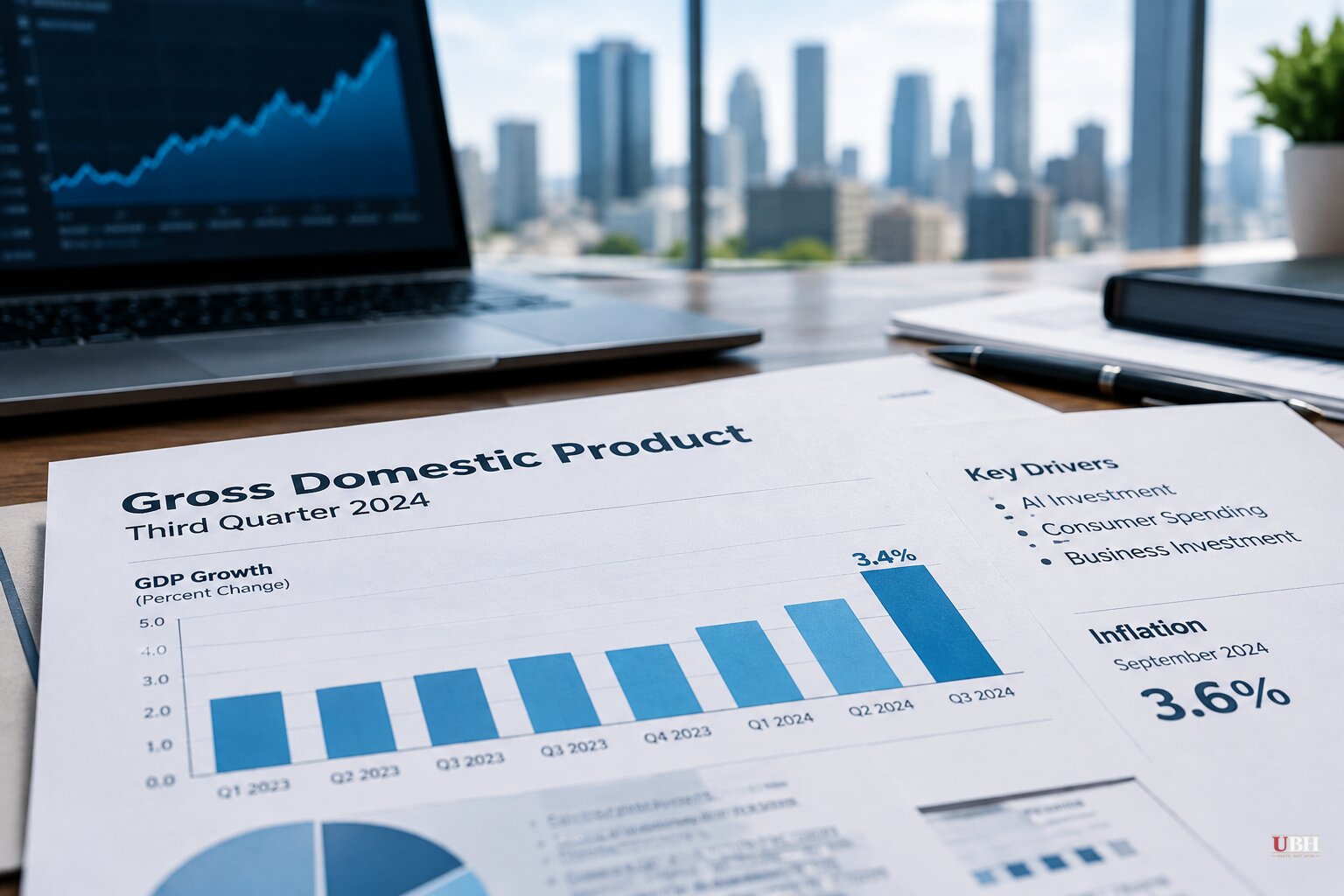
Since this morning's preview of the third-quarter GDP report, the Bureau of Economic Analysis has released the advance estimate: the US economy grew at a 3.4% annualized rate from July through September, up from 2.2% in the second quarter.
That topped forecasts. Economists surveyed by Bloomberg projected 3.2%. A FactSet survey had the median at 3.0%.
The BEA said the acceleration came from higher investment, consumer spending and government spending, partly offset by a drop in exports. Imports rose faster than in the second quarter, which subtracts from GDP.
AI spending carries the quarter
Business investment excluding housing jumped 12.7%. Spending on information processing equipment surged 37.4%, software rose 9.6%, and research and development rose 7.5%.
Household spending grew at a 3.8% annualized rate for the second straight quarter. Real final sales to private domestic purchasers, which combines consumer spending and private fixed investment, rose 4.9% after a 4.6% gain in the second quarter.
Housing was the weak spot. Residential investment fell 3.3%, its sixth decline in the last seven quarters, with high mortgage rates cited as the drag.
Some of the AI boom does not stay at home. "We talk about the boost to growth from AI, but a lot of that stuff is imported," said Eric Winograd, senior economist for fixed income at AllianceBernstein. He called it "a strong quarter driven by domestic demand activities and a drag from trade."
Inflation moved the other way
The September inflation data landed the same morning. The PCE price index, the Federal Reserve's preferred gauge, rose 0.5% from August and 3.6% from a year earlier, up from 3.4% in August. Economists had expected exactly that, according to FactSet.
Core PCE, which strips out food and energy, rose 0.3% on the month. The annual core rate ticked up to 3.1% from 3.0%. The Fed's target is 2%, a level it has not hit in more than five years.
Energy is a big part of the story. Oil prices remain above $100 a barrel, up from under $70 before the war with Iran. Gasoline averages about $4.25 a gallon nationwide, and AAA data show regular gas costing about 42% more than a year ago.
The BEA's quarterly figures show a different shape. The PCE price index rose at a 2.1% annualized rate in the third quarter, down from 5% in the second. The core measure rose 2.5%, down from 3.3%. The monthly acceleration in September came after that cooler stretch.
Households are drawing down savings
Consumer spending rose 0.5% in September, slowing from 0.9% in August. Adjusted for inflation, it was flat. Personal income grew 0.2%, down from 0.3%.
The personal savings rate fell 0.2 percentage points to 3.8%, the lowest in nearly four years. Spending has held up partly by absorbing that squeeze.
The Fed and the ballot box
The Fed held rates steady Wednesday, Oct. 28, a day before the data. In September it raised rates for the first time in three years. Chair Kevin Warsh said after Wednesday's meeting that "economic growth has strengthened" and called current inflation "too high," while cautioning against moving too quickly. He said the Fed had seen some tightening of financial conditions since the September hike.
The September hike has not yet slowed business investment, as companies kept building AI infrastructure through the quarter.
Politics is on top of all this. The midterms are Tuesday, Nov. 3. Polls show the rise in inflation has soured most voters on the economy and on President Donald Trump's handling of costs, according to the Associated Press. Trump campaigned in 2024 on lowering prices, including bringing gas below $2 a gallon.
The GDP number gives the White House a stronger headline than it had a day ago. The price data and the 3.8% savings rate are what households see at the pump and in their bank accounts.
Thursday's GDP figure is an advance estimate, the first of three. Two more revisions are due in the coming weeks and could move the number.
Sources used for this briefing
7 links from 7 independent newsrooms (syndicated copies of the same report count once)
These are the sources it draws on, linked so you can verify.


