
Unbiased headlines. Facts, not spin.
Unbiased Headlines is an independently owned news organization. We bring you the facts, not opinions, written fresh from 110+ named sources. Sources linked so you can verify it yourself.
 economy
Notable (6/10)
Event date: October 28, 2026 ·
China's Population Fell 3.39 Million in 2025, the Fourth Straight Annual Decline
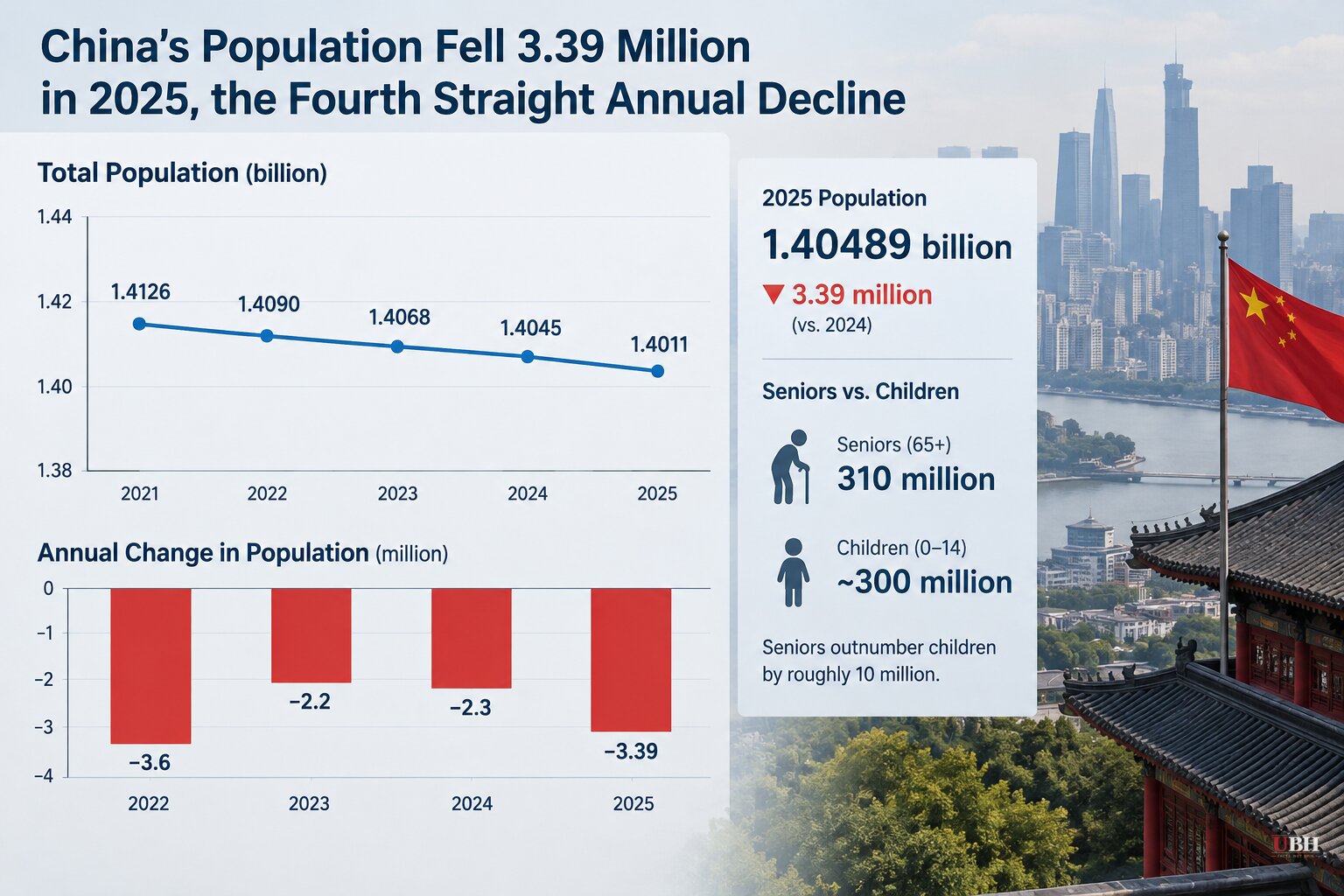
Since China's population peaked in 2021, it has shrunk every year, and the newly published China Statistical Yearbook 2026 puts the latest drop at 3.39 million people for 2025.
The National Bureau of Statistics figures put the year-end population at 1.40489 billion. That is 7.71 million below the 2021 peak. The 2025 loss is the largest of the four annual declines so far.
Seniors now outnumber kids
The yearbook data also shows a shift in the age structure. China's old-age dependency ratio reached 23.1 percent in 2025, against 22 percent for children, according to figures reported by the state-affiliated outlet Yicai.
That ratio was 15 percent in 2016 and topped 20 percent by 2021.
In raw numbers, China has more than 223 million people aged 65 and over and about 213 million children aged 14 and under. Births hit a record low in 2025.
The country's own policy history is part of the explanation. The one-child policy ran from 1980 to 2015, and rapid urbanization added to the decline in births.
Where the drop is steepest
The regional breakdown is uneven. Guangdong, the country's largest regional economy, accounted for roughly one in every eight newborns nationwide last year, according to the yearbook data.
The northeast recorded the steepest losses, with a natural population decline of up to seven per 1,000 people. Parts of central and western China also saw significant deterioration.
What the analysts say
Foreign Affairs, in a piece titled "China's long twilight," argues that the headline population number understates the problem because fewer young workers are being born. If China follows East Asia's slide to ultralow fertility, the magazine writes, it will shed about one percent of its population a year by the 2040s, roughly ten million people.
It projects the share of Chinese aged 65 and older doubling from 15 percent today to around 30 percent in the 2040s. The U.S. share, by comparison, is projected to rise from around 19 percent to just over 23 percent by 2060.
The American Enterprise Institute lays much of the blame on the one-child policy and says the post-policy "birth shock" resembles the population loss that usually follows war or plague. AEI argues the collapse undercuts planning built around a growing base of young industrial workers. With less than half as many babies born in 2025 as in 2016, it says, China's "working age manpower is set on a crash course in the generation ahead."
The Rand Corporation adds that China is "yet to become a high-income nation," so it never collected the demographic dividend that other fast-growing Asian powers did and now has fewer resources to address the pressures of an aging population. "The United States and Japan got rich before they got old, but China got old before it got rich," Rand said.
Foreign Affairs also argues that Xi Jinping's government leans on cheap exports while domestic demand stays weak. It says the system relies on "repression and reflexively following central mandates" and that Beijing "seems incapable of preparing for the social challenges it will face in the decades ahead."
That is a critic's assessment, not an established outcome.
Beijing's response
Chinese authorities point to a growing list of pro-birth measures: family subsidies, childcare support and reduced childbirth-related medical costs.
Officials have also pledged to make urban life more supportive of young people, children and families. Last week, the State Council recommended building a "fertility-friendly society" with more financial support for maternity care, preschool care and school tuition, and suggested "equalizing" services for rural Chinese who move to big cities. The Statistical Yearbook, a government publication, is itself the source of the figures above.
So far the results have not matched the effort. Four straight years of decline, and the largest drop yet in 2025, came while those programs were being rolled out. Subsidies for maternity and child care have been raised for years, in China and in other countries facing demographic decline, with only modest effects on birthrates.
What's at stake
AEI warns that the withering of China's extended family networks, long the people's only reliable social safety net, will have profound and far-reaching implications. Rand notes that the burden of paying for a large elderly population will fall heavily on today's Chinese workers.
China also remains the world's second-largest economy. Demographic decline narrows the pool of young workers that economy depends on.
The open question is whether subsidies and childcare support can lift births at all.
Sources used for this briefing
5 links from 5 independent newsrooms (syndicated copies of the same report count once)
These are the sources it draws on, linked so you can verify.


