
Unbiased headlines. Facts, not spin.
Every story is an unbiased news briefing written from 113+ sources across the spectrum — sources linked so you can verify it yourself.
 defense
Major Story (8/10)
September 29, 2026 at 10:39 AM
defense
Major Story (8/10)
September 29, 2026 at 10:39 AM
Turkey Signs Defense Pact With Saudi Arabia and Pakistan as U.S. Signals Smaller Middle East Role
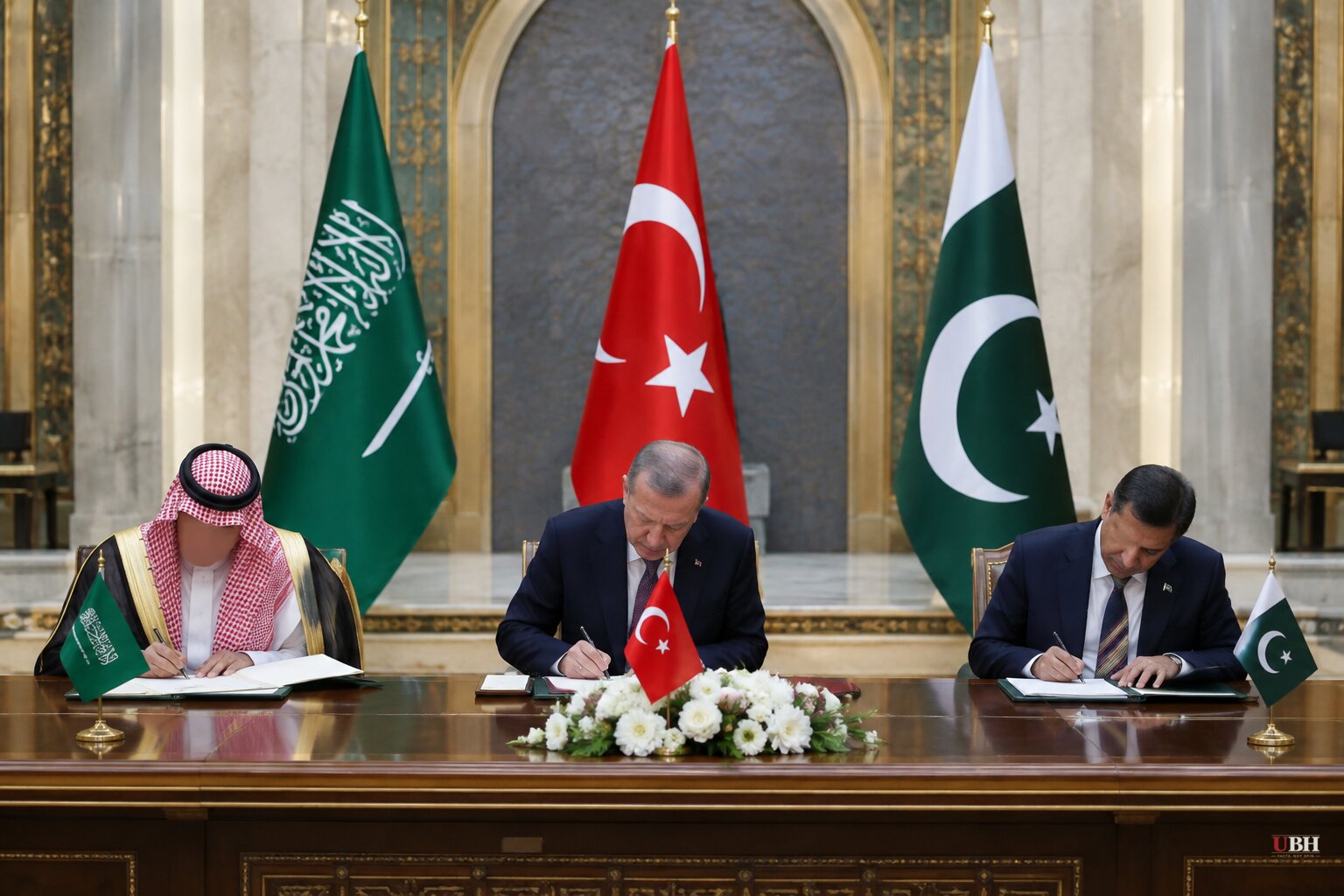
Saudi Arabia, Turkey and Pakistan signed a mutual defense pact on August 7 in Mecca, combining Riyadh's oil wealth, Turkey's expanding defense industry, and Pakistan's nuclear weapons under one roof, according to NPR. The Mecca Joint Defense Agreement includes NATO Article 5-style language: an attack on one is treated as an attack on all three.
Turkish Foreign Minister Hakan Fidan told NPR that Ankara drove the three years of negotiations that produced the pact. President Recep Tayyip Erdogan called it a signal to "the Islamic world" during a youth conference this month, according to NPR's reporting from Istanbul.
The timing isn't an accident. NPR notes the deal lands amid "growing talk in Washington of the U.S. reducing its Middle East security footprint" after the Hamas-led October 7, 2023 attack on Israel and a stalemated, seven-month U.S.-Israeli war with Iran that has left Tehran's regional proxy network in Syria and Lebanon in ruins but hasn't produced a clean American win.
Asli Aydintasbas, director of the Turkey Project at the Brookings Institution, told NPR that elements of Erdogan's government view themselves as heirs to the Ottoman Empire, which ran much of the region from Istanbul for nearly 500 years before collapsing after World War I. "There is a sense of a manifest destiny among Turkey's current ruling elite that Turkey's destined to be the region's heavyweight," Aydintasbas said. She added that as U.S. influence declines without a decisive outcome in Iran, "Turkey will be there to step in."
That ambition rests on real assets. Turkey fields NATO's second-largest military and has built bases in Somalia, Qatar and Libya, while playing a central role shaping Syria's post-Assad government, according to NPR. Ankara has also leaned on soft power. Turkish soap operas are watched across the Arab world, Turkish-built schools dot the region, and Erdogan has positioned himself as a mediator in conflicts from Ukraine to Iran.
The British magazine The Economist went further, publishing an analysis titled "When America walks away" that argued the Middle East's order will no longer be "imposed from afar" for the first time since the Ottoman Empire's dismemberment a century ago, and that Turkey is "the strongest candidate to fill the huge power vacuum" left behind, according to coverage of the piece by hispanatolia. That framing is more sweeping than NPR's own reporting, which treats a U.S. drawdown as a possibility under discussion in Washington, not a settled fact.
Turkey's obstacles are just as real as its ambitions. Aydintasbas told NPR that years of economic mismanagement have left Turkey with persistent high inflation and a weak currency, which she said undermines Ankara's ability to translate regional influence into a Turkish-led order. "Turkey's regional ambitions clearly exceed its current economic means," she said, adding that this "doesn't make Turkey a militarily or strategically weak country."
An increasingly assertive Israel is the other major check on Turkish expansion. Aydintasbas said Israel has worked to keep its neighbors militarily weak since October 7, 2023, a dynamic that constrains how far Ankara can project power even as Iran's regional network has been battered.
Turkey is a NATO member in good standing on paper, yet it still "craves F-35 jets from Washington" per NPR's own reporting. This is a reminder that Ankara was booted from the F-35 program years ago after buying Russia's S-400 missile defense system. A country angling to become the Middle East's new security guarantor can't get its most important ally to sell it the fighter jet every other NATO member flies. Turkey's hedge against Washington and its dependence on Washington are running at the same time.
None of the source reporting establishes that the U.S. has formally announced troop reductions or base closures in the region. The claim is that officials and analysts are discussing a smaller footprint, not that a drawdown is underway. Whether that talk turns into actual policy, and whether Riyadh and Islamabad see Ankara as a genuine security guarantor or a useful hedge, remains unsettled. The next marker to watch is whether Washington moves on Turkey's F-35 request, a decision that would say more about how seriously the U.S. takes Ankara's new regional role than anything signed in Mecca.
Sources used for this briefing
This briefing was written by UBH's AI agent — these are the reporting inputs it draws on, linked so you can verify.


