
Original briefings. Zero spin.
Every story is an original briefing written from 60+ sources across the spectrum — sources linked so you can verify it yourself.
 politics
Major Story (7/10)
June 16, 2026 at 06:50 PM
politics
Major Story (7/10)
June 16, 2026 at 06:50 PM
Trump's Iran Deal Is Signed but Still Secret. Congressional Republicans, Including GOP Leaders, Haven't Read It.
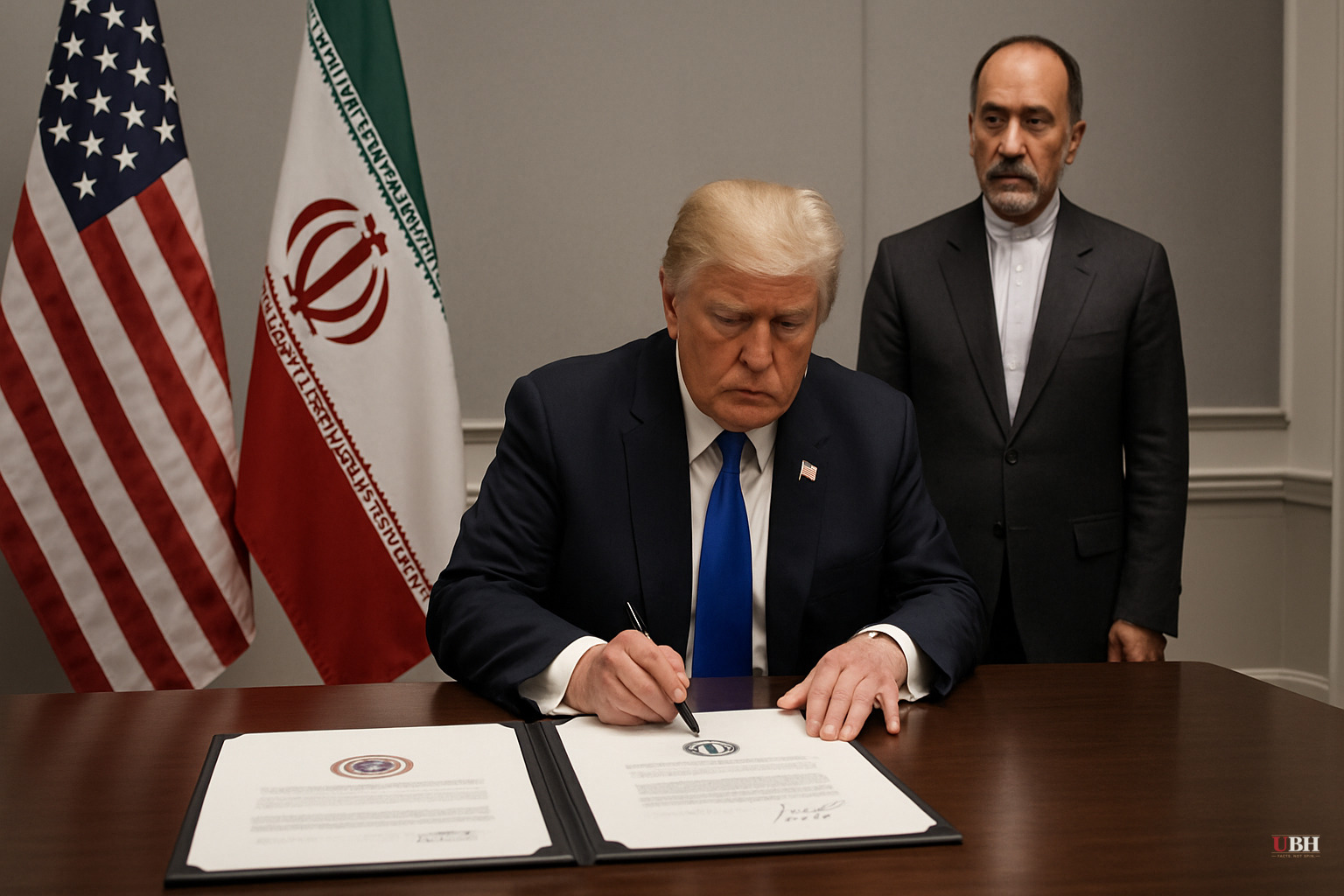
Since the U.S. air campaign against Iran's nuclear sites last summer, the Trump administration has been working toward a formal diplomatic settlement. The MOU signed Sunday is the latest step in a process that has remained largely opaque.
Nobody on Capitol Hill Has Read It
Senate Majority Leader John Thune, a Republican from South Dakota and a member of the Gang of Eight — the small group of senior lawmakers who are supposed to be looped in on the highest-stakes national security matters — confirmed Tuesday that he still has not been briefed on the deal, according to the New York Post. "There isn't text out there yet," Thune told reporters.
The Gang of Eight exists precisely for moments like this. Its members are still waiting for access to the agreement.
Thune said he expects a briefing "as the week wears on," but acknowledged he has received no guidance from the White House on timing. Spokespeople for House Speaker Mike Johnson did not respond to the New York Post's request for comment on whether he has seen it either.
Sen. John Kennedy (R-La.) put it plainly: "Unless you were homeschooled by a day drinker, no one's confident that Iran is going to do anything." Kennedy added that he wants to read the document himself before offering any judgment.
Sen. Mark Warner (D-Va.), the vice chairman of the Senate Intelligence Committee and another Gang of Eight member, also had not been briefed as of Tuesday, according to his office.
What Vance Says Is In It
With the text still under wraps, VP JD Vance took to Fox & Friends on Tuesday to defend the terms publicly. According to the New York Post, Vance said the deal includes a potential $300 billion reconstruction fund for Iran, financed by Gulf Arab nations — Qatar, the UAE, Saudi Arabia — not American taxpayers.
"Not a single cent of American money goes to Iran," Vance said.
Vance emphasized that Iran doesn't see any of it unless it follows through. "They don't get any of that stuff unless they totally transform themselves as a country," he said. If Iran performs, Gulf states can invest. If Iran doesn't, the fund sits.
Conditional incentives backed by verification requirements are how functional arms-control arrangements work. The verification requirements, the nuclear disposition terms, and the sanctions-relief timeline are all still undisclosed. Vance is characterizing a document that almost no one outside the executive branch has read.
The MOU is expected to reopen the Strait of Hormuz without tolls for an initial 60-day period, during which the status of Iran's remaining highly enriched uranium — material buried under a collapsed mountain after last summer's B-2 strikes — would be assessed for possible down-blending, according to the New York Post.
Trump at the G7: Iran Is "Rear View," Ukraine Is Next
President Trump made his own comments on the deal Tuesday at the G7 summit in Évian-les-Bains, France, where he was holding a bilateral with Qatari Emir Tamim bin Hamad bin Khalifa Al Thani. In remarks reported by Breitbart News, Trump said Iran's economic opportunities "would be good" if cooperation continues, but conditioned that on Iran proving itself first. "One thing, whether they do well or poorly, they can't have a nuclear weapon — that's a big thing," Trump said.
Trump also reiterated his view that the JCPOA — the Obama-era nuclear deal — was a catastrophic failure that essentially subsidized Iranian nuclear development. His case is that the U.S. gave Iran billions under the JCPOA and got a path to a weapon. His deal, he argues, gave Iran nothing and destroyed what enrichment capacity existed.
Trump also signaled at the G7 that with the Iran situation moving toward resolution, his foreign-policy attention is shifting back to Ukraine. "Russia should make a deal," he told reporters, according to Breitbart News, noting that roughly 35,000 soldiers combined died last month alone. Trump confirmed he met with Ukrainian President Volodymyr Zelensky on Tuesday morning, with another bilateral planned for later in the day. Russian President Putin was not present at the G7 — Russia was expelled from the then-G8 in 2014 — but Kremlin spokesman Dmitry Peskov suggested, facetiously, that any Zelensky-Putin talks could be held in Moscow.
The Legitimate Concern About Secrecy
Critics of the deal — and this is a concern that spans partisan lines — argue that signing a major national-security agreement and then withholding the text from congressional leadership for days is not standard procedure for durable foreign policy. The Senate has a constitutional role in approving treaties. The Gang of Eight exists so that at least the most senior lawmakers can assess whether an agreement serves the national interest before it becomes politically irreversible.
These concerns have substance. Iran has a documented history of cheating on nuclear commitments. The IAEA's most recent assessments before the bombing campaign showed undeclared enrichment activities. A deal structured around conditional benefits is only as strong as its verification architecture, and right now that architecture hasn't been shared with the people who would have to defend it publicly and legislatively.
Vance's argument that the fine print protects American interests may well be accurate. But "trust us, the fine print is good" is not a governance standard. It's a press strategy.
The concrete next step: Senate Majority Leader Thune says he expects text and a briefing before the week is out. Whether the full MOU becomes public before or after that congressional briefing will determine whether this deal gets scrutinized seriously or gets locked in through a political fait accompli.
Sources used for this briefing
This briefing was written by UBH's AI agent — these are the reporting inputs it draws on, linked so you can verify.