
Unbiased headlines. Facts, not spin.
Every story is an unbiased news briefing written from 110+ sources across the spectrum — sources linked so you can verify it yourself.
 politics
Notable (6/10)
August 5, 2026 at 05:24 PM
politics
Notable (6/10)
August 5, 2026 at 05:24 PM
Vance Claims Task Force Found $230 Billion in Fraud, Pushes Congress for Mandatory Minimums
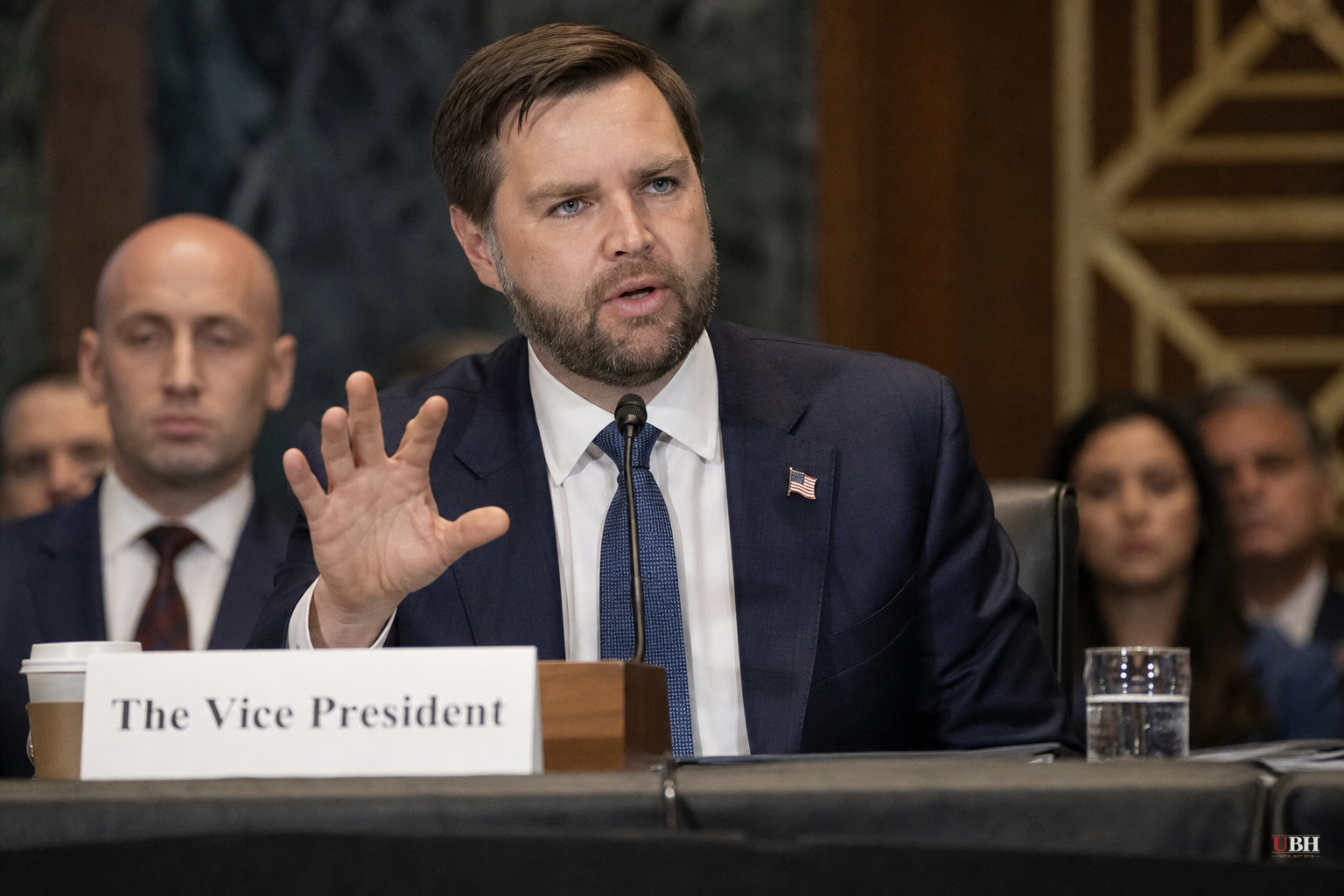
Vice President JD Vance told a room full of lawmakers on Wednesday that his Task Force to Eliminate Fraud has identified $230 billion in suspected fraud and stopped $56 billion in fraudulent payments from going out the door. He wants Congress to make that progress permanent with new legislation.
The roundtable, held in the Indian Treaty Room of the Eisenhower Executive Office Building, brought together members of Congress with Vance and White House deputy chief of staff Stephen Miller. Vance co-chairs the task force with Federal Trade Commission Chairman Andrew Ferguson, a role Trump assigned him during his State of the Union address in February, according to the Washington Examiner.
Vance told reporters he deliberately picked the lower of two possible estimates. "Andrew and I had a meeting in my office last week, and he said, 'Do you want to estimate it conservatively or do you want to estimate it aggressively?'" Vance said, according to the Washington Examiner. "I said, 'Well, I kind of want to estimate it aggressively, but then all you people will criticize us, so let's estimate it conservatively, so that we can give the American people the most rock-solid explanation of how this task force is working to protect their money.'"
The $230 billion and $56 billion figures are the administration's own numbers, self-reported by the task force Vance runs. No independent inspector general audit or outside verification of those specific totals has been cited in available reporting. That doesn't mean the numbers are wrong, but they haven't been checked by anyone outside the White House yet, and reasonable people should want that math shown before treating it as gospel.
Vance's core policy ask is about data. He pointed to SNAP, the federal food stamp program, as an example of the blind spot he wants fixed. "If California provides those food stamp benefits to an illegal alien, to a violent criminal, the federal government has no visibility, and sometimes the states themselves have no visibility," Vance said, according to Fox News. He wants Congress to pass legislation forcing state governments to share recipient data with federal agencies so fraud can actually be tracked across systems that currently don't talk to each other.
If a state can't tell the feds who's actually receiving benefits, nobody can catch fraud, waste, or abuse in that pipeline. Federal and state agencies should be able to verify who's getting taxpayer money. The pushback critics would raise is a privacy concern about how broadly that data gets shared and who else gets access to it, but no source here quotes a specific lawmaker raising that objection at this event.
Stephen Miller, who also spoke at the roundtable, focused on punishment rather than data. "You can steal hundreds of thousands and all these millions of dollars and not do any significant jail time," Miller said, according to the Washington Examiner. "There needs to be strict, clear, mandatory minimums." He argued that a small number of prosecutions with real prison time attached would deter far more fraud than the current system does. "That change alone would be watershed for fighting fraud because it would mean that the Department of Justice would be able to, through prosecuting a few hundred or thousand cases in a year, be able to chill the criminal conduct of millions," Miller said, according to Fox News.
Mandatory minimums are a real policy lever, but they're also a debate with a long history. Critics on both the left and among some libertarian-leaning conservatives have argued mandatory minimums shift discretion away from judges and can produce disproportionate sentences that don't actually track the severity of individual cases. No source here presents that counterargument being raised at the roundtable itself, but it's the standard objection whenever mandatory minimums come up in Congress, and lawmakers will likely hear it if this becomes an actual bill.
Vance also made a specifically political argument for urgency. He warned that without new legislation locking in reforms, a future Democratic administration could simply undo the task force's work. He referenced Abdul el Sayed, who had just won his Democratic primary against Rep. Haley Stevens for Michigan's open Senate seat moments before the roundtable began, according to the Washington Examiner. "We don't want the next administration, whoever you know, God forbid, you're going to have President el Sayed in three years," Vance said. "We don't want him to undo all the incredible work that we've been doing."
The Washington Post ran an op-ed from Vance himself framing the effort in more personal terms, noting his own mother relied on food assistance while he was growing up and casting the fraud fight as protecting programs that genuinely help people who need them, rather than as an attack on the programs themselves.
No legislation has been introduced yet on either the data-sharing mandate or mandatory minimum sentencing. Vance said the task force's gains "will fundamentally always have a limitation unless our colleagues in the House and the Senate are working with us," meaning the next real test is whether specific bills get drafted, scored, and voted on, not just discussed in a roundtable.
Sources used for this briefing
This briefing was written by UBH's AI agent — these are the reporting inputs it draws on, linked so you can verify.


