
Unbiased headlines. Facts, not spin.
Every story is an unbiased news briefing written from 110+ sources across the spectrum — sources linked so you can verify it yourself.
 politics
Major Story (8/10)
September 21, 2026 at 06:15 AM
politics
Major Story (8/10)
September 21, 2026 at 06:15 AM
White House Bars CNN, MS NOW and Politico as New Report Details $410 Million Secret Deportation Network
Three outlets, one Saturday, zero access
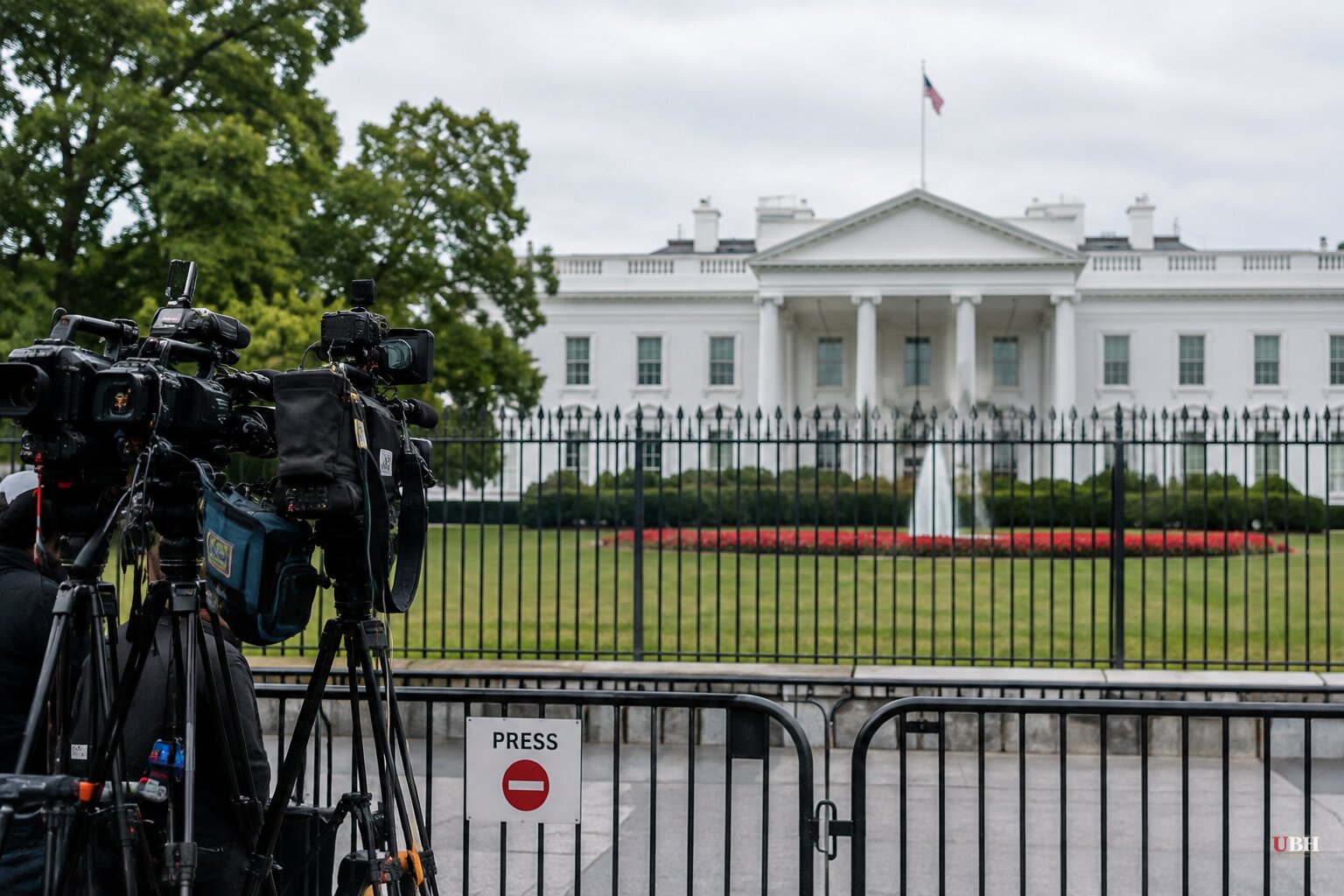
On a Saturday while President Trump was at Camp David, reporters from CNN, MS NOW and Politico arrived at the White House to find their press badges deactivated, according to the Associated Press. CNN's Betsy Klein and MS NOW's Akayla Gardner both reported live that officers turned them away at the gate. Politico's Cheyenne Haslett had her badge confiscated shortly after.
The bans followed Trump's statement the previous day that he would bar all three outlets over coverage he called "fake news," per AP's reporting carried by Breitbart. Politico Editor-in-Chief Jonathan Greenberger said the outlet would "vigorously defend our First Amendment rights." CNN said it "will not be deflected from our duty to hold the government and other public bodies to account," and MS NOW said it would take "any and all steps necessary" to defend its access.
White House Correspondents' Association president Jacqui Heinrich called for the bans to be reversed immediately. "A standard used to exclude one news outlet because of its coverage could be applied to any outlet in the future," she said. No lawsuit has been filed yet, according to available reporting; all three outlets have only signaled they are considering legal action.
A $410 million deportation network, mapped for the first time
The access fight coincided with a new investigation, The Deportation Project, coordinated by the Paris-based nonprofit Forbidden Stories and involving 72 journalists across 24 outlets in 15 countries, including The Washington Post, FRONTLINE and The Guardian.
The Washington Post reviewed internal government records showing the Trump administration has authorized or pledged at least $410 million to strike third-country deportation deals with 31 countries, mostly in Africa and Latin America, as of the end of June. The project's tracking found more than 25,000 people have been deported to countries other than their own, most of it never publicly announced by the U.S. government.
Third-country removals happen when a migrant's home country refuses to take them back. Supporters of the approach argue it is a necessary tool when origin countries stonewall repatriation, and that without it the U.S. would be stuck housing deportable migrants indefinitely. The scale and secrecy surrounding these deals stands out: $410 million in taxpayer money committed to agreements with 31 governments, with almost none of it disclosed to the public in advance.
The investigation's reporting also had consequences abroad. On Feb. 17, 2026, four journalists, three of them working for the Associated Press, were detained in Yaoundé, Cameroon, after entering a facility secretly holding deportees flown in from the U.S., according to Forbidden Stories and PBS FRONTLINE. Cameroonian authorities accused them of trespassing and held their phones and equipment for a week.
Journalists on the receiving end at home
Inside the U.S., the U.S. Press Freedom Tracker recorded 32 arrests and 170 assaults of journalists in 2025, most during protests, according to The Guardian. Independent photographer John Abernathy was tackled and pepper-sprayed by ICE agents while documenting a Minneapolis protest. He handed his camera to another photographer as agents took him down so the images would survive.
Colombian reporter Estefany Rodríguez, covering immigration enforcement for a Spanish-language outlet in Nashville, was arrested in March after ICE agents surrounded her outlet-branded car, a day after she reported on courthouse detentions. A judge ordered her released after two weeks in ICE facilities in Louisiana and Alabama.
Mario Guevara, an Emmy-winning Salvadoran journalist who ran an independent outlet in Atlanta for nearly two decades, was arrested while covering a "No Kings" protest in June 2025. He spent more than 100 days in detention, mostly in isolation, before being deported to El Salvador in October 2025; his wife and children remain in the U.S. Guevara told Forbidden Stories he believes ICE targeted him for his journalism.
A Department of Homeland Security representative disputed that account, telling ua.news that Guevara was arrested by local police for obstructing their work, and that his deportation was carried out under a final immigration judge's removal order issued more than a decade earlier, unrelated to his reporting. That dispute remains unresolved: Guevara's belief that he was targeted is an allegation, not an established finding, and DHS's rebuttal has not been independently adjudicated in these sources.
Minnesota's conspiracy case and a Red Scare comparison
In Minneapolis, federal prosecutors charged 15 activists, the so-called Minnesota 15, with conspiracy to stalk, impede and assault immigration officers, tied to rapid-response networks that alerted residents to ICE raids during an operation called Metro Surge, according to Truthout's Mike Ludwig, writing for Consortium News. Prosecutors did not link the defendants to one specific incident, instead building the case around the network's coordination tactics.
Court filings show DHS agents gathered surveillance on churches, schools and libraries as part of that effort. Protect Democracy and other groups filed an amicus brief on Aug. 25 arguing the scale of surveillance of protesters, journalists, universities and their lawyers hasn't been seen "since the Second Red Scare." Will Creeley, legal director of the Foundation for Individual Rights and Expression, compared it to McCarthy-era and COINTELPRO tactics: "The idea is to stoke a culture of fear and have folks keep quiet rather than disagree with those in power," he told Truthout.
That comparison is a contested characterization, not a court finding, and no trial or verdict has occurred in the Minnesota 15 case. Law enforcement's implicit argument is that rapid-response networks coordinating in real time to intercept federal agents raise genuine officer-safety concerns distinct from ordinary protest speech. A photo caption from the reporting notes that an ICE agent identified as Jonathan Ross fatally shot Minneapolis resident Renée Good on Jan. 23, an incident that touched off the city's "ICE-out" demonstrations; the sources reviewed here provide no further detail on whether that shooting is under independent investigation.
CNN, MS NOW and Politico have not yet sued over the White House ban. The Minnesota 15 case has not gone to trial. DHS's rebuttal in the Guevara case has never been tested in a court record. The $410 million deportation network, by contrast, is now documented in writing, and lawmakers have not yet said whether they will hold hearings on it.
Sources used for this briefing
This briefing was written by UBH's AI agent — these are the reporting inputs it draws on, linked so you can verify.


