
Unbiased headlines. Facts, not spin.
Unbiased Headlines is an independently owned news organization. We bring you the facts, not opinions, written fresh from 110+ named sources. Sources linked so you can verify it yourself.
 politics
Major Story (7/10)
Spain votes Nov. 29 to open a run of national elections in four of the EU's five biggest countries
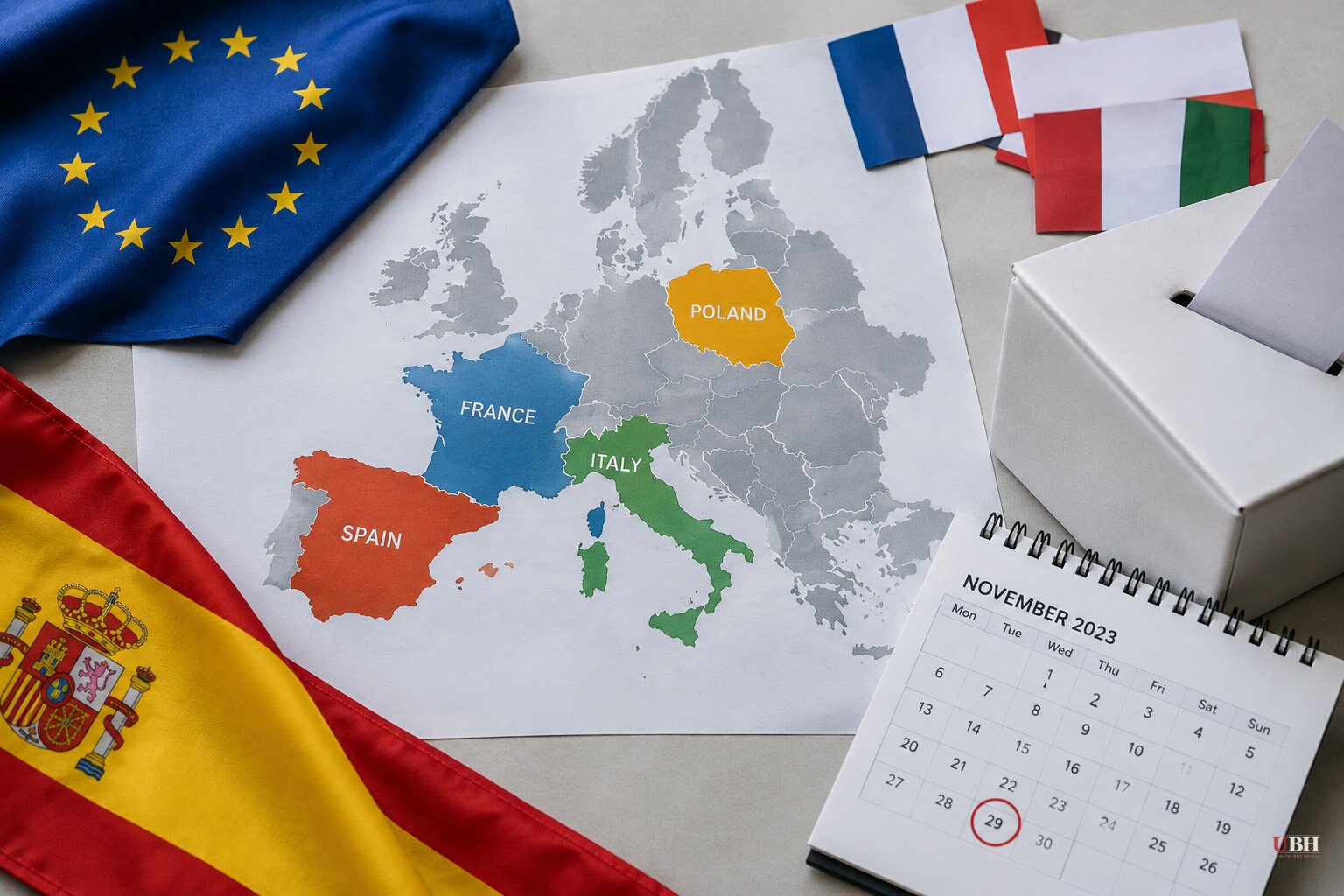
Seven days from now, Spain votes. The snap general election on Nov. 29 is the first of a string of national contests that will put governments in four of the EU's five biggest member states on the ballot between now and the end of 2027.
Parliamentary elections are also due in Estonia, Finland, Greece and Slovakia, with regional ballots in Germany.
Spain goes first
Prime Minister Pedro Sánchez's socialist coalition faces probable defeat. The challengers are the conservative People's Party (PP) and the far-right Vox, which already govern together in some Spanish regions. The PP could need Vox's support to form a national government.
France, Poland and Italy follow
France holds presidential and parliamentary elections in the spring. Marine Le Pen of the National Rally is the clear frontrunner for the presidency, well ahead of the far-left Jean-Luc Mélenchon and a divided mainstream opposition.
She also has a legal problem. France's highest court is aiming to rule on her appeal of an embezzlement conviction by early April, weeks before the first round. If the ruling goes against her, she could campaign and face voters wearing an electronic tag, according to AP's reporting.
Poland votes later next year. Nationalist parties that together command nearly half of national support could unseat Prime Minister Donald Tusk's liberal coalition, despite recent splits in it.
Italy must hold its election before the end of 2027. Prime Minister Giorgia Meloni, whose Brothers of Italy party has far-right roots, wants a second term. She faces pressure on her right from National Future, a newer party led by Roberto Vannacci.
What the numbers show
The backdrop is odd. A record 74% of Europeans say their country benefits from EU membership, according to the European Parliament's July Eurobarometer. Very few Eurosceptic parties now campaign for leaving outright.
Yet almost one in four voters backs a far-right party, a share that has nearly quintupled since the mid-1990s, according to figures in a Guardian analysis.
That analysis points to economic stagnation, the cost of living, an ageing population and strained public finances as factors eroding trust in centre-left and centre-right parties. Migration, the green transition, support for Ukraine and globalisation are the main fights. The Guardian also says Russian disinformation and the Trump administration's open backing for so-called patriotic parties are reinforcing certain narratives.
Why Brussels is watching
Only three of the 27 leaders on the European Council currently come from the centre-left. The Guardian's analysis argues that if nationalist and Eurosceptic governments take power in France, Spain and Poland, they could join with other governments to form a blocking minority.
The decisions most exposed are the EU budget, further aid to Ukraine, European defence and enlargement. The stakes, as the analysis frames them, are not an EU breakup but gradual paralysis.
The nationalists' own goal is stated plainly. They see the EU as a top-down project that undermines national sovereignty. They want to turn it into a looser association of sovereign nation-states, in the words of the Italian political scientist Nathalie Tocci as relayed in the analysis.
One analysis of the political fallout suggests the bloc could cope by working in smaller, issue-specific groups, as governments already do in the Coalition of the Willing for Ukraine.
The counter-trend
The momentum is not one-way. AP counts at least eight national election setbacks for nationalist, anti-immigration leaders or parties in roughly 18 months, in Romania, the Netherlands, Portugal, Hungary and Sweden among others. Since April, voters ousted Hungary's Viktor Orbán, ended Aleksandar Vucic's long grip on Serbia and blocked the Bolsonaro family's return in Brazil.
The U.S. midterms added to that run. Democrats won control of the House and Senate, according to AP.
"When cracks in power become more visible, this can trigger a cascade effect," said Péter Krekó, director of Budapest's Political Capital Institute.
Daphne Halikiopoulou, a politics professor at the University of York, said the midterms are "a very favorable result for the center left, and this could hinder the far right." She also said the trend toward the far right has been "the defining feature of 21st-century politics."
Others see less spillover. Analysts told AP that U.S. voters may have punished Donald Trump's economic record more than his "America First" ideas. Populist candidates also won presidencies in Poland, Chile and Colombia after mid-2025.
Sciences Po political scientist Gilles Ivaldi said that in France "the far right still has the wind in its sails." Anger at incumbents elsewhere could even help Le Pen, because her party has never governed France.
What comes next
Spanish voters decide on Nov. 29. The next fixed marker is the French court's ruling on Le Pen's appeal, which the court aims to deliver by early April, weeks before the first round of the presidential vote.
Sources used for this briefing
7 links from 6 independent newsrooms (syndicated copies of the same report count once)
These are the sources it draws on, linked so you can verify.


