
Unbiased headlines. Facts, not spin.
Every story is an unbiased news briefing written from 110+ sources across the spectrum — sources linked so you can verify it yourself.
 politics
Notable (6/10)
August 5, 2026 at 05:35 PM
politics
Notable (6/10)
August 5, 2026 at 05:35 PM
Alberta's Oct. 19 Referendum Has 10 Questions. One Is Secession. Nine Are About Immigrants.
Alberta Premier Danielle Smith set Oct. 19, 2026 as the date for a provincial referendum that includes one question on Alberta separation and nine others covering immigration policy and constitutional reform, according to Global News and CBC News.
Smith says she personally opposes separation. She's made that position public repeatedly. But she's also said she'll campaign for the other nine questions, framing them as a middle path for Albertans frustrated with Ottawa who don't want to go as far as secession.
"If you want to send a message, you should vote for the nine other questions. Give us a mandate to pursue greater and greater autonomy," Smith told a gathering of United Conservative Party members in Edson last month, according to a video posted to social media and reported by CBC News.
What the immigration questions actually do
Five of the ten questions deal directly with immigrants, according to CBC News reporter Jason Markusoff. Alberta has roughly 260,000 temporary residents, a category that includes asylum seekers, student visa holders, temporary foreign workers and their families.
If Albertans vote yes on those five questions, many of those temporary residents could lose health and education coverage. Others who keep coverage could face new access fees stacked on top of the taxes they already pay, CBC News reported.
Avnish Nanda, an Edmonton immigration lawyer who leads Our Alberta Advantage, a group campaigning against the referendum questions, says the ballot language doesn't hold together on its own terms.
"They don't make sense on their own, a lot of them," Nanda told CBC News. "And when you read them together, you can lead to these contradictory results."
Nanda's complaint points to a design concern. If a provincial government is going to ask voters to approve specific, binding restrictions on health coverage and education access for a quarter-million residents, the ballot text needs to be clear enough that a yes or no vote means something consistent.
The case for asking the question at all
Smith's defenders would argue the flip side: Alberta has genuine, long-running friction with Ottawa over immigration levels, resource policy and constitutional authority, and a referendum is a legitimate democratic tool to gauge public appetite for provincial pushback. Petitions on both sides of the separation question have drawn hundreds of thousands of signatures, according to Global News, which is itself evidence that this isn't a fringe concern being manufactured out of nothing.
Critics counter that opinion polls have long shown massive majority support for Alberta staying in Canada, and argue Smith called the vote to placate separatist hardliners inside her own United Conservative Party rather than because the outcome is genuinely in doubt. That's a characterization of motive, not a proven fact, and Smith has not confirmed that reasoning herself. She has said publicly that she wants to settle the separation question "once and for all."
Prime Minister Mark Carney has opposed the separation push outright, calling the fall vote a "dangerous bluff," according to Global News. Carney compared it to Brexit, arguing separatist organizers are making promises about Alberta's future outside Canada that don't hold up and are ignoring the practical costs of leaving.
Flags on lawns, grievances at work
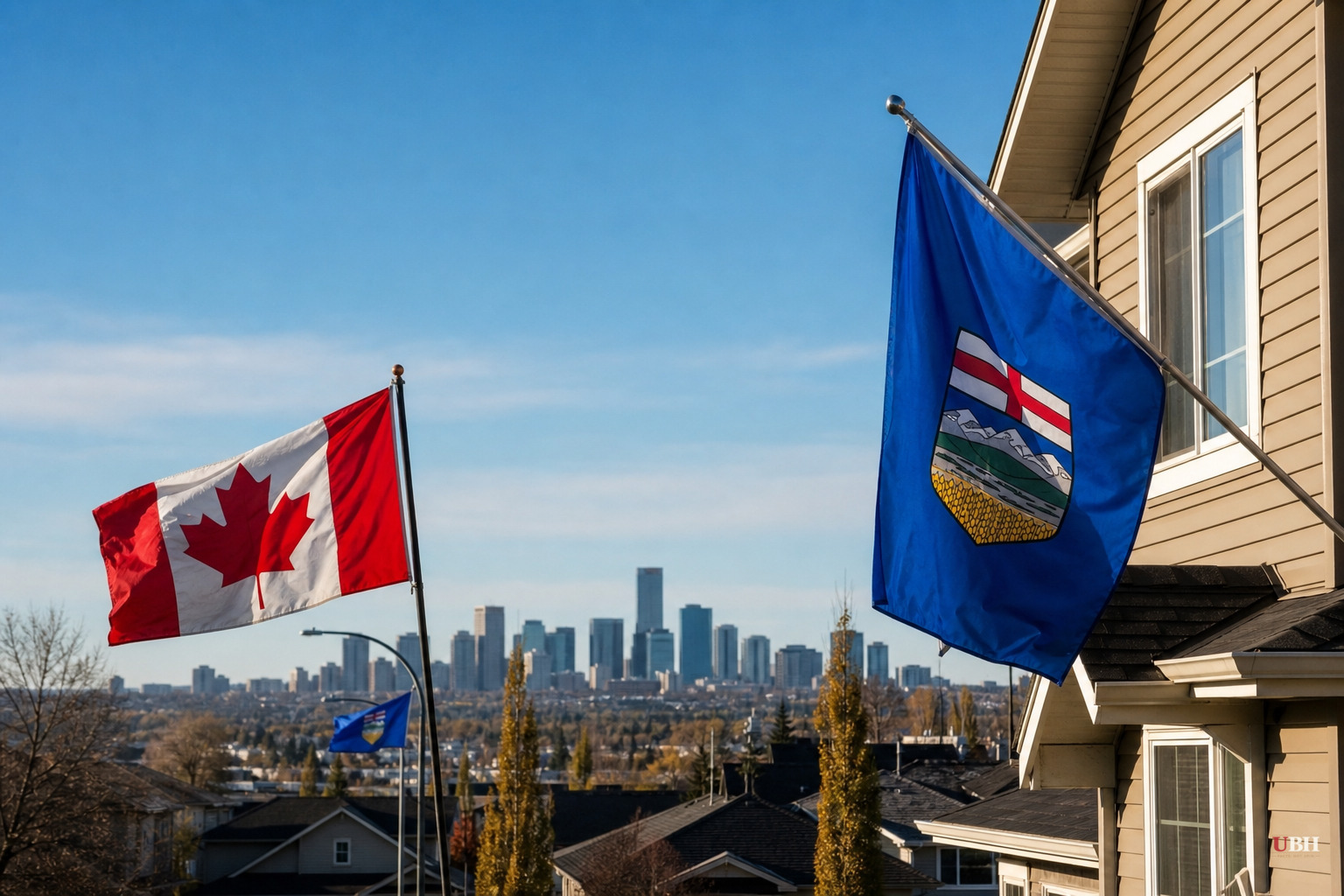
The political fight has spilled into everyday life. Global News reported that Airdrie resident Sarah Batchelor, a 49-year-old music teacher, put up a Canadian flag after a neighbor displayed Alberta's provincial flag, a symbol increasingly associated with the separatist movement.
"It's just a weird vibe. It makes my heart sad," Batchelor told Global News, adding that the Alberta flag "is a hallmark of our heritage" and that its adoption by separatists has changed how it reads on a porch.
The symbolism fight has gotten more concrete elsewhere. A rodeo parade in Sundre, northwest of Calgary, was canceled last month after organizers rejected a float covered in Alberta flags over fears it would be read as a political statement, and the cancellation drew threats and abuse, according to Global News. Separately, the United Food and Commercial Workers union filed a grievance after grocery chain Sobeys displayed the Alberta flag in several of its Alberta stores, arguing in an online statement that the flag alienates customers and employees who identify with Canada.
Batchelor says she doesn't want the flag-waving to stop, even though it stings. "This is a democracy, and you have the freedom to express your views. But we need to be just as loud with our voice," she told Global News.
On Oct. 19, Alberta voters walking into polling stations will need to understand exactly what they're authorizing when they mark yes or no on five separate, interlocking immigration questions that Nanda says can produce contradictory outcomes depending on how they combine. Neither Smith's government nor the reporting so far has produced a plain-language guide resolving that.
Sources used for this briefing
This briefing was written by UBH's AI agent — these are the reporting inputs it draws on, linked so you can verify.


