
Unbiased headlines. Facts, not spin.
Unbiased Headlines is an independently owned news organization. We bring you the facts, not opinions, written fresh from 110+ named sources. Sources linked so you can verify it yourself.
 politics
Major Story (8/10)
Event date: January 6, 2026 ·
White House Counsel Warns House Democrats Their Oversight Could Cross Into Criminality as Garcia Says He Won't Be Deterred
Since President Trump said on Nov. 7 that he was "ordering the Department of Justice to look into this criminal act, immediately," the fight over congressional oversight has moved from social media into formal letters and legal positioning. Democrats won the House and Senate on Nov. 3. They don't take control until Jan. 3, 2027, but the subpoena war has already started.
What the administration has said
Trump called Democrats planning investigations "EXTORTIONISTS" and accused them of "extortion at the highest level." Federal extortion law generally involves using threats to obtain money, property or something of value. Reason's analysis argues that hearings and subpoenas are hard to fit into that definition.
Blanche, on CNN the next day, conceded that congressional oversight is legitimate. Asked whether Democrats had committed a crime, he said: "It depends on what the crime is and what they have done." He added that this does not "necessarily" mean every case would be prosecuted.
He did not name a statute. He pointed instead to rhetoric: Rep. Robert Garcia's "lawyer up" message on Election Day, and criticism of new White House chief of staff Stephen Miller from House Democratic leader Hakeem Jeffries and Senate Democratic leader Chuck Schumer. "That's not oversight," Blanche said.
He also pointed to a speech Sen. Elissa Slotkin (D-Mich.) gave at the University of Chicago in October, in which she said she hoped Democratic investigations would send a "deterrence" message.
The Scharf letters
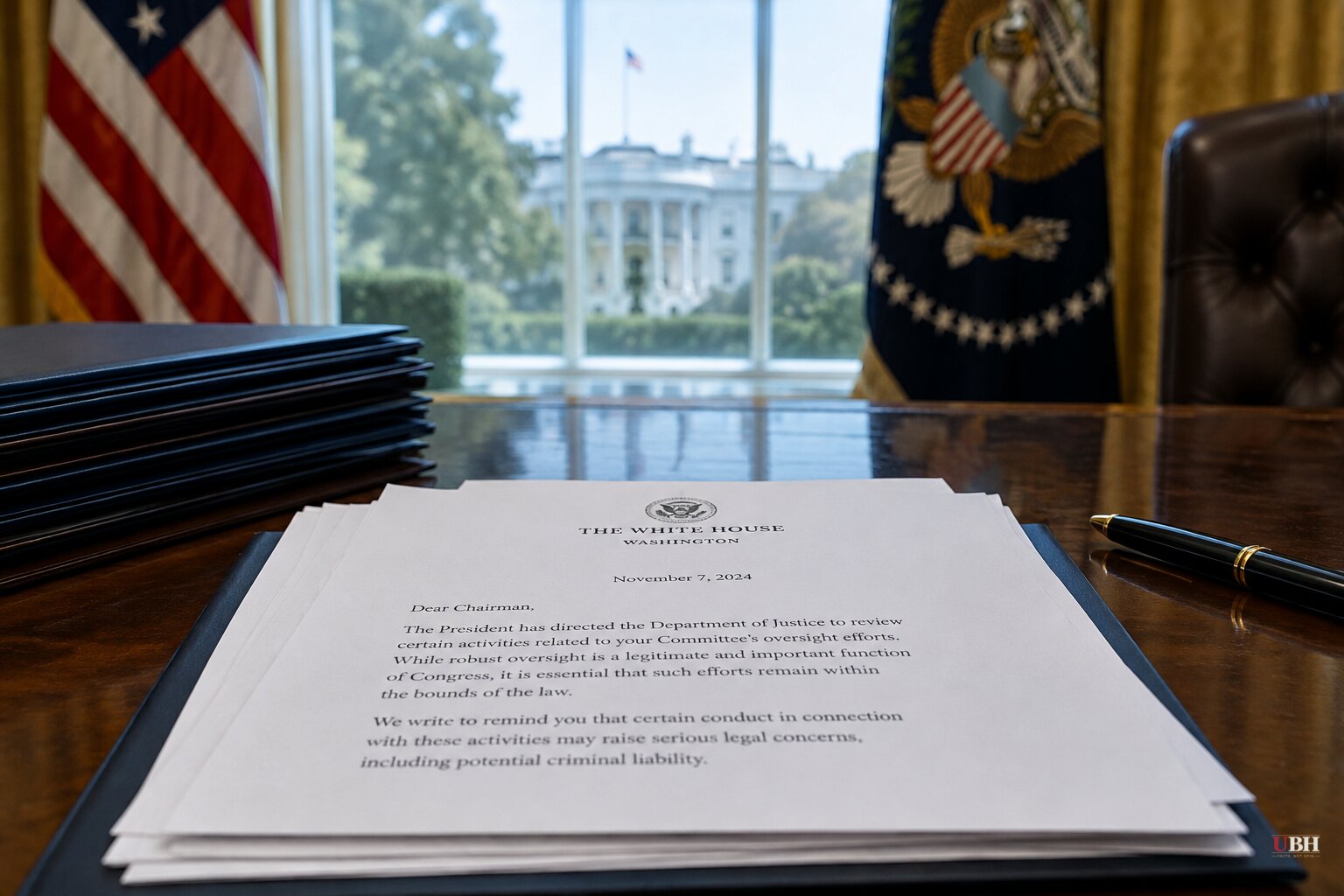
On Nov. 9, White House Counsel Will Scharf sent a three-page letter to Garcia, the likely next chair of the House Oversight Committee. It accuses Garcia and other Democratic leaders of showing "a clear intent to transgress" constitutional limits on investigations.
The letter says it is "abundantly clear" that the coming process will be used "to harass and aggrandize, rather than to advance any legitimate legislative end." It also says "threats to executive branch officials designed to deter them from public service, or process designed merely to abuse or instill fear in the recipient may cross the line into blatant criminality." And it says issuing unlawful subpoenas meant to deprive citizens of their rights "may warrant further investigation."
Note the wording: "may." The letter does not say a crime has occurred.
On Nov. 18, Scharf sent a second letter, this one to Democratic ranking members of House and Senate committees. It responds to their post-election document requests and says they "drip" with animus or pettiness. In his letter to the incoming Oversight chairman, Scharf wrote that "the Administration will not be extorted and will not be cowed by unlawful process motivated by animus, pettiness, hatred, or any other unlawful motive."
What Democrats say
Garcia answered on Nov. 11. "It appears Donald Trump has something to hide," he said. He argued that Congress's authority "comes from Article I of the Constitution, not from the permission of the White House," and that Democrats "will not be deterred by baseless threats from a weaponized DOJ or from the President's lawyers."
Other Democrats have not exactly lowered the temperature. Sen. Ron Wyden posted a single word, "Subpoenas." Sen. Ed Markey said Congress would "need to plant new forests for all of the subpoenas we'll be printing." Democratic leaders have named the Trump family's business dealings, immigration enforcement, healthcare pricing and corporate corruption as targets.
That rhetoric is the raw material for the administration's argument. Whether it amounts to anything beyond political bluster is what the letters leave open.
The legal ground
Sara Zdeb, a visiting assistant professor at Emory School of Law, wrote Nov. 23 for the American Constitution Society that the administration's threats appear to ignore the Speech or Debate Clause, which immunizes members of Congress for legislative acts. She argues Congress can investigate nearly anything that serves a legislative purpose.
The Supreme Court said as much in McGrain v. Daugherty in 1927, the Teapot Dome-era case. The Court held that the power of inquiry, "with process to enforce it," is "an essential and appropriate auxiliary to the legislative function." The test limits Congress to subjects "on which legislation could be had."
Zdeb's reading is that the test is not much of a constraint. The administration's letters rest on the opposite premise: that an investigation designed only to harass falls outside legitimate legislative purpose. That is the argument courts would eventually have to sort out.
Companies in the middle
The collision will not stay between the branches. Democratic committee leaders have sent requests about the Trump family's ties to the crypto industry, the administration's pressure campaign on law firms, and the relationships between cabinet officials and the industries they regulate.
Michael Bopp, an investigations lawyer at Gibson Dunn, told CNN: "There's just more this time. There are more interactions between third parties and this administration that are of interest to Congress." CNN reported, citing a person familiar with the matter, that at least one organization targeted by a Trump executive order last year quietly turned over records to Democrats within 48 hours of Election Day, after months of stonewalling. Third-party subpoenas are a standard congressional tool backed by decades of precedent.
The wider DOJ pattern
Trump has also kept up his attacks outside the oversight fight. In recent posts he accused Democrats of cheating in the midterms, and he renewed calls to prosecute six Democratic lawmakers who advised troops not to follow illegal orders, whom he calls the "Seditious Six." The Los Angeles Times reported that the Justice Department has separately warned California election officials of possible prosecution over ballots it alleges came from noncitizens, and has issued criminal subpoenas for officials to appear before a federal grand jury.
Protect Democracy, an advocacy group that tracks what it calls retaliatory prosecutions, says most such cases since January 2025 have failed. By its account, charges were dropped, grand juries declined to indict and judges issued rebukes. The group's definition of "retaliatory" is its own, and the administration disputes that framing.
What comes next
The 120th Congress is set to convene Jan. 3, 2027. Garcia is expected to take the Oversight gavel then. No one has yet issued a subpoena, so the first one, and whether the White House complies or invokes executive privilege, will show whether Blanche's "it depends" turns into a charging decision.
Sources used for this briefing
7 links from 7 independent newsrooms (syndicated copies of the same report count once)
These are the sources it draws on, linked so you can verify.


