
Unbiased headlines. Facts, not spin.
Unbiased Headlines is an independently owned news organization. We bring you the facts, not opinions, written fresh from 110+ named sources. Sources linked so you can verify it yourself.
 politics
Major Story (8/10)
Fourth Circuit Lets Virginia Restrict Local ICE Agreements, Keeps Its Mask and ID Rules for Federal Officers Blocked
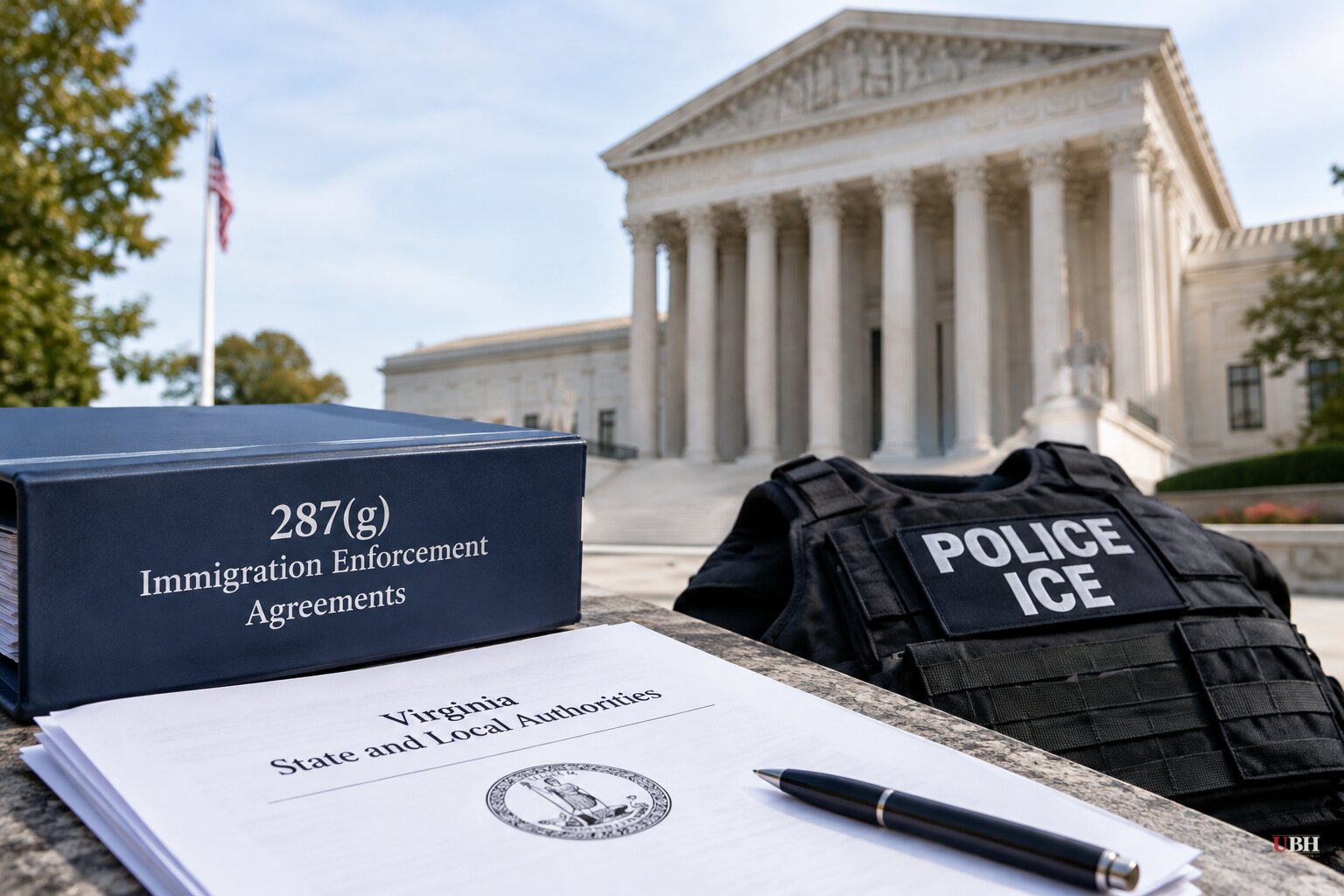
Since Virginia's Democratic-led General Assembly passed two immigration-related laws this spring and U.S. District Judge Robert Payne blocked both with a preliminary injunction, the case has sat in limbo. On Monday, Nov. 23, the Fourth Circuit split the difference in United States v. Virginia.
The panel vacated the injunction against the state's 287(g) law. It affirmed the injunction against the law's mask and identification requirements for federal officers.
What the court said about 287(g) agreements
Under Section 287(g) of the Immigration and Nationality Act, ICE can sign agreements that let trained local officers perform certain immigration enforcement duties under federal supervision. Participation is voluntary.
Virginia's law sets conditions on those agreements. It generally bars localities from assisting immigration operations unless they are presented with a valid judicial warrant, subpoena or detainer. It also requires that ICE refrain from enforcement actions at schools, churches and polling places and from using surveillance technology. Existing agreements had to comply by Sept. 1, 2026, or be treated as void.
The Justice Department argued that the law unlawfully interferes with federal enforcement and existing contracts. Payne agreed, finding the law likely violated the Contracts Clause and the doctrine of intergovernmental immunity.
Judge Toby Heytens, writing for the panel, disagreed on both counts. "The intergovernmental immunity doctrine does not apply because the 287(g) law neither directly regulates the federal government nor prevents private parties from contracting with it," he wrote.
On the Contracts Clause, Heytens gave two reasons. Every agreement covered by the injunction lets the state side terminate without cause, so the law does not "substantially impair" any contract. And even if it did, a state cannot contract away "an essential attribute" of its sovereignty, which here is its power to decide whether and on what terms to assist with federal law enforcement.
Heytens leaned on the Supreme Court's 1992 decision in New York v. United States, which bars the federal government from commandeering state governments. The federal government "could not order the commonwealth's own agents — be they state or local officials — to enforce federal law," he wrote.
Virginia Attorney General Jay Jones called the ruling "a significant victory for Virginia" that "reaffirms the commonwealth's authority to determine whether and under what conditions state and local resources may be used to assist federal immigration enforcement efforts."
The mask and ID law stays blocked
The second law restricts when law enforcement officers, federal ones included, may cover their faces. It also requires visible identification while on duty. It carves out exceptions where masks or anonymity may be needed for officer safety or certain operations.
Here the panel sided with the Justice Department. Heytens wrote that the measure directly regulates federal officers. "Just as Congress may not 'issue orders directly to the states,' states may not issue orders directly to the federal government," he wrote.
He was careful about the state's motives. "We question neither the sincerity nor the reasonableness of the commonwealth's objections to masked and otherwise-unidentified law enforcement activities, and we emphasize that states may limit or forbid such conduct by their own state and local officers," he wrote.
Judge DeAndrea Gist Benjamin joined the majority. Judge Robert B. King concurred in part and dissented in part, saying he would have vacated the injunction on the mask law too.
King wrote that state laws "traditionally enjoy a presumption of constitutionality," especially when a state acts under its traditional police powers. He said the law regulates "only a limited aspect of an officer's public conduct" and does not dictate how officers perform their duties. The exceptions, he wrote, "demonstrate that the Commonwealth is not seeking to impede federal law-enforcement functions."
At oral argument, Virginia's solicitor general said the mask provision was an exception to a general anti-masking rule that applies to everyone in the state, and that nothing about immigration duties requires anonymity. Federal lawyers countered that the law singles out federal officers for special treatment.
The ruling follows similar decisions elsewhere. Courts have halted other state laws aimed at stopping ICE officers from concealing their identities, including litigation over a California law.
The Legal Aid Justice Center, which filed amicus briefs in the case, said the 287(g) law is "no longer enjoined and is now fully in effect." The group said agreements must adopt the required conditions or be void, effective immediately. Senior Supervising Attorney Emily Lopynski said "state and local officers should not be allowed to terrorize immigrants in Virginia under the guise of federal immigration enforcement."
The stakes reach beyond Virginia. ICE counts more than 2,700 such agreements with state and local agencies, up from 135 when Trump's second term began. Those agreements have deputized more than 29,000 local officers. Government data analyzed by fwd.us show they produced more than 6,600 arrests in July, about 15% of all ICE arrests, even after Congress gave the agency a one-time $75 billion infusion and it hired roughly 12,000 officers.
The decision also lands after this month's sheriff elections. The Associated Press identified races in several states, including North Carolina, Indiana, Maryland and Wisconsin, where 287(g) agreements played a role in a sheriff's defeat.
The Fourth Circuit's rulings come at the preliminary-injunction stage, so neither side has a final judgment. The Legal Aid Justice Center said the case now goes back to the district court for further proceedings.
The case numbers are 26-01874 and 26-02258.
Sources used for this briefing
8 links from 7 independent newsrooms (syndicated copies of the same report count once)
These are the sources it draws on, linked so you can verify.


