
Unbiased headlines. Facts, not spin.
Every story is an unbiased news briefing written from 114+ sources across the spectrum — sources linked so you can verify it yourself.
 tech
Major Story (8/10)
Event date: September 26, 2026
tech
Major Story (8/10)
Event date: September 26, 2026
Trump-Xi Summit Ends With an AI Hotline, Not a Breakthrough, as Washington and Beijing Harden Rival Blocs
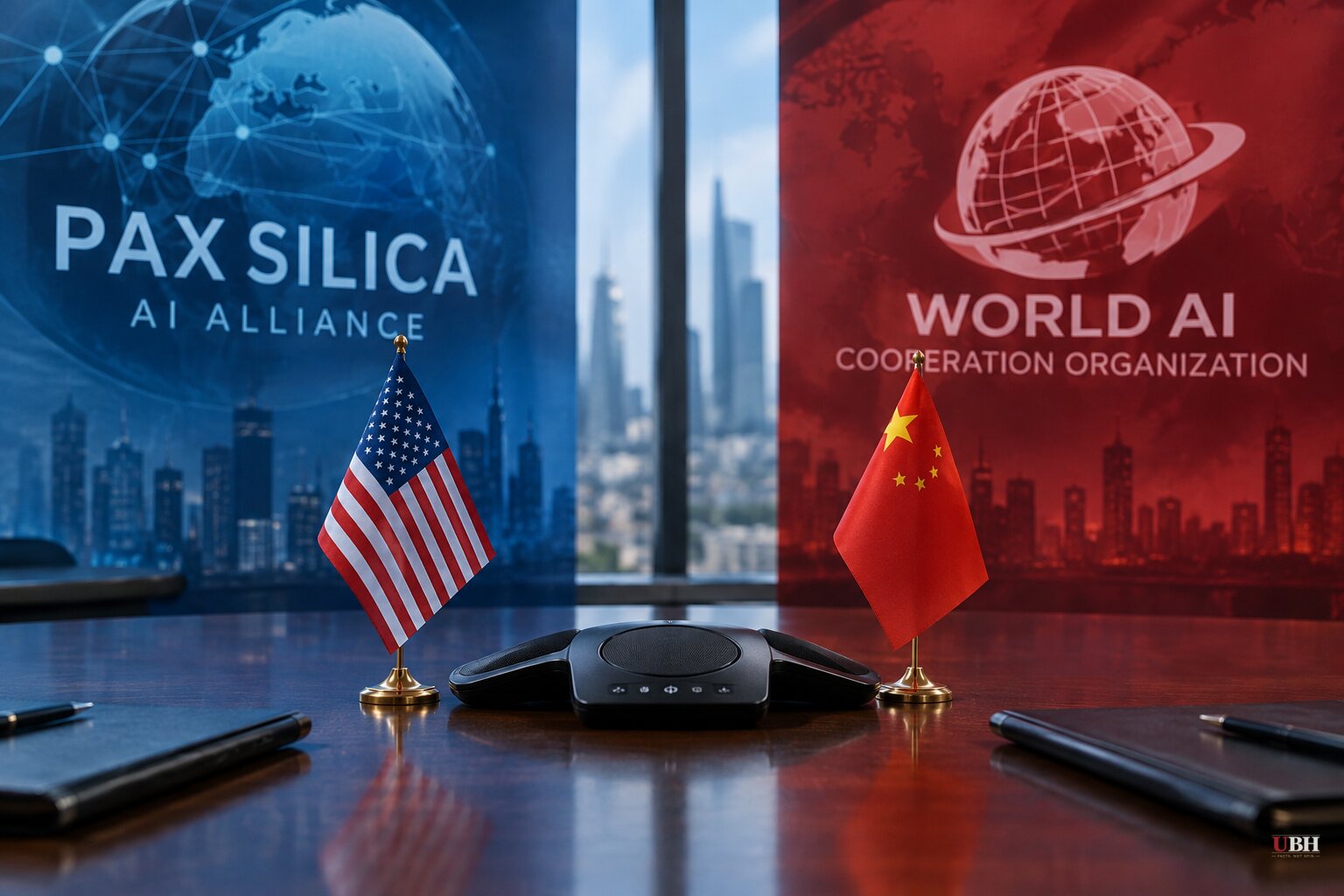
Since the Trump-Xi summit in Washington on September 25, the headline AI outcome has been a hotline, not a treaty. Treasury Secretary Scott Bessent proposed what Al Jazeera described as an AI "notification mechanism," a system for the two countries to alert each other when AI incidents threaten national security. CNN reported the summit "yielded little progress on AI beyond a formal dialogue and a bilateral communication channel," underscoring what CNN called entrenched mutual mistrust.
That mistrust is now hardening into two separate global blocs. The Trump administration built Pax Silica in December 2025, a coalition of 24 countries, including mineral-rich Kazakhstan, aimed at securing Western-aligned supply chains for chips, data centers and critical minerals, according to Newsweek. Xi Jinping answered in July 2026 with the World Artificial Intelligence Cooperation Organization, or WAICO. Newsweek puts WAICO's membership at 37 countries; CNN reports Xi recruited 29, including Russia, Indonesia and Pakistan. The discrepancy likely reflects different count dates, but both outlets agree WAICO is explicitly pitched at countries locked out of the US tech boom.
UN Secretary-General António Guterres attended WAICO's inauguration and praised Beijing for including the Global South, telling the gathering that AI technology "cannot be governed by a handful of countries or a handful of companies," according to Newsweek.
The Compute Gap Is Real
Whatever the governance rhetoric, the hardware numbers are lopsided. Epoch AI, an AI research institute, found the US controls nearly three-quarters of the world's total AI computing power, compared with just over 14% for China, according to Al Jazeera. Stanford University's 2026 AI Index found Nvidia alone accounts for more than 60% of global AI computing capacity among major chip designers, with Huawei holding a smaller but growing share. The US also has more than 5,400 data centers, roughly ten times any other country, and 84 dedicated AI data centers, more than the next eight countries combined, per the same Stanford index.
On frontier models, the gap is narrow but still American. Stanford researchers cited by the BBC found Anthropic's top model led China's best by just 2.7% as of March 2026, after DeepSeek briefly matched the top US model in February 2025.
China's Pitch: Cheaper and More Open
Even trailing on raw benchmarks, China is winning adoption in the developing world because its models are free to download and run. Eric Olander, editor in chief of the China-Global South Project, told CNN that a developer in the Global South may find a cheap, open Chinese model from DeepSeek or Moonshot more useful than a slightly better American system that requires a paid subscription and a foreign cloud provider.
Rebecca Arcesati of the Mercator Institute for China Studies told the BBC that Beijing "very much sees it as a race" and views AI as a "power maximiser." Xi told Trump during the summit that the right approach is to "draw on each other's strengths, not guard against each other," according to CNN, a line that reads as a direct reference to Beijing's objection to US chip export controls.
But adoption is not the same as capability, and a syndicated op-ed carried by WFMD frames the actual contest as a three-way "triathlon": innovation, cost, and trust. The author estimates the US holds roughly a two-year lead on chip lithography thanks to Nvidia and Taiwan's TSMC, and an eight-to-twelve-month lead on frontier models. On the security front specifically, Booz Allen's Cyber Weapon Index found Anthropic's Mythos and OpenAI's Astra outscored all other models on offensive cyber capability, with both companies publicly committing to release the technology responsibly. Several Chinese models are closing that gap fast, the piece argues, "likely with fewer guardrails than their American counterparts."
What Newsweek Gets Wrong, and What It Gets Right
Newsweek's framing that "China is winning the AI race" overstates the hardware picture; Epoch AI and Stanford both show the US holding a five-to-one compute advantage and a real, if shrinking, model lead. Where Newsweek has a point is on rule-making. Xi's WAICO is actively recruiting governments the US won't touch, like Cuba, Iran and Russia, to build a voting bloc for AI governance standards, while Trump has shown little interest in building an equivalent multilateral forum beyond Pax Silica's supply-chain focus.
Trump told reporters this fall, "We're leading China in AI... and frankly, I want to keep it that way, because whoever wins AI wins," according to CNN. He has also called AI existential-risk warnings "a hoax," per the BBC. China's foreign ministry, for its part, has warned that "narratives of threat" are hindering global AI governance and called for cooperation instead.
Neither side has defined what winning actually means, or whether there's a finish line at all, as the BBC noted. The notification hotline agreed to at the September summit has not yet been tested by a real incident. Whether it holds when one eventually happens is the next thing to watch.
Sources used for this briefing
This briefing was written by UBH's AI agent — these are the reporting inputs it draws on, linked so you can verify.


